
31 Unexpected Life Lessons From the Man Who Solved the Market
Insights from the Cold War code-breaker who built Wall Street’s most profitable (and secretive) hedge-funds
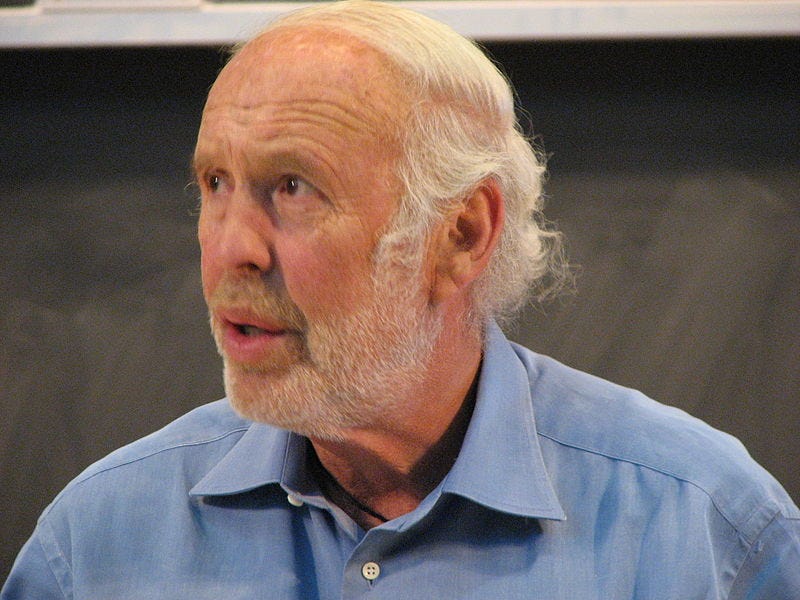
Now with thinning grey hair, a tweed jacket and a Merit cigarette in fingers, Jim Simons is the man who solved the markets.
Jim Simons was a mathematics prodigy co-developing the Chern–Simons theory, he turned NSA code-breaker during the Cold War, and then built one of Wall Street’s greatest and most-secretive hedge-funds; Renaissance Technologies.
Since 1988, Renaissance Technologies has returned a compound annual growth rate of 66% (with a Sharpe Ratio of around 6.5%). That’s astronomical. For comparison, Warren Buffett’s Berkshire Hathaway, annual returns were around 16% over the same period.
Today, Jim Simons is worth over $23 billion, making him the 21st-richest man in the United States. He uses his incredible wealth to help cure autism and discover the origins of the universe.
Since his story was captured in one of 2019’s most-popular business books, The Man Who Solved the Market: How Jim Simons Launched the Quant Revolution, it has sparked much debate. It reveals many unexpected life lessons, including:
- Why collaboration was Renaissance Technologies’ secret to success
- Obsession is what it takes to be great
- You don’t have to care about business to get rich
- A former CEO of Renaissance Technologies (not Jim Simons) is the reason Donald Trump was elected
- Why numbers are more persuasive than stories
- And the meanest and funniest Halloween costume
Are you ready? Let’s explore the best lessons we can learn from the academic-billionaire, Jim Simons. We’ll start with the advice he took from his father…
1. “Do what you like in life, not what you feel you ‘should’ do.”
Jim Simons had always dreamed of having a great deal of money. Yet he didn’t follow the typical path to wealth like a management consultant, investment banker, or corporate lawyer. Instead, he followed his passions — pursuing the mathematics he loved, working as an academic, and even riding a moped down South America. He did what he loved and still made a great deal of money. Because his father taught him an important lesson…
Matty Simons spent years as the general manager of the shoe factory, but he never received the ownership share Peter had promised. Later in life, Matty told his son he wished he hadn’t forgone a promising and exciting career to do what was expected of him. “The lesson was: Do what you like in life, not what you feel you ‘should’ do,” Simons says. “It’s something I never forgot.”
He wished he hadn’t forgone a promising and exciting career to do what was expected of him.
2. Obsession is what it takes to be great
In the world’s greatest athletes, entrepreneurs, and investors we see the same thing. They weren’t driven to be ‘great’ in the abstract sense of achieving status, fame, and wealth. Rather, they were obsessed with one specific game, idea or skill.
What Jimmy liked to do more than anything else was think, often about mathematics. He was preoccupied with numbers, shapes, and slopes. At the age of three, Jimmy doubled numbers and divided them in half, figuring out all the powers of 2 up to 1,024 before becoming bored.
He was preoccupied with numbers, shapes, and slopes.
3. No publicity is better than good publicity
People, especially publicists, often say that “Bad publicity is better than no publicity.” Well, that’s up for debate now. When you have a unique strategy that makes you millions and billions of dollars, wouldn’t you want to keep that a secret? At least that was the attitude of Jim Simons…
Simons once quoted Benjamin, the donkey in Animal Farm, to explain his attitude: “‘God gave me a tail to keep off the flies. But I’d rather have had no tail and no flies.’ That’s kind of the way I feel about publicity.”
“God gave me a tail to keep off the flies. But I’d rather have had no tail and no flies.’ That’s kind of the way I feel about publicity.”
4. You don’t have to care about business to get rich
Many people detest the idea of business because they don’t like sleazy sales guys, marketing gimmicks, and get rich quick schemes. While I personally think that good business has absolutely nothing to do with those things, it’s encouraging to know you don’t have to care about business at all (or read financial reports) to become fabulously wealthy.
Jimmy had a friend who was quite wealthy, and he was struck by the comfortable lifestyle his family enjoyed. “It’s nice to be very rich. I observed that,” Simons later said. “I had no interest in business, which is not to say I had no interest in money.”
“I had no interest in business, which is not to say I had no interest in money.”
5. Bad ideas are good
Bad ideas are part of the creative process. I’ve had more than my fair share, and I’m sure you’ve had some too. But that doesn’t matter one iota — as long as you can distinguish between the good and the bad (or even better, test them).
Lenny Baum, among the most accomplished code-breakers, developed a saying that became the group’s credo: “Bad ideas is good, good ideas is terrific, no ideas is terrible.”
“Bad ideas is good, good ideas is terrific, no ideas is terrible.”
6. Getting fired is a win
Almost all of the key characters in this book were fired at some point. They were fired for breaking the rules, standing up for what they believed in, and daring to be different. Still, despite being fired they were incredibly successful. And more likely, that same underlying spirit of rebellion and autonomy that got them fired, helped them make their extreme wealth.
Getting fired can be a good thing. You just don’t want to make a habit of it.
7. Failure IS an option
Salespeople know this. If 99 people reject your pitch, but 1 buys from you — you can still be enormously successful. Boxers know this. You can swing 50 times at your opponent, you only have to land a clean blow once. Traders know this too.
“If you trade a lot, you only need to be right 51 percent of the time,” Berlekamp argued to a colleague. “We need a smaller edge on each trade.”
“If you trade a lot, you only need to be right 51 percent of the time.”
8. Modernity changed us
Modernity has humbled us in ways we are only beginning to accept. The power of human knowledge, while incredible, is being outshone by computers in many industries.
“As computers came in, human judgment went out.”
9. Why Jeff Bezos changed his company name to Amazon
Jeff Bezos worked as a programmer/ analyst for D.E. Shaw — a rival to Jim Simons company. And it was D.E. Shaw that could see the potential for a site like Amazon;
“I think people will buy things on the internet… Not only will they shop, but when they buy something … they’re going to say, ‘this pipe is good,’ or ‘this pipe is bad,’ and they’re going to post reviews.”
Although Amazon began with a different name;
He [Bezos] originally chose “Cadabra” but dropped the name because too many people mistook it for “Cadaver.”
10. Their Medallion fund used a single trading model
This is a sign of things to come. With better machine learning systems and increasing access to big data, this pattern of increasingly complex models will penetrate many industries — from supply chain management to media buying.
A collection of trading models was simpler and easier to pull off, Laufer acknowledged. But, he argued, a single model could draw on Straus’s vast trove of pricing data, detecting correlations, opportunities, and other signals across various asset classes. Narrow, individual models, by contrast, can suffer from too little data.
11. Relative status is more important than absolute pay
Be careful of insulting your best people. They may do the work for less money than they’re worth, because they love the intellectual challenge, but if you insult them, they will leave in a heartbeat.
Several years later, when a new pay scale was instituted that elevated the group’s administrators above the cryptologists, Patterson became livid. “It was the insult, not the money,” says Patterson, who told his wife he’d rather drive a bus than remain in the group. “I had to get out of there.”
“It was the insult, not the money.”
12. Trading is more about people than prices
Short term trading is as much about game theory than any underlying economics. You don’t make money by predicting performance, you make money by predicting how people respond to changes in a stock’s performance.
“What you’re really modeling is human behavior,” explains Penavic, the researcher. “Humans are most predictable in times of high stress — they act instinctively and panic. Our entire premise was that human actors will react the way humans did in the past … we learned to take advantage.”
Humans are most predictable in times of high stress — they act instinctively and panic.
13. It’s not about the money
Billionaires aren’t (primarily) driven by money. The luxury yachts, private jets, and Bugattis are a bonus. Because with money, comes power — the underlying motivation.
“Emperors want empires,” one griped to a colleague.
14. Numbers are more persuasive than stories
The current trend in marketing is that ‘stories are king’. You need a story to sell a great idea to your clients. Even this book cites the power of stories.
However, it’s not true in the case of Renaissance Technologies. All companies had to do was see the returns they were making and wanted it. The numbers did the work. Despite the rhetoric, the story didn’t matter.
“No one ever made a decision because of a number. They need a story.” — Daniel Kahneman, economist
15. You can’t teach smart
The best companies always want the best people. It doesn’t matter if they know the industry — that’s easily taught. Common sense and intellect, especially in one person, are still and surprisingly valuable commodities.
“We can teach you about money,” Patterson explains. “We can’t teach you about smart.”
16. You already know what I’m going to write next
Basically, the financial models work by analyzing recent changes to a stock’s price and predicting where it will go next. If the model finds a high probability (or even 51%) that it will move in a particular direction, it will make a trade. If you’re familiar with Markov models, this makes intuitive sense. But perhaps this power is not unique to machines…
According to linguists, people in conversation unconsciously guess the next words that will be spoken, updating their expectations along the way.
17. The meanest and funniest Halloween costume
This made me laugh. Too much. Perhaps because I have a friend from high school with exceptionally long arms.
I think the important thing in this example, is it is the employee making fun of the boss. When you’re being funny (and slightly cruel), it’s good taste to do it to someone more powerful than you are. It’s okay for the jester to make fun of the king.
Mercer had such long arms that his wife sewed him dress shirts with extended sleeves, as well as odd colors and patterns. At a Halloween party one year, Jelinek, who had a mean streak, came dressed as Mercer, wearing a shirt with impossibly long sleeves. Mercer laughed along with his colleagues.
It’s okay for the jester to make fun of the king.
18. Porn and high-tech don’t mix: Choose your name carefully
You can hardly fault the IBM team for this mistake. The fact that they didn’t know the mistake they were making was probably a good thing.
The IBM brass loved the idea and hired the team, which brought its Deep Thought program along. As the machine won matches and attracted attention, though, complaints emerged. It turned out that the chess machine’s name made people think of something else — famed 1972 pornographic film Deep Throat, a movie at the forefront of what is known as the Golden Age of Porn.
The chess machine’s name [Deep Thought] made people think of something else — famed 1972 pornographic film Deep Throat
19. Small bugs can have HUGE effects (And it doesn’t matter who fixes them)
The culture of Renaissance Technology was remarkably open. Ideas were judged on their merit, not from who thought of them. Perhaps more than anything this was the secret of their success.
When Magerman fixed the bug and updated the number, a second problem — an algebraic error — appeared elsewhere in the code. Magerman spent most of the night on it but he thought he solved that one, too. Now the simulator’s algorithms could finally recommend an ideal portfolio for the Nova system to execute, including how much borrowed money should be employed to expand its stock holdings. The resulting portfolio seemed to generate big profits
… A junior programmer fixed the problem? The same guy who had crashed the system a few weeks after being hired? Brown and Mercer ignored the doubts and restarted the system, with Simons’s backing, incorporating the improvements and corrections. Instant gains resulted, defying the skeptics. The long losing streak was over. Magerman finally received the appreciation he longed for, receiving a cherished pat on the back from Brown.
20. Academics and making money don’t mix
The theory is easy when you don’t have to test it in the market. What works in academia often doesn’t work in the real world. Journal articles only have to pass a peer review. Naturally, your peers are far more forgiving than the faceless, ruthless market.
Each week, Simons decided, Brown, Mercer, and other senior executives would be assigned three papers to read, digest, and present — a book club for quants with a passion for money rather than sex or murder. After reading several hundred papers, Simons and his colleagues gave up. The tactics sounded tantalizing, but when Medallion’s researchers tested the efficacy of the strategies proposed by the academics, the trade recommendations usually failed to pan out. Reading so many disappointing papers reinforced a certain cynicism within the firm about the ability to predict financial moves. “Any time you hear financial experts talking about how the market went up because of such and such — remember it’s all nonsense,” Brown later would say.
Any time you hear financial experts talking about how the market went up because of such and such — remember it’s all nonsense
21. Being rich doesn’t mean you have to fly first-class (Unless your wife insists on it)
We notice the rich person driving a Bentley. But we don’t notice most wealthy individuals, because most would rather blend in than stand out. Having money is enough, having people know that you have money doesn’t matter.
You can be rich without showing it off. In fact, that’s the best way to go from being rich to being wealthy.
Some employees seemed embarrassed by their swelling wealth. As a group of researchers chatted in the lunchroom in 1997, one asked if any of his colleagues flew first-class. The table turned silent. Not a single one did, it seemed. Finally, an embarrassed mathematician spoke up. “I do,” he admitted, feeling the need to offer an explanation. “My wife insists on it.”
22. Pay your employees as much as you can
Why aren’t my employees staying late? How can I get them to focus better? Why don’t they care as much as me? That’s the attitude of many selfish, inconsiderate, and short-sighted business owners.
Jim Simons was not short-sighted. He knew that incentivising his team with big bonuses would make him much more money than it would cost him.
And more important in my opinion, it aligns the mission of management and employees so they work as a team.
Simons used compensation to get staffers focused on the firm’s overall success. Every six months, employees received a bonus, but only if Medallion surpassed a certain profit level. The firm paid some of the money over several years, helping to keep the talent around. It didn’t matter if staffers uncovered new signals, cleaned data, or did other lower-profile tasks; if they distinguished themselves, and Medallion thrived, they were rewarded with bonus points, each of which represented a percentage of Renaissance’s profit pool and was based on clear, understood formulas. “You know your formula from the beginning of the year. It’s the same as everyone else’s with just a couple of different coefficients, depending on your position,” says Glen Whitney, who was a top manager of Renaissance’s infrastructure. “You want a bigger bonus? Help the fund get higher returns in whatever way you can: discover a predictive source, fix a bug, make the code run faster, get coffee for the woman down the hall with a great idea, whatever … bonuses depend on how well the fund performs, not if your boss liked your tie.”
You want a bigger bonus? Help the fund get higher returns in whatever way you can.
23. Perception is everything when you’re leveraged
Debt makes you fragile. We all know how much money it can make you when things go well, but the reverse is just as true. And like the sharks on Wall Street always attach if they smell blood in the water.
Reality sunk in when Meriwether visited a friend, Vinny Mattone, a veteran trader who favored black silk shirts, weighed about three hundred pounds, and wore a gold chain and pinkie ring. “Where are you?” Mattone asked, bluntly. “We’re down by half,” Meriwether said. “You’re finished,” Mattone replied, shocking Meriwether. “When you’re down by half, people figure you can go down all the way,” Mattone explained. “They’re going to push the market against you …. You’re finished.”
When you’re down by half, people figure you can go down all the way.
24. If you’re taking financial steroids, don’t hold the downside
What do you call a person responsible for all of the downside while only a portion of the upside? A sucker. Or at least that’s what they’re called in finance.
Unfortunately, many people don’t know they’re suckers. As the Renaissance example shows. Instead of being personally responsible for their leverage, many banks would suffer the bulk of the losses if Renaissance’s trades went bad. So was the bank manager the sucker? Absolutely not. He would get a big bonus if he bought in decent profits, but wouldn’t be responsible for the losses. In this case, the bank’s shareholders are the suckers.
By contrast, Medallion’s options strategy allowed it to have $12.50 worth of financial instruments for every dollar of cash, making it easier to trounce the rivals, assuming it could keep finding profitable trades. When Medallion spied especially juicy opportunities, such as during a 2002 market downturn, the fund could boost its leverage, holding close to $20 of assets for each dollar of cash, effectively placing the portfolio on steroids. In 2002, Medallion managed over $5 billion, but it controlled more than $60 billion of investment positions, thanks in part to the options helping the fund score a gain of 25.8 percent despite a tough year for the broader market.
25. Domain knowledge doesn’t matter
The people at Renaissance Technologies weren’t financial experts. The firm specifically avoided hiring anyone with a Wall Street background. And that didn’t matter.
The important thing in trading is to make money. Knowing exactly what’s going on doesn’t matter. Seriously. There’s a brilliant example in a great book by Jim Paul — What I Learned Losing a Million Dollars. A trader bought and sold green lumber for decades. The entire time he thought it was normal lumber that was painted green. It didn’t matter one iota that he didn’t know that green lumber means it has a high moisture content.
You don’t have to understand a complex system to operate successfully within it.
“So, we have a signal,” Mercer began, his colleagues nodding nervously. “Sometimes it tells us to buy Chrysler, sometimes it tells us to sell.” Instant silence and raised eyebrows. Chrysler hadn’t existed as a company since being acquired by German automaker Daimler back in 1998. Mercer didn’t seem to know; he was a quant, so he didn’t actually pay attention to the companies he traded. The endowment overlooked the flub, becoming RIEF’s latest investor.
He was a quant, so he didn’t actually pay attention to the companies he traded.
26. A former CEO of Renaissance Technologies (not Jim Simons) is the reason Donald Trump was elected
Robert Mercer became the co-CEO of Renaissance Technologies when Jim Simons stepped away from the role. But as an AI researcher and computer scientists, he had been as important to Renaissance Technologies as much as any man, including Simons. In short, Robert Mercer was an eccentric genius who became an eccentric billionaire and put Donald Trump in the White House. Let’s follow the connections.
- Robert Mercer purchased 50% of Breitbart News for $10 million.
- Mercer invested in Cambridge Analytica.
- In 2013, Mercer received data that suggested, “Voters were becoming alienated from both parties as well as most mainstream candidates.”
- Mercer launched a super PAC to oppose Hillary Clinton. They became Donald Trump’s largest backer.
- When Trump’s campaign was struggling, it was Merce’s daughter Rebekah who resurrected it. She told Trump she had a way for him to turn the election around. “Bring in Steve Bannon and Kellyanne Conway,” she said. “I’ve talked to them; they’ll do it.” Trump took her advice. The rest is history.
Together, Robert Mercer and his daughter Rebekah were as responsible for Trump’s victory more than anyone else, besides Trump himself. The data they harvested predicted an outsider would win the election, they were Trump’s largest financial backers, and they changed his election strategy and recruited the two people he needed. They were Trump’s guardian angels, and at the same time, Hillary’s demons.
Oh, and Mercer was also influential in the successful Brexit campaign.
27. Humble Hillary. Where was she?
While Mercer had been a conservative, Jum Simons had always been quite liberal politically. Naturally, he was a supporter of Hillary Clinton and wanted to see her win the election.
However, when he went to make a donation to Clinton’s campaign, it was deemed unnecessary.
Clinton’s team reached out to Simons, saying that if he was going to make additional political donations that year, he should direct them to the party’s effort to win control of the Senate. The Clinton camp seemed so confident of victory that they deemed additional help for their own campaign unnecessary.
28. The data that matters: Pizza deliveries to the Pentagon
Investors look anywhere for an edge. Even at a local Washington D.C. pizza shop.
More adventurous investors may even use it to prepare for a potential crisis if, say, they see a series of unusual pizza deliveries at the Pentagon in the midst of an international incident.
29. Collaboration was their secret to success
While at other quant funds and in academia, researchers typically work by themselves, Renaissance as different — and that’s what made the difference.
There’s a misconception about introverts; that they don’t like talking with and collaborating with others. In reality, introverts don’t like small talk or collaborating on boring, or easy challenges.
Introverts can talk about ideas for hours. Give them a strong enough reason and they’ll seek out their colleagues and help them. Renaissance technologies did this by continuously and purposefully finding new and difficult challenges, as well as sharing the profits.
If you want your team of intelligent introverts to collaborate; give them a strong enough purpose and watch what happens.
Scientists and mathematicians need to interact, debate, and share ideas to generate ideal results. Simons’s precept might seem self-evident, but, in some ways, it was radical. Many of Renaissance’s smartest staffers had enjoyed achievement and recognition earlier in their careers toiling away on individual research, rather than teaming with others. Indeed, talented quants can be among the least comfortable working with others. (A classic industry joke: Extroverted mathematicians are the ones who stare at your shoes during a conversation, not their own.) Rival trading firms often dealt with the issue by allowing researchers and others to work in silos, sometimes even competing with each other. Simons insisted on a different approach — Medallion would have a single, monolithic trading system. All staffers enjoyed full access to each line of the source code underpinning their moneymaking algorithms, all of it readable in cleartext on the firm’s internal network. There would be no corners of the code accessible only to top executives; anyone could make experimental modifications to improve the trading system. Simons hoped his researchers would swap ideas, rather than embrace private projects. (For a while, even the firm’s secretaries had access to the source code, though that ultimately proved unwieldy.)
Scientists and mathematicians need to interact, debate, and share ideas to generate ideal results.
30. The best life lessons from the man who solved the market
Jim Simons earned a PhD from Berkely, is an award-winning mathematician, worked at the NSA as a code-breaker to intercept Russian messages, is one of the all-time greats of Wall Street, and is a generous philanthropist. It’s worth listening to the life lessons he shared when speaking to a school...
“Work with the smartest people you can, hopefully smarter than you … be persistent, don’t give up easily.”
&
“Be guided by beauty … it can be the way a company runs, or the way an experiment comes out, or the way a theorem comes out, but there’s a sense of beauty when something is working well, almost an aesthetic to it.”
31. Jim Simons helped me see clearer
Jim Simons story, captured in the book The Man Who SolvedThe Market, helped me see the technology behind quant trading, the influence of hidden Markov chains, the power of data, and the value of the right kind of collaboration.
When I visited the Atacama Desert in Chile, I was excited because it is one of the best places in the world to conduct astronomical observations. I was excited to see the stars and planets clearer than anywhere else in the world. However, a big storm came and I didn’t see anything.
The main thing I took away from Jim Simons, The Man Who Solved The Market, was that impossible problems often have a solution — if you’re relentless in your pursuit to solve it.
Simons helped fund a $75 million effort to build an enormous observatory with an array of ultrapowerful telescopes in Chile’s Atacama Desert, a plateau 17,000 feet above sea level featuring especially clear, dry skies. It’s an ideal spot to measure cosmic microwave radiation and get a good look into creation’s earliest moments.
Today, Jim Simons is working to solve our oldest and hardest problem, while smoking a Merit cigarette.