
30 Years Before Harry Potter Another Boy Went to Wizarding School
Ursula Le Guin’s Earthsea Cycle is arguably superior to J.K. Rowling’s books
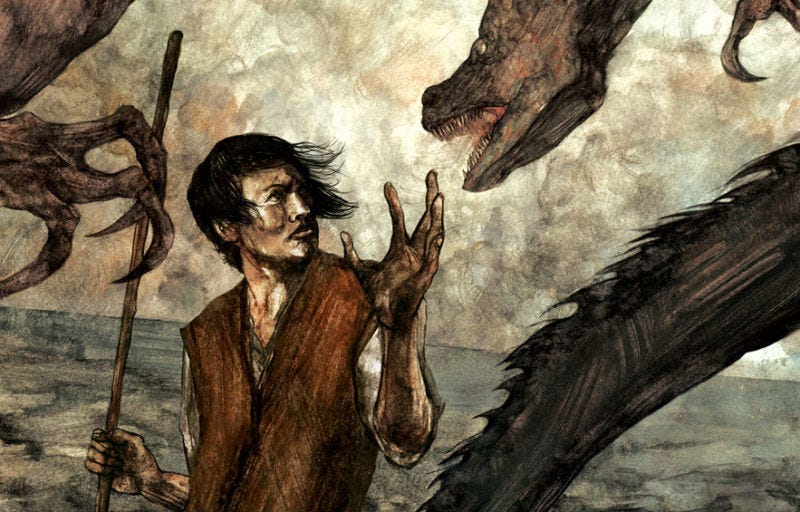
By now, most of the world is familiar with the story of the boy who goes to wizarding school. But several decades before the chosen one faced Voldemort, another would-be wizard set off on a similar journey.
In 1968, the publisher Parnassus Press approached Ursula Le Guin, proposing she write a YA book that would be the first in a saga. She initially declined, having never written for children, and thinking she lacked the experience to do the work justice. In her words, “I sort of ran away, I was terrified.”
But then she considered it.
Adolescents are people, she thought. They’re very good readers. Sometimes they’re the best readers of all. She asked herself: what makes a young adult book? The answer: having a young adult central character.
Thus Sparrowhawk, hero of A Wizard of Earthsea was born.
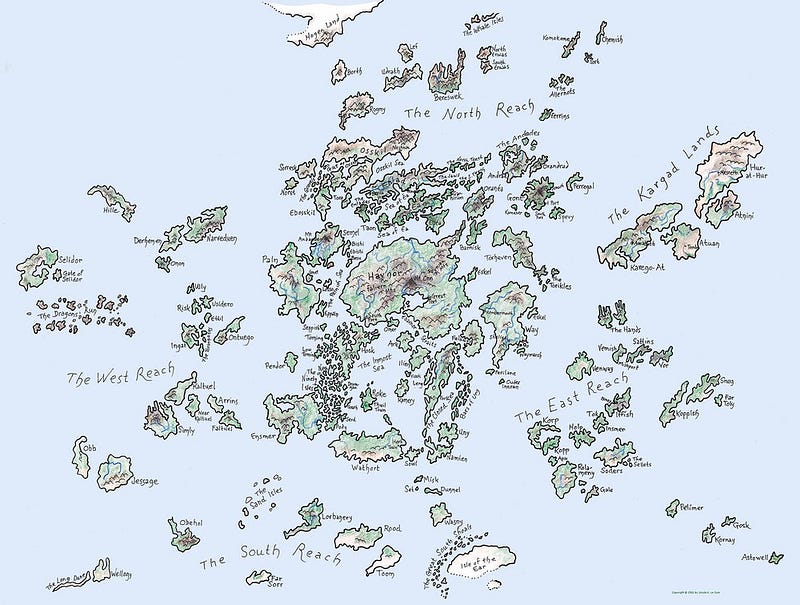
Le Guin had previously written a couple of short stories that took place on islands populated by wizards and dragons. When she began thinking about the book, these islands expanded to become an entire archipelago. The first thing she did was draw the map. This map would remain unchanged in a series written over 33 years, with the final installment, The Other Wind being released in 2001.
When I was a child, we had a tape recording of a dramatization of the first book, A Wizard of Earthsea. Narrated by Judie Dench, and replete with gripping dialogue and music, it utterly captivated me. For whatever reason, I never went on to read the next books in the saga, but the story had an undeniably profound effect on me.
So profound in fact that, a month ago, and over 25 years since I listened to that tape recording, I decided to actually read the Earthsea Cycle.
Aside from the obvious parallels with Harry Potter, Le Guin’s books are vastly different in themes, tone, and style. In my opinion, they are more morally complex, and, ironically, despite their comparatively shorter length, greater in depth and scope.
I don’t mean to criticize Harry Potter books too harshly. After all, they’re a global phenomenon for a reason. I was one of the many who grew up with the boy wizard, devouring each new edition like it was candy.
But Earthsea is different.
Much different.
Le Guin isn’t just a fantasy author. She is one of the few writers whose science fiction and fantasy books have managed to transcend their respective genres, becoming acknowledged as high literature. Her masterpieces, The Dispossessed and The Left Hand of Darkness are still considered landmarks.
The story of A Wizard of Earthsea is about a boy called Sparrowhawk from Gont (an island famous for goats and wizards) who, after many hard-won battles, eventually becomes a wizard of great repute. With each book more about the world, its history, magic, and inhabitants are revealed. Of course, compelling world-building is to be expected from any half-decent fantasy saga, but what separates Le Guin from the majority is her subversion of expectations. In a genre that’s often saturated with hackneyed writing and tired tropes, Le Guin deftly adds a great deal of complexity in a relatively short word count. In the world of Earthsea, victory, trust, loyalty, and virtue are not necessarily what you might assume them to be.
Reading her prose has an almost meditative effect. Like the magic the wizards of Roke use, it is spare, balanced, and lyrical. As you wend your way through it, you feel as if you aren’t reading a YA book written in the late sixties, but a tale many centuries old.
Take this passage when Ged first encounters the Archmage of Roke:
“In that moment Ged understood the singing of the bird, and the language of the water falling in the basin of the fountain, and the shape of the clouds, and the beginning and end of the wind that stirred in the leaves: it seemed to him that he himself were words spoken by sunlight.”
Unlike a lot of fantasy fiction, there are hardly any descriptors, which adds to the impact of old, simple words like “water”, “wind”, and “sunlight”. The power of the archmage is framed differently from the heavy-handed displays of power fantasy readers might be used to. It is power indistinguishable from the earth, redolent of the permeability between all things.
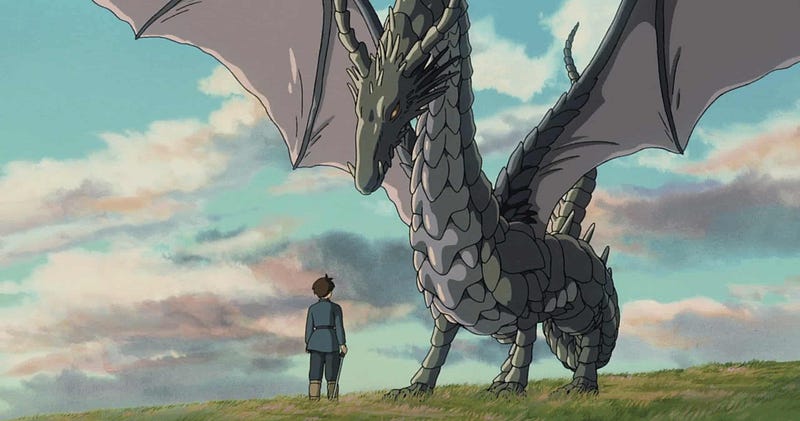
Contrary to Harry Potter, the magic of Earthsea isn’t just instrumental; it is a part of the world itself. Called “The True Speech”, dragons are born knowing this language, and can even lie with it. Conversely, wizards take pains to learn how and when to use it. Furthermore, unlike their ancient and scaly counterparts, wizards can only speak the primordial language truly.
The magic system of Earthsea is founded upon the“naming” of things. For on the archipelago all things have a true name, from a rock (tolk), the foam of the sea (sukien), to the eponymous hero, Sparrowhawk (Ged). Knowing these names is the key to their power, which is why the people of Earthsea guard their true names vigilantly, telling only those whom they trust with their lives.
Balance is at the core of Le Guin’s books and in many respects, Earthsea draws much from the teachings of Taoism (in which Le Guin had a deep interest). Keeping the equilibrium is first and foremost in a wizard’s mind, and tipping the scales too much can have devastating consequences. Indeed, Sparrowhawk learns this first-hand when he uses a dangerous spell out of pride:
“And through the bright mishappen breach clambered something like a clot of black shadow, quick and hideous…”
Despite the epic quality of many of the book’s events, the adventures of Earthsea are chiefly internal. The characters constantly wrestle with their identities, morality, and roles they are often forced to play.
“Wizard” and “Wise” have the same old English root, and, understandably, the concept of wisdom is central to Earthsea. There is an argument to be made that, to accurately convey wisdom, the author must be wise herself. Reading the Earthsea Cycle reveals that Le Guin more than satisfies this requirement, and is a master at conveying wisdom convincingly:
“From that time forth he believed that the wise man is one who never sets himself apart from other living things, whether they have speech or not, and in later years he strove long to learn what can be learned, in silence, from the eyes of animals, the flight of birds, the great slow gestures of trees.”
Again we see that true wisdom is that which understands humans aren’t removed from or above the natural world, but indistinguishable from it.
The second trilogy in the Earthsea Cycle (Tenahu, Tales from Earthsea, The Other Wind) was written 20–30 years after the first. Tonally and thematically different, the stories are more oriented around female protagonists like Tenahu. It sees a more mature writer revisit her universe, explore many unanswered questions, and focus more on the role of women, aging, and grief.
All things considered, I would recommend these books not just to fantasy readers, but to all lovers of fiction. Journeying through the Earthsea Cycle feels as if you are nestled in the roots of a gnarled tree, running your fingers along its many fissures. It feels as if you are riding your trusty vessel with the magewind at your back, and your eyes fixed on the horizon. As David Mitchell put it:
“A Wizard of Earthsea reads like the retelling of a tale first told centuries ago, and whose twists and turns have been handed down through generations of storytellers. It is timeless.”
If you would like to support me directly you can buy me a coffee.
You can also support me by signing up to Medium using my referral link. Not only do you get full access to Medium, but you will be helping me realize my dream of writing creatively full-time!


