
Passive Income
3 Ways to Massively Amplify Your Passive Income from Dividend Stock Portfolios
What financial advisors don’t share about managing money

I love passive income. I love it even more while I’m traveling the world and it’s paying for my adventures.
You can find any number of basic investing guides that suggest buying and holding or index fund investing for retirement. But these techniques fall short with small and mid-sized accounts.
I will show you, using 3 simple strategies, how to create a reasonable income from almost any size investment account. At the end of this article, I will bring it all together into a set-it and forget-it style portfolio (with a flow chart) that brings in far more income than any traditional investment portfolio would. Of course, I will never recommend ignoring your investments!
Even if you have dividend-producing assets, and you definitely should, what I’m going to share with you has the potential to double or triple your income from the exact same investments over the same time frame. This isn’t hyperbole, today I’m going to share the basics of Options Trading. Many people who have tried options trading have lost money doing so. The techniques I’m going to describe will help you avoid this downfall by playing the opposite side of the transaction from most people. It’s a bit like being the casino, rather than the gambler.
Here are the requirements: 1) The knowledge, as is the case with any investment, 2) a free account with one of the many banks or brokerages who provide options contracts (in my experience, the best is the Think or Swim platform from TD Ameritrade), and 3) at least $2000 to invest so that you meet the minimum required to trade options in your account.
What are options, and how do I trade them?
I want this to be as simple as possible because I believe anyone can do it with a little help. I also believe that, along with dividend producing assets, these basic options strategies should form the basis of every well-rounded equities account.
Options are a contract that provides the right to purchase a specific Equity, ETF, Index Fund, Commodity, or Future at a specific price by a specific date. Each option contract is associated with 100 shares of the underlying asset. These options contracts can be bought or sold (more on that shortly).
Knowing that you can do this with many different types of investment, let’s just use a company stock as an example.
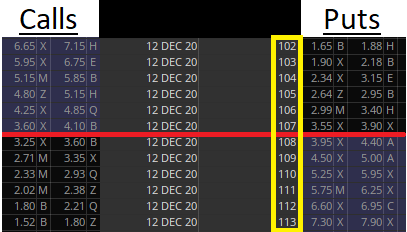
The above image is an example of a real options chart for a company we will call ABC. The price on the 2nd of December 2020 was 107.16 (note that options contracts generally have an expiry date each week, and that you can buy them for any week or month up to 2 years out in time). The red line marks the approximate price on this day. The yellow box shows a range of prices where the stock could potentially move in the coming weeks (these are called “strike prices”).
There are two types of options: Calls and Puts. You can calculate the value of a call or a put option by finding the midpoint between the bid and ask price (for example, the 108 Put has a spread of 3.95–4.40, therefore its estimated value is 4.18). Remember, the value of each contract is multiplied by 100 for the number of shares it controls; therefore, the actual dollar value of the option in this example is $418.
Buying a call allows you to buy 100 shares of the underlying stock at a specific price on or before the date of that option contract (Dec 12th in the example above). Buying a put allows you to sell 100 shares at a specific price on or before that date. We won't’ be buying options in my basic strategy. Generally speaking, buying options (without using more complicated approaches I will save for another day) is for suckers or gamblers. You would be wise to avoid joining them.
Instead, we will be selling calls or puts, thus giving someone else the right to either buy our shares away from us (with the calls) or sell their shares to us (with the puts). We sell options for two major reasons. The first is due to a factor called Theta; this represents time decay and a daily trickle of cash into your account. Think of it as a dividend that pays out over time rather than all at once.
The second reason we sell options is to reduce the price we pay for the shares we own or want to own in the future. This gives us a better entry point, or cost basis, and is a far safer way to enter or add to positions than the more common dollar-cost-averaging. Let’s talk about how this works with the first two basic strategies that should be in every investor’s toolbox.
Strategy 1: Covered calls
Here’s the scenario: company ABC’s stock price is at roughly $107 per share today. You already own some of ABC and it’s done really well lately so you’re already quite happy! You think it could go up a little more, but not much; and it could actually fall a bit before heading higher.
This is the perfect set-up for a covered call (it seems really good for the market as a whole right now actually).
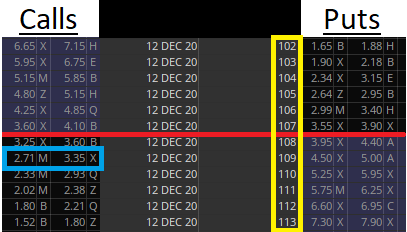
For every 100 shares you own, sell a covered call (the stock you own is what makes the call “covered”) a little above the price where you think ABC might go, say $109 (shown in the blue box), by the date on the contract (Dec. 12th). For doing so, you take in $303 (the midpoint between 2.71 and 3.35, times 100 shares) per contract you sell. The $303 you gain in profit is called the option’s “premium”.
One of two things will happen now. Scenario 1: the price of ABC continues higher (for example, say it reaches $110 per share on December 12th). The contract you sold is used by the buyer (the contract was “exercised”), forcing you to sell your shares at $109, thus keeping your $2 gain per share from $107 to $109 but losing out on that extra dollar from $109 to $110. However, you keep the $303 you collected on the contract, or $3.03 per share. This is the equivalent of selling your shares for $112.03 even though the stock price is only $110!
Scenario 2: the price of ABC falls, ending at $106 on December 12. You have lost a dollar on your shares themselves; BUT, you get to keep that $303 you made for selling the covered call when the contract expires worthless on the 12th. So instead of losing money on your shares that went down in price, you have actually collected profit! In fact, you could think of this call as downside protection equal to a loss of $3.03 per share.
The great thing about this — you can sell these calls every week, or two weeks, or month, still collect your dividend as long as you still own your shares at the ex-dividend date, and collect that extra income on the top.
How do you lose money on covered calls? You lose money if the stock drops below the price you paid for the stock minus the price of the call option you sold. You always lock in a profit if the stock goes up or stays flat. Here’s the takeaway: the covered call offers downside protection in the form of income but has reduced upside potential is the stock skyrockets. This is an excellent strategy for those dividend stocks that usually trade sideways or trend upward slowly.
Strategy 2: Cash-covered puts
Let’s look at a slightly different scenario. You want to acquire shares of ABC, and the stock price is at $107 as before. ABC is a great company, but you think it may be a little too expensive at $107 and may drop a bit before going back up.
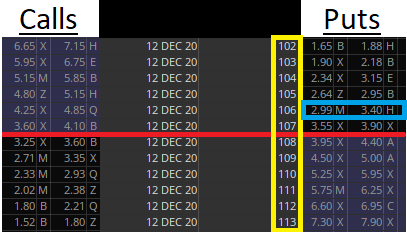
This time, we will sell a cash-secured put (like the example contract shown in the blue box above). We are required to have enough cash available in our account to purchase 100 shares per contract that we sell — this is what makes the put “cash-secured”. We will also want to sell the put at a strike price below the current price of the stock (an explanation for why we do this will require an article of its own).
So we sell the 106 put for about $320. Like before, the contract we sold will lose value over time (in this case, over the next 10 days it goes to $0). I will note here that you may buy back your sold put (or call) at any time, thus locking in any change in value from the time you sold it until the time you close the position.
Here are the two most likely outcomes: 1) ABC stays above $106 (your put’s strike price), the contract expires worthless on the 12th of December, and you keep the $320, or 2) ABC drops some, let’s say to $105 by the 12th, and you are forced to buy 100 shares for $106 each despite the price of ABC now being $105. In this second scenario, you are losing $1 per share upon purchase, but keeping your $3.20 per share from the options contract you sold; therefore, your actual entry price on the position is $102.80 and you are still profitable by $2.20 per share (compared to the current stock price of $105).
This is what it means to reduce your cost basis. You have just established a position in ABC for a total of $4.20 per share less than the price you would have paid when you first sold that put (in other words, if you had bought the shares outright at $107).
How do you lose money on cash-secured puts? You lose money if the stock drops below the strike price of the put minus the price of the put option itself. In the example, you lose money if the stock falls below $102.80. You always lock in a profit if the stock goes up or stays flat (the $320 you brought in when you sold the put, in this example). Here’s the takeaway: cash-secured puts offer income and a reduced entry point for your new position but have reduced upside potential if the stock skyrockets.
Strategy 3: The Wheel, a combination of strategies 1 + 2
If we put this all together, we are left with a strategy called “The Wheel”. This is a set-it and forget-it style strategy that you only need to check at the expiry date of your options contract.
Starting from a cash position, the strategy looks like this:
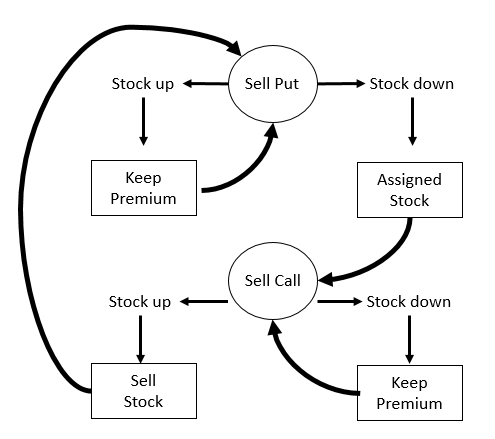
Knowing what to do next is always quite simple. If you have cash, sell a put. If you have stock, sell a call. It's really that simple to get started. Of course, there’s always more to learn!
Here are a few bonus tips:
- I like to sell these options about 2 weeks from their expiration date, longer is always acceptable but I wouldn’t go shorter. More on that next time.
- For cash-secured puts, you can calculate your Return on Cash by calculating Premium/Value(of 100 shares). I like this to sit above 2% in a 2–4 week period (a whole lot better than a dividend you may notice!)
- There is a technique called “Rolling” which will prevent your stock from being called away from you. This can be used to secure your dividend if the ex-dividend date is coming up. The next article will be all about rolling.
- Always be ready to reassess the fundamental value of your stock positions. You may not want to hold on forever!
I hope you found this article interesting and educational. My next article will be about managing these options contracts prior to their expiry date, allowing you to bring in even more premium and reduce any potential loss even further!
Leave your questions and comments, I will make sure to address them all.
(Required disclaimer: I’m not a financial advisor. Any information provided is not intended as investment or financial advice. This information should only be used as a place to start your own research.)


