
Productivity
3 Ways to Boost Efficiency for a Freelancer
Based on five years of experience

I am a freelancer since 2016, working mostly in digital marketing. During those years, I went through many ups and downs in my work efficiency.
I remember a 20-years-old version of me when I couldn’t organize myself, so I was “working” whole days with trembling hands from too much caffeine.
As a 22-year old, I started creating highly complicated plans, mostly in google sheets — charts, progress bars, conditional functions, reminders, data from other sources, etc. It ended up sitting each morning for up to 40 minutes filling all the data.
There was also a time where I tried to control everything with obsessive time-management, which took all my spontaneity and made me live like a robot.
I tried almost every method to boost efficiency that you can google — most of them are useless or even destructive, e.g., over-planning or other complications. Using my experience, I can boil it down to three (hopefully) useful essentials to boost freelance efficiency.
Track the time and work in “productivity sessions”
Time-tracking is a “must-have” to all freelancers, in my opinion. Why? The majority of us working from home, and it’s easy to get lost without that data.
There are various free apps to track the time, e.g., most popular, Clockify.
How to set up time tracking?
It’s very simple — you have to create few projects depend on your work. In my case, these are like: “Writing and editing,” “Ebook and its marketing,” “Internet Marketing,” “Building a Personal Brand,” and “Copywriting.”
After setting projects, you have to develop a habit to start the timer on the chosen app and stop it immediately when you get completely distracted. That is what you can call a “productivity session.”
The most famous technique of this kind is the “Pomodoro technique”:
The technique uses a timer to break down work into intervals, traditionally 25 minutes in length, separated by short breaks.
In one of my articles, I defended the argument that the key to increasing productivity is a break, where, e.g., I linked the study of the Draugiem Group, which tells us that:
According to our research, it’s best to work and focus for 45 minutes and then take a ten-minute break away from the computer.
Rest is not work’s adversary. Rest is work’s partner. They complement and complete each other.
— Alex Soojung-Kim Pang
Create one clean spreadsheet to track the work
It’s better to keep data and goals in a simple form to stay efficient.
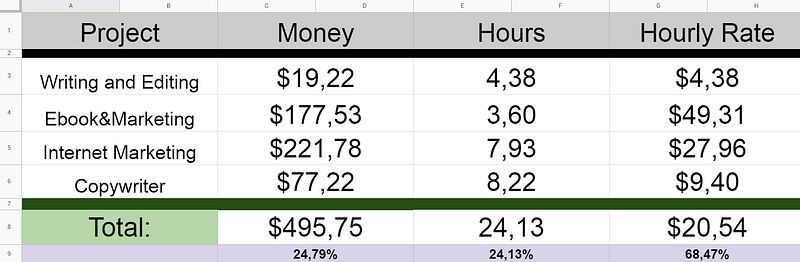
How to create such a spreadsheet? Looking simple, but there is some basic formatting:
The size of elements depends on your resolutions, but in my case, cells: C and D, E and F, G and H, are connected.
C8 value is: =Sum(C3+C4+C5+C6) E8 value is: =Sum(E3+E4+E5+E6) G8 value is:= Sum (G3+G4+G5+G6)
Money and Hourly rates values are format to “American dollar.” Hours are format to “Number” with an additional cell formatting:
=Sum(X /60+Y )
You have to enter a proper X (minutes) and Y (hours) values to get formatted time to a number.
Finally, a violet place is for goals, so money goal, hours goal, and rate goal is a great way to challenge yourself and be motivated by a daily % progress. Each cell is formatted in a way, e.g., =SUM(C8/2000)
The simple spreadsheet will cover all the data without any other distractions. All you have to do is tracking your working time, as I explained above, and filling the data from time to time. The connection of clear spreadsheets and time-tracking creates a great organizational system to develop work.
Goals are good for planning your progress and systems are good for actually making progress
— James Clear
Control the day or the day will control you
For me, two hours after waking up determine the productivity of the day.
I organized many weekly challenges for myself with specific goals, for example, “amount of productive time” in a week, and found out that the days where I started working two hours after waking up are generally way more productive.
Why it’s important? Because when we adopt a given lifestyle (and we should), we start to live up to a cycle. There is the point where we wake up and go to sleep that we shouldn’t change to keep our biological clock working well.
The days where I waste the morning are pretty normal until I realize that.
Then I start running, trying to recover from wasted time, thinking that the day will be bad anyway. As a result, I’m overwhelmed by tasks and duties, which leads to unnecessary anxiety, stress, and procrastination.
That’s why I often try to do as much as I can within two hours after waking up, even If I’m a barely living zombie. That often includes basic activities like reading the mail, answering comments/direct messages, and organizing social media, but at least I don’t start the day with a negative handicap.
The first hour of the morning is the rudder of the day.
— Henry Ward Beecher
The Takeaway
Being a freelancer is not as easy as many people think.
It requires developing systems and routines to stay on the right track. We are independent — there is no boss, no parents, not even colleagues, as Mel Robbins put it wonderfully:
No one is coming to save you. No one is coming to push you. It’s all up to you. You need to parent yourself.
Time management and datasheets are crucial to staying efficient by measuring our work’s effect and seeing what works and what is not.
I also recommend challenging yourself from time to time, e.g., trying to reach 50 “productive hours” in a given week. It’s quite important because, as a freelancer, we often don’t have the outside motivation to push forward.
If you enjoy reading such stories, consider signing up to become a Medium member. It’s 5$ a month for unlimited access to stories on Medium. If you sign up using my link, I’ll earn a small commission.