
3 Unconventional Ways to Meditate That Feel Like Cheating
Be mind-full, not mind-empty
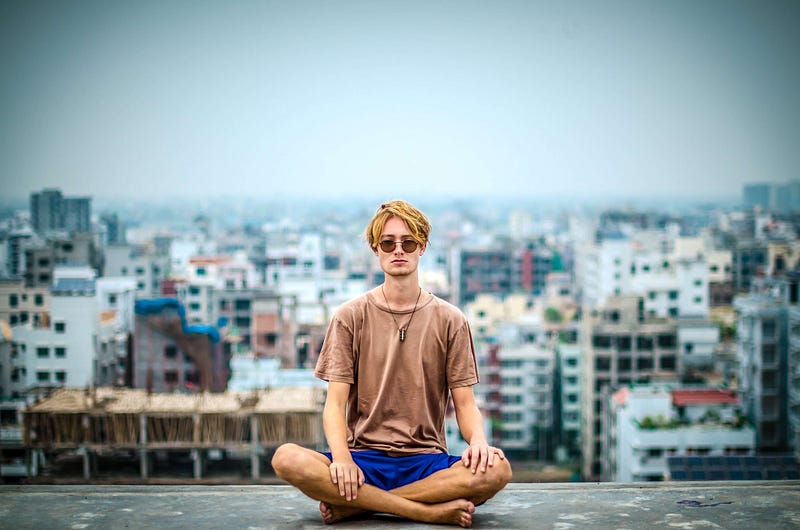
We often think of meditation as sitting cross-legged in a dark room with sage wafting about.
Trying our hardest to clear our minds.
But this doesn’t work for everybody — and people struggle to understand what a clear mind means.
Any time I’ve tried conventional meditation, my mind wanders into 2 thoughts:
1. “Am I doing this right?”
2. “How long has it been?”
The truth is, everyone can and should meditate. But not everyone finds a practice that works for them.
Copy + paste these techniques into your life to reap the benefits of meditation.
Be mind-full, not mind-empty
Most meditation advice comes in the form of clearing one’s mind — to become empty.
But this simply doesn’t work for everyone.
With the business of work and life, constant phone pings, and side hustles to be hustled, it can feel nearly impossible to simply turn off your brain.
Especially for someone untrained in doing so.
That being said, meditation is incredibly powerful and has many great benefits, such as:
- Reducing stress & anxiety
- Promoting mental focus
- Reducing physical pain
- Boosting creativity
- Improving sleep
The list goes on…
So, how does one meditate without switching off?
By embracing what meditation really is.
The only meditative principle that matters
The best definition of meditation I’ve ever heard came from a Buddhist monk named Mingyur Rinpoche. He said,
“Meditation is awareness.”
You don’t have to clear your mind to meditate. It’s not about doing anything. It’s simply being aware and present — what most people call mindfulness.
Just like anything worth doing, meditation shouldn’t feel like a chore.
Instead, a peaceful vacation inside your own head. And much like a vacation, everyone enjoys meditation differently — because we’re all unique.
In its simplest form, meditation is awareness. Nothing more, nothing less.
Here are 3 unconventional ways to meditate
Just like anything in life, there’s no one-size-fits-all meditation practice. What works for you is what works — period.
The trick is, finding a practice that fits your lifestyle.
I call them mechanisms. Tools to cue introspection and deep thought. Here are 3 of mine…
#1. Not grabbing at air
We all grab at air— figuratively and literally.
We reach for our phones when there’s a lull in conversation. When doing chores, we’ll put pop in our earbuds to listen to a podcast.
When I feel myself grabbing at air, I ask, “What am really reaching for?”
9/10 times I’m avoiding my thoughts.
Thinking can be scary — and painful.
We fear the unknown and with so much distraction in the world, our thoughts become a mystery.
If you truly want to pick up your phone to do something you feel good about, do it. And if what you need at that moment is to unwind to a podcast, amazing.
But recognize when you’re just avoiding being alone with your thoughts.
Thinking can be painful — but it’s worth it.
#2. Embracing nothing
There’s an ancient Buddhist concept called “Anatta”. It’s the practice of not-self or nothing.
The basic principle behind Anatta is that we don’t have control over our thoughts, feelings, or perceptions.
Our concept of “self” doesn’t exist — we’re not drivers. More like influential passengers.
Embracing nothing can be as simple as lying on the floor and letting yourself be unproductive. It can be deciding what to eat without rushing yourself.
Embracing nothing means understanding you aren’t in control. When you can become a willing passenger, you can appreciate the beautiful scenery your mind has to offer.
#3. Walking meditations
This is by far my favourite way to meditate.
Forward ambulation (moving forward) has been shown my decrease activity in the amygdala — the area of the brain responsible for stress.
This allows you to get into deep thought — it also boosts creativity.
The left-right patter of your footsteps creates a grounding tempo as well — an anchor. This helps you get lost in thought (or non-thought) depending on what your brain needs.
Plus, it’s a great way to get out in nature, breathe in fresh air, and exercise. I walk 20 minutes every day, and it’s become my cure-all elixir for everything mental health-related.
Bonus: Don’t have an opinion
Thoughts are deeply personal. But it’s amazing how much we think for other people. We’ll see something on the news and start getting pulled into the conversation.
When something happens to us we’ll think of how we can describe it to our friends/family.
When something happens, it’s ok not to have an opinion.
To simply observe and move on. If something isn’t happening to you then it’s not happening to you. Don’t have an opinion. Don’t take it on.
You’ll be amazed at the perspective you can gain by not having a horse in the race.
Life is what you make it — so make it work for you
Understanding that there is no right or wrong way to do anything is freeing. It allows you to experiment and live the way you’d like.
To summarize:
- Meditation is simply being aware
- You don’t have to be mind-empty to be mindful
- Listening to your body is meditation
- Doing nothing is meditation
- Going for a walk is meditation
Meditation is what you make it — so make it the best experience. For you.


