3 Tips to Making Your Own Game

Lots of people think game development is easy, or at least have a million ideas to pitch to you when you mention you’re a developer. I’ve had Lyft drivers try to pitch me their ideas and tell me why it’s so unique and would make a ton of money. Really though, if you’ve worked professionally in this industry you know it’s not as easy as slapping together some art and duct-taping some code to it (although I’ll admit some games do look like that is the case).
Have you started multiple projects and never finished? Or perhaps you’re just getting started and have a million ideas waiting to be made. This is for you.
I’ve been a part of several indie game dev communities and probably 90% of the stuff people are working on never sees the light of day. So why is that? Time management.
Yeah I know, it’s kind of a boring answer, but it’s true. I’ve been working in the game industry for 10 years now, and as a producer, it’s sort of my job to do time and task management. So I guess it goes without saying that I notice this as a big gaping hole in most indie dev planning. I want to just go over some high level ideas with you. Yes, these will probably seem obvious in retrospect when you read them, but often the best advice sounds that way. This is all sort of beside the point though. You’re here for TIPS, right? So let’s get to it:
1. Dedicate time to working on your project
It’s easy to get sidetracked. When I made my first game, Doggo Dungeon, I did so during my commute to my day job on the train.
I had a really long commute, like, REALLY long: 2 hours just one way!
So this gave me essentially a part-time job’s worth of hours every week to work on something I love. Being on the train I didn’t have access to wifi so no distractions: No checking my email or Facebook out of habit, no getting pulled into discussions on discord or slack, and no people trying to talk to me or ask me questions. Just some chill music in my headphones and a laptop burning a hole in lap.
It might sound blindingly obvious but this is where lots of people fail. They just don’t dedicate time and brain space to working on their game. This applies to any hobby too though. If you have distractions you’ll have to spend time getting back into the headspace of what you were working on, and that takes time too. Before you know it you’ve done pretty much nothing and it’s been a few hours.
So how do you dedicate time? The best way is to hide. If you have a laptop go hide somewhere where no one will bug you, turn off your wifi and set yourself a block of time to work on your pet project. If you’re on a desktop, barricade the door. I have an 8 month old at home and finding time is hard, but I try to set some aside every day to still work on my passion project. Get in the habit of doing this at a set time every day and you’ll soon be amazed just how much you’ve accomplished in a short amount of time.
If you work on your game in short bursts then stop for weeks on end you’re going to have a bad time.
You’ll spend a while looking at your old code and wondering, “What the heck was I even doing?” This also brings me to the second point:
2. Set Small Goals
You may or may not have heard of AGILE development. If you are a new indie dev this might not be a word you’ve ever come across. I could give a lecture on this (and I have) but to give you a TL;DR: set small goals you can achieve quickly that produce results you can see. If you’re a producer or project manager you might be cringing a bit at that description since it’s very simplified but stick with me here. In a studio setting, we tend to have sprints, or set goals for the week, to work toward. With the goal being something playable at the end of that week. As an indie dev you might be in a team of 3 or 4 people, or maybe solo (like I was). Without others around you there isn’t a lot of incentive to always have something playable. So you need to set your own goals and stick to them.
I like to use Trello. I set a few sketchy goals of what I need to work on, so I have a plan. Once you’ve got this break it down into some parts you can finish in a sitting or two. In my case this was my train ride, so I tried to see what I could accomplish in a two hour window. If you go into it with this in mind you won’t spend time floundering wondering what to work on next and you’ll leave with something actually done.
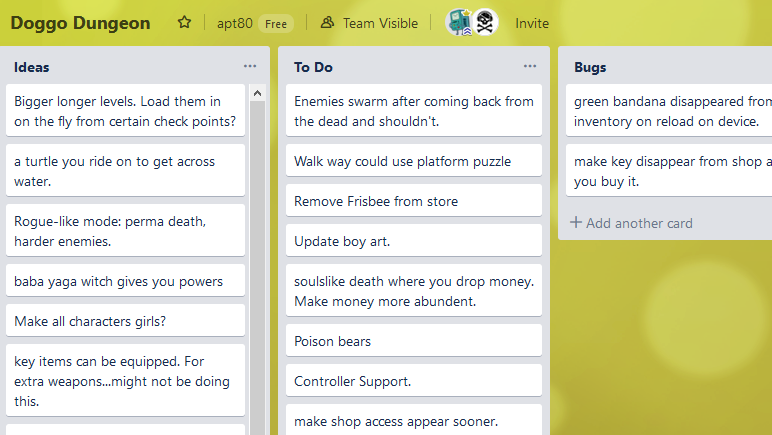
As you can see I like to just toss up ideas, things I actually need to do, bugs I found, and further to the right things I’m actively working on and things that are done. This is a simple way to keep track of your work and what you need to do still. If your goal is, “I want to make a puzzle platformer” that’s a good start, but what does that entail really?
It might be tempting to jump in and trying to start coding something but trust me you will get much further much faster if you take a little time early on to write out your thoughts. You’ll definitely find holes that you hadn’t thought about. You’ll come up with new ideas too, just by forcing yourself through the exercise. Trust me on this one, the bigger your game gets the more you’ll wish you had started this way.
3. Don’t Overthink It
It’s easy to get caught up wanting to make the perfect game. If you have never released a game, that should be your goal. Getting something, anything, out there for people to play. Not making your perfect game.
I’ve seen way too many first time devs say “I’m making a mmorpg”
Maybe you have a great idea for the next Undertale, Spelunky, or somehow have delusions you’ll be making a WoW-Killer (I’ve seen way too many first time devs say “I’m making a mmorpg”). Let’s be clear, and have a bit of hard truth: you’re not making any of those things. Your first game will likely be a hot mess. Don’t dispair though. No one does it right the first time. It takes practice like anything else in life. Too many indie devs get caught up iterating on their game forever, then eventually lose steam and never release it. No one ever sees their hard work, they get discouraged, and move onto the next project, or even worse they never try again.
Your first goals should be something simple. Maybe work on making one mechanic of your game really good. Get it out there for someone to try and see what they think. As with anything creative some people will love it and some will hate it. Both types of feedback are useful to you to know what to do next time.
Let’s say this isn’t your first rodeo. If you’re an experienced game dev you can still make the mistake of stepping into this pitfall. The key goes back to planning. Have goals along the way and what it means to call your game done. Having an end in sight can mean the world when in the middle of a project.
Joining a dev community can help keep you inspired and give you a sounding board for ideas.
In the current game development arena there are lots of ways to get your early alpha builds out to people. Once someone is actually playing your game its really motivational to keep making it better. I have a discord with some friends for development of my games.
So get out there and make something great! I would love to see your demos, concepts, or prototypes. Comment below with any questions or ideas…or hop into my discord chat. As long as I’m not hiding away working on something I should be active in there, and good luck.


