
3 Things You Can Learn From the Art of a Man Who Makes Crop Circles Look Like Child’s Play
Art that isn’t meant to last
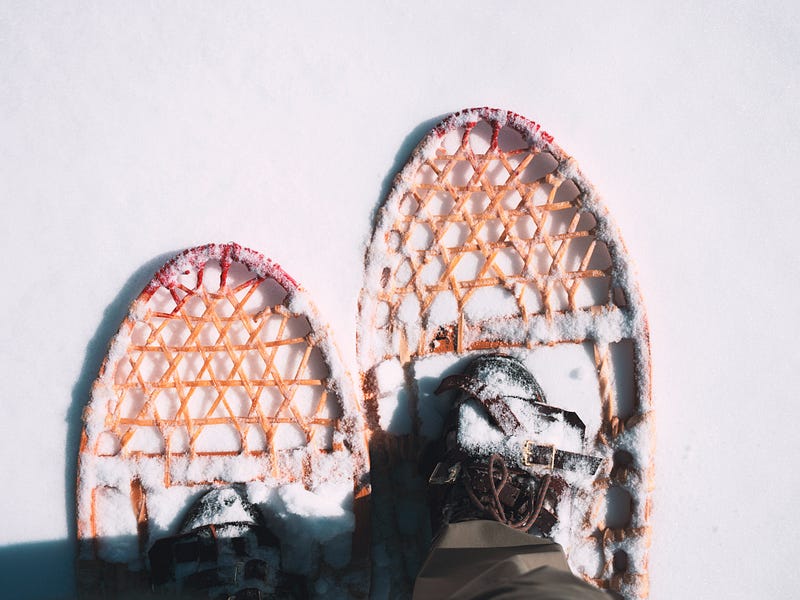
In the French Alps, there’s a man who walks around in the bitter winter cold for 12 hours at a time. He’s in his sixties, and he can cover as much as 30 miles.
But he doesn’t go anywhere.
Sunny days with no wind are the best for Simon Beck. Because on those days and with just his snowshoes, a compass, and a mental model — constrained only by daylight, energy, and his imagination — he creates landscape art at scale. His works are a race against daylight and time.
And they make crop circles look like a toddler did them.
They last as long as conditions hold — which sometimes isn’t even long enough for him to finish. A change in weather can wipe them away.
Beck’s art is the most generous kind: the kind that isn’t meant to last.
1 millimeter = 1 step
Exercise got him started. But curiosity kept him going.
Beck was an avid runner until foot troubles kept him from the sport, and he began to take walks instead. But it didn’t hold his attention. So one day he made things more creative: he paced a star shape into the snow. A big one.
He realized quickly it was no challenge: Beck is an expert navigator, and has been doing it for decades. He won the British orienteering championship in 1974, and made a career since then as a freelance orienteering mapmaker. Orienteering is a sport where athletes race their way to various checkpoints across rough country, with just a map and a compass.
The star was easy. Beck wondered what else he could do.
Advanced geometry was a natural next step, for a guy who was into math as a kid, and who’s been navigating landscapes for much of his life. His favorite designs — the Mandelbrot set, The Koch curve, and the Sierpiński triangle — are beyond anything I ever learned in a math class.
They’re hypnotic shapes that he maps out using a scale of one millimeter = one step. Then, he holds the picture in his mind and walks it into existence one pace at a time. Smooth slopes and frozen lakes come alive with his designs, and if the weather holds long enough to get pictures, he’s happy.
You can read a lot of links about Simon Beck. But none of them tell you much.
His art teaches me a few things, though — even if I’ll never see it in person.
Small parts = big parts
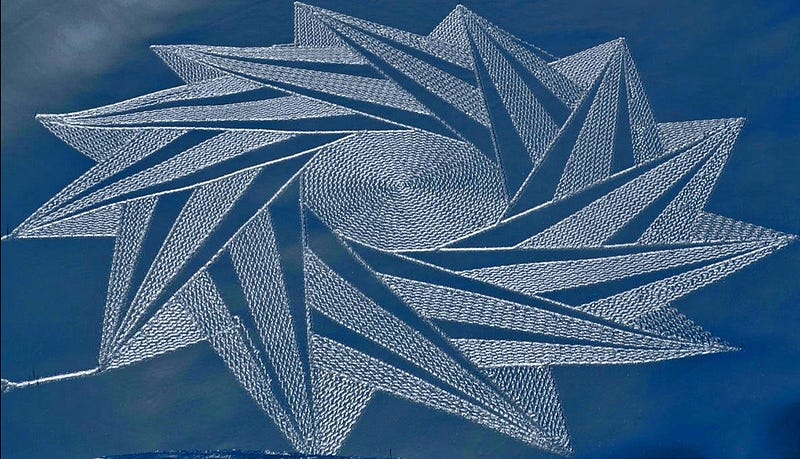
The Sierpiński triangle is just one big triangle, with successively smaller triangles fit into it. It’s just iterations, small parts added up to get big parts. Most of Beck’s designs are like that: eye-catching and math-heavy, but in the end?
Just small parts assembled well.
A design might look terribly complex. But in the way of many complex things, the recipe is just time, effort, and rules. The order to go in, the points where you add the next set of shapes.
Sometimes we encounter things that seem to hide a secret. They seem so complex, so intricate. I’m willing to bet that most of the time, the secret’s just adding small things up to big things.
Small efforts up to big efforts.
It’d be easier if there were a secret, but the “secret” is often just hard work and time in a trench coat.
Sometimes we need to think backward
As kids we’re taught to tackle things directly and work from the outside in. Goal setting as adults reinforces the habit to be determined and focused, to get things done by running straight at them.
But for his art, Beck works backward:
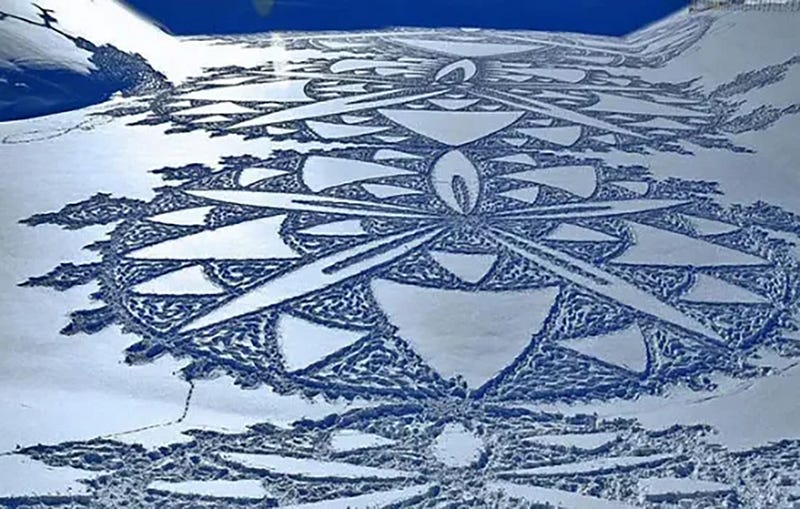
‘Usually I work outwards from the center,’ he explained . . . “Straight lines are made by using the compass and walking in a straight line towards a point in the distance, curves are made by judgment. Both require a lot of practice to get good.
— Simon Beck Stomps out a Series of Giant Snow Artworks
Instead of navigating toward something, step by step he navigates away from it.
Beck’s technique is a perfect example of a kind of problem-solving called “backward thinking.” It’s how the NASA engineers got the Apollo 13 crew home in 1970, and it’s useful when we face complex problems with interconnected parts — problems like geometric art, for example.
The scientists among us may have learned backward thinking along the way, but many of us didn’t. And it’s valuable because some things can’t be tackled directly. They’re too complex, or we can’t see enough of the problem.
Sometimes we can take a cue from Beck, who begins with a clothesline and a central anchor point. We can start with the destination we want, and work outward from there.
We might even end up with a more creative solution.
Take it seriously, sooner
So many creators have a version of this statement: I wish I’d taken it seriously, sooner.
Simon Beck is among them. Looking back at his interests and skills his journey makes sense, but even he didn’t see it at first, in the moment. He said it took him five years to begin taking his creations seriously.
Like many of us, he moved toward his creativity only gradually. Sometimes accidentally. Like many of us, he studied a subject in school that ended up at odds with his real interests:
The truth is I never really became an engineer. I did Engineering Science at Oxford because everyone said ‘You have to go there if you can get in, you would be a fool to turn them down’, and I went there knowing I did not want to do the course, and from then on I was fighting a losing battle against my problems.
— Perseverance and patience define the works of the British snow artist Simon Beck
We often ignore the things we’re drawn to. We brush them off as hobbies. But if we’re drawn to things others aren’t, there’s a reason. If we’re doing something unique, there’s a reason.
We should do the work to find out why.
Beck often runs out of daylight by the end and finishes his designs navigating by headlamp, finding his way in the dark. He sleeps with the hope they’re still there in the morning, long enough for a picture.
There’s something poetic about that. Because we’re all in the dark sometimes, finding our way.
Art isn’t about why
I love the symmetry and hypnotism of Beck’s art. Those are the things that grabbed me first, but what drew me in further was the sense that there was more to it. More to understand.
And while I was — and remain — curious about why he does what he does, in the end art isn’t about why. Art is about provoking a response in us. It’s about changing, and learning.
When we challenge ourselves to respond to things, we learn from them.
Additional links:
- Simon Beck’s Facebook page
- TEDxKlagenfurt
Join my newsletter Quarter Turn for more like this, free every Wednesday


