
3 Things Tucker Carlson Did Right
Credit where credit is due
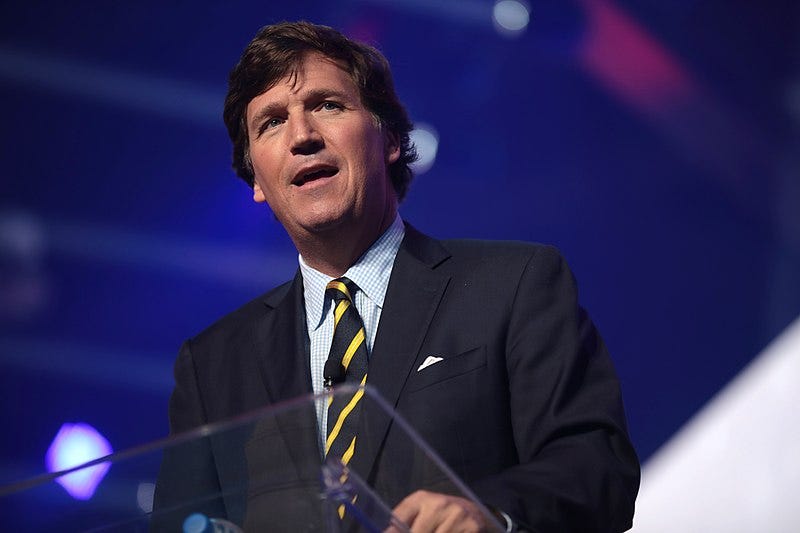
.jpg)
Tucker Carlson is slap bang back in the limelight, if he ever left it. He is arguably the most important journalist in the world at this time. He got the interview with Vladimir Putin — the ultimate Boogeyman, the monster under your bed, the Devil; the man Nancy Pelosi recently called; ‘one of the most evil people in the world’.
Although, Nancy’s only ‘not a big fan’ of the man responsible for blowing more than 11,500 children to bits in Gaza, Benjamin Netanyahu, which does make one think two things: 1) She’s no expert. 2) She’s firmly on the scale herself.
And Putin is firmly back in the news for the right reasons, the interview, and for the wrong reasons, the death of Alexei Navalny. On a personal note, despite all I write about Russia, Ukraine and world politics here, and many of you will know my views, it was extremely sad to hear of his tragic demise. You can expect an upcoming piece on Navalny, his life and his death.
And for Carlson, the powers that be and the majority of the mainstream have been hoisting the sword of Damocles high as they can, calling for his head and baying for his blood for daring to hold the interview. Even Putin for his own more than likely self-serving ends stuck the knife in.
But, to my mind, credit where credit is due. It wasn’t perfect by any means, nonetheless, there were more than a few things he did right.
1. He got the interview
Carlson claimed that no other western journalists have tried to interview Putin. This was corrected both by spokesperson for the Kremlin Dmitriy Peskov and the BBC, among others. It would also be just plain mad, were it to be true. It isn’t true, to be sure.
So, with all these, in all likelihood, hundreds of journalists seeking an interview with the Russian President, why was Tucker Carlson graced with the opportunity?
Simple. His ideology, or lack thereof.
Many hate Carlson for some of the stuff he thinks and says. I fundamentally disagree with him on immigration, women’s reproductive rights, climate change and likely a great deal else, but on world politics, American foreign policy and the forever wars he makes eminent sense.
Carlson talks about America’s interests and what is in the interest of the country he’s from. He understands that all countries have their interests, ambitions, aspirations, needs and lines in the sand, with powerful states having the muscle to back up their words with might if needs be. America has its interests, as does China, as does India, as does Russia.
They understand that Carlson is ‘pro-American’, in fact, for them, that’s the natural order of things: he’s American; he should be pro-American.
The acceptance that the other has a right to its own otherness and that the game is played by many players all playing to best promote and protect themselves is the world of Henry Kissinger and George Kennan. They represented America’s interests to the utmost of their abilities, and they knew China and the Soviet Union would do the very same. This was the way the game worked, and they were never above compromise and concession, dialogue and discussion, and certainly never above getting their hands dirty.
This is the world Putin is from. This is the world Sergei Lavrov is from.
They understand that Carlson is ‘pro-American’, in fact, for them, that’s the natural order of things: he’s American; he should be pro-American.
What is not natural for them is an ideology that carves the world up into good and evil states — liberal and illiberal — casting the latter has some sort of monstrous vestigial tail, something with ‘hooves and horns’ that cannot be reasoned with, that cannot be bargained with and can only be trusted to wreak death and destruction at every turn and drag humanity down into the primordial soup.
It is really only the far left and the far right that now make any sense when it comes to world politics. Most everyone else across the West is drowning in a sea of rampant delusion, rabid zealotry and unreflective hubris.
Carlson got the interview because, on this issue, he’s sailing on the surface and can see the sea for what it is. In these mad mad times, that’s no small achievement.
2. He listened
So many are so deep in the sea that they fundamentally misunderstand how politics between states differs from politics within a single state. They’ve been ripping Carlson to shreds for not taking Putin to task on a litany of issues. These are mostly domestic, of course, because an essential component of megaloliberal ideology is to see a country’s internal political system as the signifier sine qua non for whether a state is to be deemed a good guy or a beast.
Carlson could have put one or two more questions to Putin, which, if Putin is to be taken at his word, the president would have even relished. But if someone seriously thinks that a journalist from one country can interview the leader of another, subjecting them to an unrelenting interrogation, then they know nothing of notions such as legitimacy, power, proportionality and context.
Just picture any Western leader sitting for an interview with a Russian journalist allowing themselves to be excoriated on a range of their domestic failings for a two-hour period, all the while happy as Larry to answer each and every barb.
That’s never going to happen. That’s not the way international politics works. That many see it in these terms shows just how far western journalism has sunk and just how inept it is in attempting to impart even a modicum of objectivity to international relations.
Carlson really did listen. Probably a little too much. He listened while Putin rambled off into the ancient past to expatiate on things that have no bearing on the here and now before coming back to talk at length about the structural, security and societal issues that every bearing on the here and now. The goal was to let the leader of Russia present his country’s position, a position that the majority of Russians mostly agree with, in order to let western publics hear it unfiltered and undiluted, to then decide for themselves.
And this is where western journalism stands at present: it can only speak; it cannot listen.
Credit where credit due but criticism where criticism is due too. Carlson should have put a few more questions to Vladimir Putin about the war, its resolution and what a peace agreement will look like. He probably should have interrupted a little more. He probably should have been a little less mild mannered and meek.
But he really did listen and really did take in what he was hearing, where the vast majority of modern western journalists would have been foaming at the mouth with incandescence, cutting the leader of Russia off at every turn.
And this is where western journalism stands at present: it can only speak; it cannot listen.
3. No high horse: No moral high ground
Another core element of the perversion of liberalism that has become the locus of world politics is that the moral high ground belongs forever and unassailably to liberal states. This has given birth to a dualistic logic of good states and bad states; good wars and bad wars. It has all but killed off dialogue and traditional diplomacy. And it has stacked up hypocrisy and arrogance to astronomical levels. It is being put to the sword for the reason that a number of states are now powerful enough to move to seek a new grand bargain with the US-led West, where the views and values of said states will have to be incorporated into the international order.
He understands that saying it’s all Russia’s fault is neither true, nor right, nor helpful.
Carlson vehemently rejects this ideology. And it is not that he has no sympathy for Ukraine; he recognises the vast death and destruction that the war has wrought. He knows it is a great tragedy and a human disaster that has left ‘hundreds of thousands of people dead’. This is not up for debate; only a complete fool (and Carlson is quite the opposite, regardless of how much you may loathe him) or some kind of inveterate moral freak would see it otherwise.
But what Carlson does reject is the pure dichotomy and singularity of cause and culpability. He knows it’s not black and white. He knows everything can’t be pinned on the odious figure of Vladimir Putin. He understands that saying it’s all Russia’s fault is neither true, nor right, nor helpful. There is a long history littered with mistakes and wilful acts that has brought us here. There are structural and security issues which were never addressed after the fall of the Soviet Union and only got worse and worse with time. There are multiple disparate forces which pull this and way and that within Ukraine itself; it is not one homogenous mass with a single story and a single identity, no matter how much some movements within that society will it to be so.
The good-bad bifurcation is not only unfair and untrue, it is also hugely counterproductive, helping to destroy any chance for peace and de-escalation. When you cast the other side as the Devil, you eviscerate any possibility for negotiation. Carlson understands that at some point there will have to be peace negotiations and a post-conflict settlement; as long as the whole thing doesn’t metastasise into some kind of global war. He sees that the sort of moral absolutism and intransigence described above represents both a factor driving the conflict and a factor preventing its resolution.
We can use the analogy of God and religion to illustrate what is at play. In fact, this was the first moral absolutism that had to be surmounted in Europe in order for the states not to be constantly at war.
One can believe in one’s God, prefer one’s own value system and way of life, and generally see the alternatives as worse and inferior. But, at the same time, a person can accept that what’s right for you, may not be right for others. This acceptance is the heart of religious tolerance, and it is a core feature of any healthy liberalism worth its salt.
Or, one can do all the above but see life, society and world politics as a ever-raging battle between good and evil, where the crusade to convert all non-believers into believers is fully justified because it is given the celestial seal of approval by virtue of the very God you happen to worship.
He does not view it as a monstrosity riddled with all the worst of humankind, capable of only doing bad and something that one should look down their nose at whilst of course holding it.
In international politics, Tucker takes the first path, and this was the sort of thinking he brought to the interview. He loves America and loves the American way of life, but he accepts that Russia has a right to love the things it loves and has a right to its way of life. He respects Russia as an equal and an equal member in the community of nations. He does not view it as a monstrosity riddled with all the worst of humankind, capable of only doing bad and something that one should look down their nose at whilst of course holding it.
Could many other western journalists do the same? As it stands, their number would be in the extreme minority.