
3 Things I Did to Improve My Writing During the Pandemic
Writing during a time of tragedy made me a better writer and a better person.

I graduated from college in May 2020 into an unprecedented global trauma. To say it depressed me was an understatement. On any week my moods ranged from completely hopeless to cautiously optimistic. But I was lucky enough to have a family I could move in with and remote work to support myself. I was grateful because I had resources not everyone else had- but I couldn’t sit still and write.
I was grateful to have a family to stay with and to work from home, but my inability to focus made me feel ungrateful. It made me feel like a failure. I had the time and the resources to create, and I wasn’t.
Then I realized how awful and unforgiving this line of thinking was. I would never apply that logic to another writer, creative, or friend during the pandemic. Why was I doing it to myself? My internal monologue was that of a tone-deaf self-help guru. I fed into the idea that I “lacked discipline” if I wasn’t productive during a pandemic. A pandemic, people!
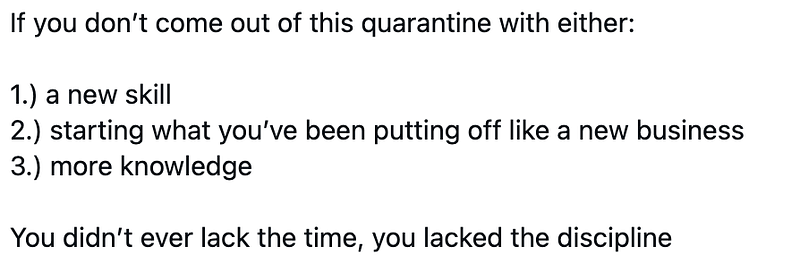
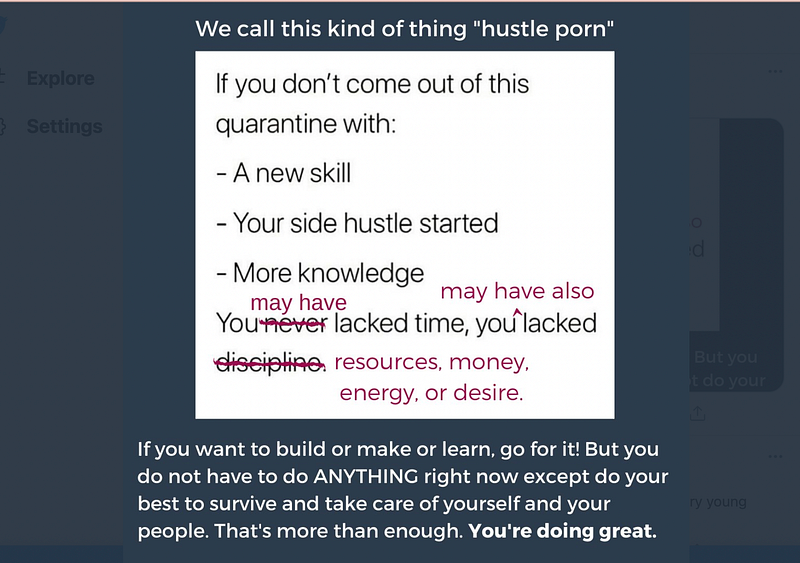
Productive [noun]: the alluring promise of constant creation captured in a single word. Usually involves some sort of guilt trip and is a cornerstone of hustle culture. Probably a trap. (This is a personal definition, of course.)
That line of thinking is absolute BS. As soon as I rejected it, focusing on writing ironically became easier.
Once I let go of the need to be busy for the sake of being busy, I created higher-quality work. Here’s how I focused on writing during the worst parts of the pandemic.
1. Specific goals were nowhere to be found
Early in the pandemic, I used page counts to complete more work- but these targets did the opposite. The page count intimidated me. It scared me off. It made me feel swamped during a time when I was already experiencing intense stress, fear, and pain. I was overwhelmed, to begin with, so why was I making the process harder on myself by using arbitrary, self-imposed metrics? It’s not like I had any client deadlines… I was doing this to myself.
I pivoted and focused on making writing a daily habit instead of a specific page count. Some days I spend my entire practice brainstorming and building upon ideas. Some days I spend the entire session bookmarking reputable resources that inspire me. Other days I sit and write for hours.
Being a writer isn’t just writing. In any job, there are many administrative tasks that support your craft.
I’ll repeat it once more with feeling! Writing isn’t just writing. It’s research, it’s planning, it’s connecting with others. It’s making your work accessible, discoverable in a digital market and creating a distinct brand. So why limit your practice only to a page or word count?
By working on my writing business each day, I create accountability and a long-term system for myself. It gives me maximum momentum when creating new work. And when I sit down to write a script or an article, I end up with far more volume than I did when I was forcing a page count. I was being productive instead of forcing productivity.
It might seem scary to abandon a word or page count, but try it for just two weeks. See how it works for you and if it helps take some of the stress out of your daily practice.
2. I made every class a new adventure
I’ve been able to access several affordable courses online to improve my scriptwriting since I finished my degree. Since I’m such a recent grad, the school was still my “normal”. Going from interactive, thought-provoking courses to working in my sister’s old bedroom in front of a computer was jarring. Taking classes brought excitement and adventure back into my life.
Not only have I been able to grow by getting feedback from my instructors, but my classmates inspire and motivate me. Connecting with new people across the world made my “home office” (the corner of my bedroom with a desk) a little less lonely. Every time I joined a class I looked forward to a new lesson on craft, and every time I logged off I was fired up. I wanted to create more work to share it with a group of people who inspired me and my work became more about connection… instead of feeling obligated to hit word counts solo. I went from feeling ashamed by a small volume of work to fulfilled by collaboration and camaraderie. It gave me the support I needed as a young person whose life had changed in such a tremendous way.
Taking classes is more than working on craft, it’s an opportunity for connection. There are so many free and low-cost courses now that are no longer restricted by location. Try auditing a course to see if it’s a good fit, look at local community college offerings. I can vouch for Film North and Second City as a scriptwriter. Second City offers scholarships, while Film North offers a discounted rate for those at or under the poverty line.
3. With the plan out the window, I was forced to adapt
Prior to the pandemic, I thought of myself only as a scriptwriter, because that’s the work I had produced. But with the theatre industry hard-hit, I took the time to explore new mediums.
I dove deeply into writing for television and blogging. It helped me open up my mind to new mediums of expression. I ended up writing and acting in a short film with friends completely over Zoom and used improv to create a solo web series on my phone.
I let go of the need to work in a certain framework, and my focus sharpened. Instead of fitting projects into mediums that didn’t fit, they became more specific. I wasn’t fighting the work anymore, and it made it much easier to create.
Getting your work done can be guilt-free. Try out these tips and see how they work for you. And remember to breathe!
Lydia-Renee Darling is an actor, writer, and creative in Madison, WI. She is also a self-titled “quadruple M”: a mixed, multi-hyphenate media maven.