
3 Things “9 Perfect Strangers” Got Terribly Wrong About Psychedelics
Magic mushrooms aren’t as dangerous as you think.
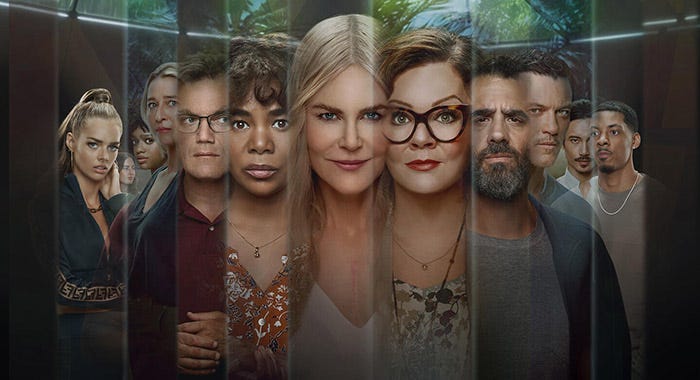
Earlier this summer, “9 Perfect Strangers” kicked “The Handmaid’s Tale” off its throne as the most-watched show on Hulu. The series is based on a book written by Liane Moriarty, best-selling author of “Big Little Lies”, another HBO hit series. The show was highly anticipated and expectations were high.
Kidman plays a mysterious and ethereal wellness guru that hand-selects nine strangers for her high-end retreat “Tranquillum”. As part of her notorious healing program, guests drink psilocybin, the psychoactive ingredient in magic mushrooms, in their smoothies every morning. They only learn about this after the fact, as doses are progressively increased.
It’s exciting that psychedelics as a healing modality are finally making their way into mass media.
What’s much less exciting is the way they were portrayed in this show. Some of it is not necessarily accurate, and some of it is downright wrong.
By reiterating some of the harmful anti-drug propaganda instated by Nixon to fight not drugs but those using drugs (Hippies and Afro-Americans), the show, unfortunately, further perpetuates some of the deeply ingrained misconceptions and stigma around psychedelics.
Let’s get into what it got wrong.
Psychedelics Do Not Cause Withdrawal Symptoms
The most bothersome misrepresentation occurred in a scene early on during which Nicole Kidman (as “Masha”) speaks to her trusted helper Delilah.
“Are you back on your dosage?”, she asks Delilah. “Withdrawals from psilocybin can render you dangerous.”
There’s so much wrong with that sentence.
Let’s break it down.
Psychedelics are not addictive
According to drugpolicy.org, the psilocybin contained in magic mushrooms does not have addictive properties. There are two main reasons for that:
- Experiences are usually so intense and challenging, both mentally and physically, that most people are unlikely to feel compelled towards frequent usage to begin with.
- In addition, the human body quickly develops resistance, and with that, makes it extremely difficult to experience the effects after repeated usage (it tapers specifically after day four).
- Finally, there’s practically no lethal dosage for psilocybin, unlike many of the current legal and over-the-counter drugs (including alcohol). So, even if these substances were addictive, they wouldn’t pose any danger for overdoses.
“Psilocybin is not considered to be addictive nor does it cause compulsive use” — Drug Policy (US)
There’s no withdrawal, if anything, there’s an “afterglow”
As a result, there are effectively no withdrawal symptoms from magic mushrooms. At least none that are perceivable to the human mind and body.
Unlike other substances like MDMA, which have a “come down” as a result of depleting your serotonin reserves, there’s no such thing as a come down with “classical” psychedelics like LSD and mushrooms.
In fact, it’s the opposite: the days after, you may continue to feel the positive effects of psychedelics. A study of 1,200 users conducted by Yale University confirmed the “afterglow” that is commonly experienced among users.
So, even more problematic than the fact that there wouldn’t be any withdrawal symptoms to begin with is the statement that they’d be “dangerous”.
That’s simply outright false.
Psychedelics Do Not Make You Violent (Usually, It’s Quite the Opposite)
Overall, the series doesn’t do well in depicting how psychedelics like psilocybin and LSD impact human perception and behavior.
If you watch the series and know nothing about mushrooms, you’ll probably think they make you downright crazy, delusional, and violent.
One day during the 10-day retreat, participants split up into a female and a male group for a day in nature. The male group returns that night with a barbarically hunted goat, which they presumably killed with their bare hands. One father who’d come to Tranquillium to heal grief from his son’s suicide precedes to say that he never thought he’d be able to do something like this.
The same guy in a different scene violently bangs his head against a tree.
In another scene, Nicole Kidman is worried about one of her guests having a violent outburst and becoming dangerous as a result of the drugs.
Scene after scene, there’s violence.
Psychedelics don’t promote or create certain qualities, they simply amplify or bring to light what’s already in you
This is important to understand.
Yes, someone who is violent or deals with anger issues might find themselves facing these shadow qualities during a psychedelic journey.
But of the nine strangers, almost half show violent behavior at some point or another during the show, which makes the viewer believe the violence arises as a result of the psychedelic mushrooms.
This is not what happens when a lot of people take psychedelics together.
If you want to see what actually happens, go to Burning Man or join a plant medicine ceremony and watch people connect deeply and talk about love.
The one quality psychedelics reliably produce is the feeling of love
There is however one theme that frequently arises, journey after journey.
And it’s quite the opposite of violence.
Psychedelics remind us of the love that is all inherent in us, the love that we’re made of, the love that is the fabric of the universe.
If we just look at the hippies in the counter-culture movement of the 60s and 70s, it’s more than obvious. It was an anti-war movement after all.
During Psychedelic Trips You Usually Still Know What’s Real (and What Isn’t)
The final thing that needs to be clarified is how hallucinogenic trips really get.
It’s tough to generalize because no two trips are alike, even for the same person. So I can only speak from my own experience here. But I’ve not once had a journey where I didn’t know what was real anymore and what wasn’t.
Yes, you may hallucinate.
But if you do, you know that you’re hallucinating.
I always know because things I see appear so absurd that it’s obvious that they’re a delusion resulting from my altered state. Think the classic psychedelic “melting” of things in your environment, or something that’s normally lifeless and static suddenly starts shapeshifting. One time I took a deep breath lying under the star-studded sky during an Ayahuasca ceremony and suddenly was breathing in love directly from the universe into my heart. Obviously, I knew that that experience was facilitated by the plant medicine. Which of course doesn’t make it less real, but that’s another discussion.
I’m mentioning this because there are tons of scenes in which guests are frantically chasing illusions and seeing things but don’t realize they’re hallucinating.
I don’t know anyone that’s ever happened to. Again, might be possible, but I’d say it’s unlikely and not as common as promoted in the series.
Final Thoughts
I was thrilled to learn that such a high-profile production is tackling the topic of psychedelics and bringing it to a wider audience. But I’m disappointed with the image that the audience is now left with.
Going forward, I hope there’ll be more formats that show psychedelic experiences in a more truthful way.
That’s not an easy feat, altered states of consciousness are hard to describe and best personally experienced. But I’m convinced we can try harder to bring this topic into entertainment in more informed ways. (If you’re curious to read what these journeys really feel like, I have plenty of stories on my profile).
Here are two things that the show does get right:
- Plant medicine should be treated with respect, as they can produce mentally and physically challenging experiences. Sadly, “9 perfect strangers” fell short in displaying what lies at the end of these more challenging experiences: liberation, freedom, love, and joy.
- Psychedelic journeys are about letting go, whether it’s resentment or anger, a deceased loved one, or a limiting belief that’s keeping you small. They help you identify what’s most critical to leave behind and show you the path to do so — it’s still on you though to take the necessary steps.
Want to stay in touch? Join my e-mail list here.