
3 Strategies To Help You (Finally) Reach Your Big Goals
Your planner is not a magic bullet
Every year, it never fails to seduce me: that shiny new planner with all the extra pages for goal setting and notes. The colorful, felt-tip pens. The bright stickers. The pretty planner supplies call my name, beckoning me to open my wallet, because this year, this planner is going to be the magic bullet that helps me accomplish my big dreams.
Most years, I cave. The planner arrives on my doorstep and I open it with hopeful expectation. At first, I use it every day. I write in it. I consult it. I carry it with me wherever I go. But by the summer months, I usually just open to the month-at-a-glance pages. By the end of the year, I sometimes forget to write in it at all.
Do you have a big goal you’re planning to pursue this year? Whether you have a demanding job, or you have demanding kids (or both!) taking some time to name exactly what it is you hope to accomplish, and breaking it down to small, doable steps is what will get you there. In my experience, the fancy planner won’t save you. Your planner may help you carve out the time to work on your goals but you need a road map and sustainable habits to get you there. Otherwise, your big dream just ends up in a box labeled “Someday.”
Today, I want to share three strategies you can use to meet your big goals.
Create a road map
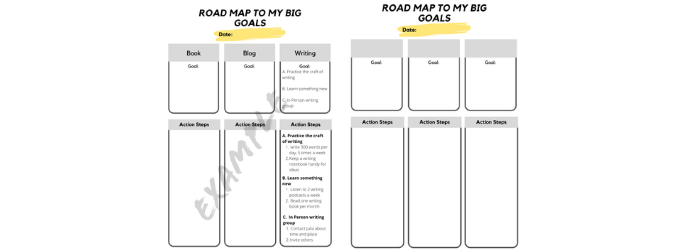
Two years ago when I was getting serious about my writing, I had a lot of goals and plans and things I wanted to accomplish. My ideas were numerous and sometimes vague. One day in November (because who says you have to wait for a new year?) I made a bulleted list of all my writing goals. I noticed patterns, and topics emerged from subtopics. I created a three column sheet labeled “Book” “Blog” and “Improve Writing” and listed 1 to 3 specific goals under each topic. Then, under each goal, I wrote a few action steps I could take that would help me make progress on this goal.
For example, under the column “Improve writing,” my goals were:
A. Practice the craft of writing B. Learn something new C. Join an in-person writing group
Under goal B “Learn something new” I had two action steps:
1. Listen to one writing podcast a week 2. Read one book about writing per month (and take notes)
Creating a road map can help you focus on concrete, actionable steps you can take towards your big goals. It takes something that feels overwhelming and out of reach and makes it bite sized and attainable. Here’s a sample of the form I used:
Pick a small chunk of time
Once you have your road map in hand, you’re ready to carve out some time to work on your action steps. When you’re working on a big project, it’s tempting to think we need hours every day in order to make progress. When I wanted to establish a daily writing routine, I thought I needed at least one to two hours with my pen and notebook in hand. This simply wasn’t feasible and I ended up frustrated and resentful when my “daily” writing time only happened once a week.
Instead of pressuring myself to spend hours and hours writing every day, I took James Clear’s advice in his book Atomic Habits and scaled this habit down until it was a small chunk of time to “make sure that you are at least showing up in a small way each day.”
When I told myself I only had to spend 15 minutes writing every day, I had no reason to skip it. Suddenly I was finding time every single day to work towards my big goals! In this way, I was able to make slow and steady progress towards my book!
Give yourself no excuses: pick a small chunk of time every day. Even tiny steps add up to make a big impact!
Use a habit tracker
Every day, once my fifteen minutes of writing are up, I color in a square on my habit tracker. A habit tracker is a way to visually mark your progress, whether it be check marks on your personal calendar or a special piece of paper you hang somewhere you can see it.
In his book Atomic Habits, James Clear says habit tracking is powerful for three reasons:
- It creates a visual cue that can remind you to act.
- It is motivating to see the progress you are making. You don’t want to break your streak.
- It feels satisfying to record your success in the moment.
All of this I have found to be true. I have tacked my habit tracker on my refrigerator and I’m terrified of breaking my streak. Even my two little boys keep me accountable! Habit trackers are so rewarding, it can be tempting to track the 302 habits you are trying to cultivate, but Clear advises it’s most effective to limit our tracking to our most important habit!
Get started
Don’t count on your planner to be the magic ingredient that will help you accomplish your big goals. Use these three strategies to help you along the way! I’m rooting for you!
Like what you read? Join Medium with this link to get access to thousands of stories and to support writers like me!