
3 Simple Questions That Help You Create Headlines Readers Can’t Help But Click On
and, for instance, generate a viral article
Oftentimes, when I come across a headline on Medium, I look at it for one millisecond, and think to myself:
I’m sorry, but I have no idea what you’re trying to tell me!
And what do I do next? I scroll right past it.
BuzzFeed has an internal rule. Every writer must write 30 versions of a headline in order to find the right one.
As far as I’m concerned, I also play with different headlines. Mostly, I come up with around five to ten.
- One I pick for my long-form article.
- One I pick for writing a short-form post which directs to my more extensive resource.
Recently, one of my short form articles went viral
I didn’t even know that a short form post could go viral. But it can! Although my long form article performed very well, my short form article was picking up speed and traction insanely quickly.
To date, it has generated 1.3k views and made around $23.
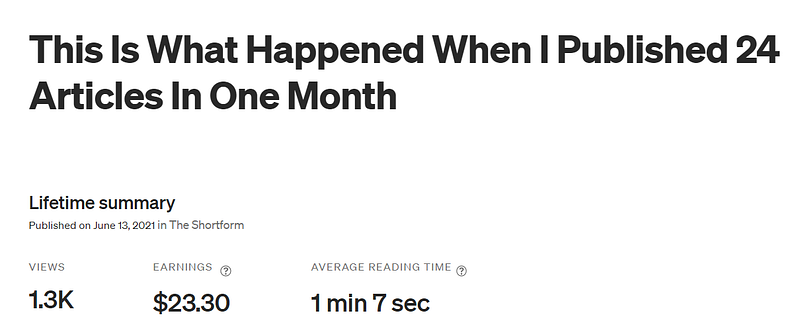
At this point, I couldn’t quite pinpoint the secret sauce to my success. Now I can, and I’ve made my post about powerful headlines super-actionable so you can apply the secret sauce immediately in your own writing.
99% of writing online is about the headline
In fact, within a microsecond, potential readers scan your headline and decide intuitively whether they will click on your article or scroll right past it.
The headline of my long form article was: The secret to my first $500 month.
The headline of my short form post was: This is what happened when I published 24 articles in one month.
What’s the difference between them?
Why my headline worked so well
I learned from Nicolas Cole’s book that the only way your audience can come to a conclusion is if you answer in the headline 3 W-questions.
In every headline, there are three different elements you should be specific about. Answering WHAT and WHO begin the journey. WHY is the end of that journey.
3 simple W-questions for your magnetic headline
Let me pick my engaging short form article and show you step by step what made the difference, and how you can create a compelling headline too.
1. WHAT is your story about?
Your audience needs to know what your article is about in order to start deciding if it’s valuable for them and worthy of their time.
In my case, in the beginning, I give the following answers…
articles (What?)
24 (How many?)
in April (When?)
2. WHO is it for?
You should name the audience this article is valuable for.
In my case, it was implicitly not explicitly.
Writers (Who?)
3. WHY should I read your story?
At the end of the skimming process, you answer what the potential reader is going to get out of your story. What are you promising? What does he/she get out of it?
This is what happened (WHY?)
In my case, I didn’t answer explicitly but implicitly. I said something happened when I published 24 articles.
In order to give my audience more information about the promise and outcome of reading my article, the subtitle said:
for instance, I doubled my earnings
The Curiosity Gap as simple framework
One overarching framework behind this 3 W-question concept is the so-called curiosity gap, which Nicolas introduces in his book.
You can draw a line down the middle, and call WHAT and WHO part one, and WHY, part two.
The gap between them is called the Curiosity Gap.
There’s tension. You want to learn more. You want to click on this headline in order to get what the article promises or makes you curious about.
Specificity is key
I think every headline should cover this simple framework. Instead, many writers try to be creative by writing unspecific headlines such as ‘The green tree’ or ‘Down by the lake’, ’This is what you need to know now’.
The first examples are great for a poem but not for an informative piece. The ladder makes me wonder what this article is all about.
Specificity is key and means clarity. Your headline should always reflect the compelling idea behind your story.
If you click to read, you’ll get the middle
The filling is important. If your headline has made someone curious and he’s clicked on it, do you know what he’s looking for? Right! For the filling.
You’ve already given him the beginning and the end:
Published 24 articles in one month — tripled my earnings
Now your reader wants to know what happened in the middle of the story. He’s curious. There’s tension. He’s excited to learn more.
What’s in it for me?
When you put something in front of your potential readers, take a second and ask yourself:
Do I think this is valuable enough for someone to give me 15 or 30 seconds of their time? Is that something they’re looking to pay for with their time?
In my case, the average reading time is 1.07 min, which is really great for a short form article with 150 words and 1 min read. It means people read the whole piece.
Since it’s just a short form post with the key outcomes and more information about the ‘filling’, your reader gets even more curious. He’s likely to click on your long form article linked in the article.
Wrapping it up
Apply the secret sauce immediately in your own writing…
- If you want to become a prolific writer in the online writing world it’s crucial to look at your headline thoroughly and answer the three W-questions every reader wants to know.
- Online readers just scan your headline and within a microsecond, they decide whether they click on it or not — no matter how compelling your content or insights may be.
- Go check your headlines. Maybe in the past few months, you wrote a headline and now you can see why no one clicked on it.
- Or maybe you were answering the 3 W-questions WHAT, WHO, and WHY in one of your headlines that people loved without knowing about this simple framework.
Thanks for making my words part of your day. I’m Kristina God, 9x Top Writer & one of the Top 2,000 writers on Medium.