
3 Screen-Free Ways to Expose Children to Mathematics
Creative strategies based on psychological principles and learning theories.
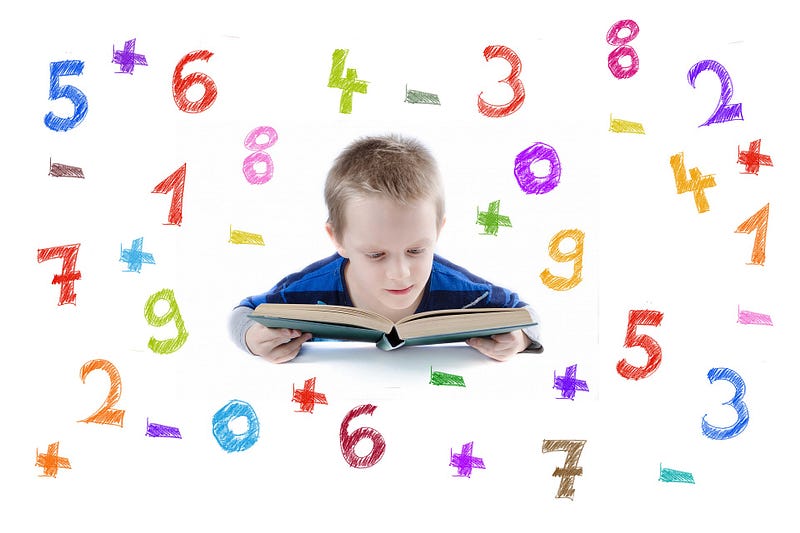
Kids say the craziest things, and crazier still, they often believe what they say.
One day, after picking up my son from kindergarten, my then five-year-old proclaimed, “I don’t like math.” I responded with a perplexed, “why?”, because I remembered kindergarten math being pretty fun, counting groups of bananas and cute puppies. He shrugged his shoulders and sighed, “I just don’t like it.”
Later that evening, my husband and I discussed the conversation and felt concerned. If our kindergartner was already making a value judgment about math, he was setting himself up for a long and difficult school journey.
We decided we better take action. Armed with my knowledge of learning theories and my spouse’s creativity, we implemented the following strategies to hopefully change my son’s mind about math.
Repeated Exposure
Learning theories emphasize the importance of exposure when mastering new concepts. The more you see something, the easier it is to remember.
With this in mind, we began writing math problems and multiplication tables on the bathroom mirror. Back in the day, we used sticky notes, but a more environmentally friendly option is a dry erase marker. Over the course of the day, while my son was brushing his teeth or washing his hands, he would see the math problem and say it out loud.
We tried to change the problem every day, switching the color of the sticky note (or using a new color marker) and placing it on different sections of the mirror. This helped to keep the information novel and engaging.
This quick five-second strategy of both seeing and saying the math problem was repeated several times a day as he used the bathroom. Through frequent exposure, he learned the information in an easy, low-stress way.
When my son’s friends would come over, they would ask about the sticky notes and my son would respond, “That’s our math game.” His friends were getting exposed to math too!
The Geometry Song
To help our son learn geometrical formulas, we encouraged him to sing them using the same tune from the song, “The Wheels on the Bus”. If you are not familiar with the music, you can listen to it here. This is our geometry song:
The area of a circle is pie r squared Pie r squared Pie r squared The area of a circle is pie r squared All day long
The circumference of a circle is 2 pie r 2 Pie r 2 Pie r The circumference of a circle is 2 pie r All the way around
The area of a triangle is ½ base height ½ base height ½ base height The area of a triangle is ½ base height All day long
This music mnemonic was so effective that our son learned all the formulas in one day, as did his two-year-old brother. When our children eventually took geometry, they easily recalled the formulas from the song we sang years earlier.
The Power of Free Choice
I made a folder for our son with age-appropriate math worksheets, most of which I found online for free.
The worksheets were kept in the den and he had access to them at all times. When he wanted spending money, in addition to regular household chores, he could choose to do math. For every question answered correctly, he earned a nickel. If a problem was incorrect, we would review it together, after which he would earn the nickel.
This idea was inspired by Leon Festinger’s 1957 theory of cognitive dissonance. In brief, this theory states that if our behavior does not align with our attitude, we experience discomfort. In order to alleviate the psychological tension, we need to change either our behavior or our attitude.
My son had already expressed a dislike for math. If he then freely chose to do the worksheets, this behavior would be inconsistent with his beliefs. Why would someone who dislikes math intentionally choose to spend time on it?
As it turns out, my son often preferred doing math problems over the other household chores. The more success he had with math, the more he sought out opportunities to do it. With every worksheet he completed, his piggy bank became heavier and his attitude about math grew more positive.
Final Thoughts
The same five-year-old who stubbornly proclaimed that he did not like math is now preparing to be a high school math teacher. He loves math so much that he wants to spend his career teaching it to others.
These early learning strategies, in addition to some amazing math teachers, helped my son develop into a gifted mathematician. Over the years, family and friends have also used these techniques and reported great results. The strategies can be adapted for most subjects — we used similar tactics for learning spelling words.
Through exposure, music mnemonics, and reinforcement, learning difficult topics is easier. If you have a child that thinks math can’t be fun, perhaps these strategies will work for you too!
Jill is a clinical psychologist, blogger, and mother of 5. She shares behavioral health tips every Sunday on her blog.