
3 Reasons Why I’m Not Worried about a Drop in Read Ratios
What is your definition of success on Medium?

Here are 3 different perspectives of what the success metric on Medium looks like:
🎈“If you are playing the content creation game, and you aren’t operating with a sense of urgency and prioritizing volume, you’re doing it wrong. “— Nicolas Cole
🎈 “The most important thing to know about Medium’s Read ratio is that it isn’t nearly as important as engagement (i.e., new followers, recommendations, comments.)” — Doug Crezensi
🎈“I’ve taken pride in a strong Read Ratio overall. It is a sign I’m connecting with my audience, regardless of how few views I have (and I mean few). And regardless of the “engagement,” be it shares, tweets, or comments, I’m on the right track.” — Jane Trombley
Which one of the above can you relate to the most?
So what is Read Ratio?
Read ratio or RR is the difference between views (number of visitors who clicked on a story’s page)& reads (number of visitors who have read the entire story).
While some such as Thomas Smith considers a good RR between 20% and 50%, Aamir Kamal considers a good RR to be between 40% — 70%. While Anthony Moore suggests a good RR is 30%.
I know many, including myself, were concerned about the drastic decline in read ratios post-pandemic. In fact, I enjoyed high read ratios, even a 100% RR on some long forms, during my first year on this platform. Can’t get any better than 100%, however, those days are long gone.
I don’t know whether it was an algorithm change or the fact that life returned to normal post-pandemic that resulted in a nose dive in my RRs.
Now it hovers in the ≈ 30% to 60% range.
Am I worried?
Initially, yes. But now, not really.
Mainly because I have managed to create a (very) small but unique brand personality as a blogger which helps drive traffic to my blogs.
Brand personality refers to how you make your readers feel about your blogs and as an extension, you. Brand personality is crucial in order to be able to stand out from the crowd as this excerpt explains: “Like all marketing, your brand personality must attract *and* repel people. Otherwise, you’re like a magnet with no charge. Nothing (and almost no one) will stick around. A personalityless brand doesn’t really know who they are or who they’re talking to.”
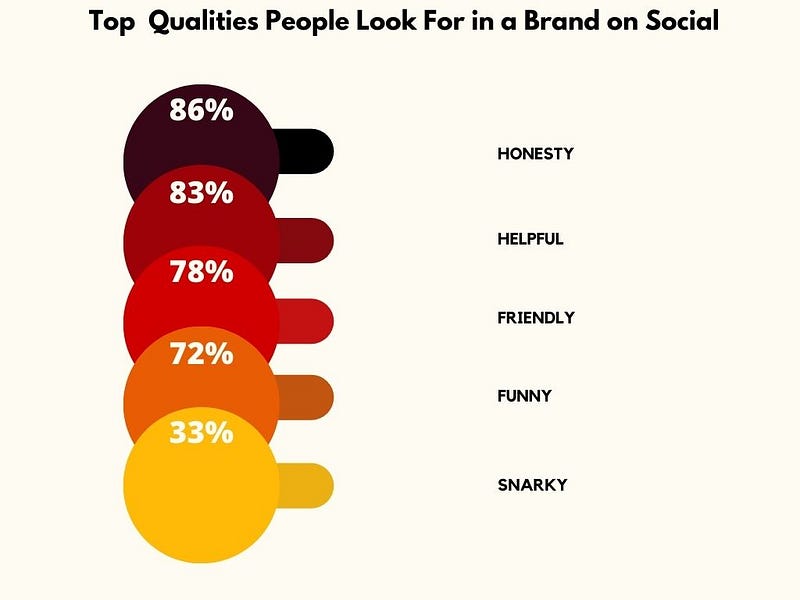
In a survey conducted by Sprout, people rated trust as the top quality they look for in a brand closely followed by friendliness and humor.
What it means is, if you are putting on a persona rather than being genuine about what you are offering, readers will be quick to spot it and might negatively impact your brand’s credibility.
3 observations and lessons learned about RR based on personal experience
❓True or false: Does engagement increase RR?
Not from what I see. But engagement certainly increases the views.
There are readers who are of the opinion that claps and comments are just vanity metrics. If claps trigger the algorithm and engagement leads to views then I’m not sure how it can be a vanity metric.
Contrary to what many may think or are realizing, getting high reader engagement on a consistent basis is no easy feat. Experts say put in a call to action at the end of your piece to attract audience engagement but what if they are not moved enough or bothered enough to respond?
Others may argue that their readers are not writers so prefer to be passive readers rather than engaging.
From my experience writing on 2 platforms, I have found that it doesn’t really matter whether your readers are writers or nonwriters for if they are sufficiently moved by your content, it is likely to elicit a response.
And when readers are actively engaging with your content, it is also likely that you will have a lively comments section where discussions are happening between the reader and author as well as among the readers. This in turn attracts more readers who are curious about the hoopla and boom, your views go up.
Lesson learned: Engagement is good for business
❓True or false?: The experts suggest that you can increase your RR by just changing its title.
I decided to run an experiment on this with one of my recent articles. Initially titled “How I Met my Look-Alike on a Dating App,” this post was struggling in the views department until I decided to zhuzh it up to this without changing the story: “Why It Was Shocking to Unexpectedly Meet My Doppelganger in Real life.”
While the RR improved only marginally, the views picked up, especially after it was shared on social media.
Lesson learned: My previous title not only did not match my content and tone but lacked the wow factor. Once I changed that, people started clicking on the post.
❓True and false?: Focusing on one niche and audience can improve RR
Maybe.
Last month, I decided to focus on one niche, relationships, specifically in the context of romantic relationships, and writing for a specific audience than just putting content out there for a general audience.
Once I narrowed down my audience, I decided I was going to pursue a fun series with the purpose of entertaining.
While I did not experience a spike in RR, my 8-part Medium crush series did decently with regard to views.
Lesson learned: Writing for a target audience rather than a general audience certainly has its benefits.
3 reasons why I’m not worried about a drop in RR
1. I see slow but steady growth with regard to new readers and subscribers in part due to writing in different niches as well as promoting my blogs across various social media platforms.
LinkedIn| Twitter| Facebook| Instagram| Mastodon| NewsBreak
2. I continue to have consistent reader engagement for both my long forms and short forms as I did when I was a newbie writer which means I’m doing something right.
3. I notice the views and the diversity of my readers increase as I continue to reach a wider audience and my articles are shared and recommended by others.
What are your thoughts about Read Ratios? Are they up or down? Do share any tips to improve them (if inspired to do so).
If you found the above post informative, then you may find this one helpful too:


