

3 Principles of Making Organisational Change Not Only Happen but Also Succeed
There are many perspectives on organisational change. One size truly does not fit all. However, many leadership teams overlook the importance of some basic principles. Through our consulting engagements, we have come across the following three key principles that seem to be the most commonly overlooked when it comes to organisational change.
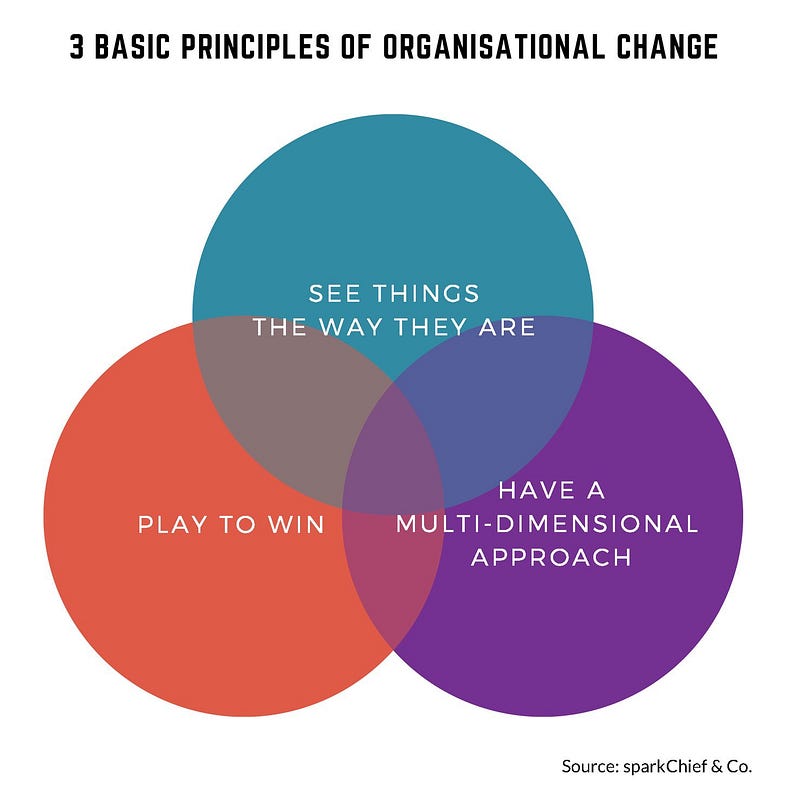
1. Having the Capacity to See Things the Way They Are
The number one reason why so many organisations fail to resolve their key organisational challenges is because they fail to identify the real challenges they face in the first place. In order to identify real challenges, you have to be able to see things the way they are — not as you think they should be — and that requires transparent management practices, courage, and true leadership. After all, it is only when we find the truth that we can truly change things. Most organisations try to tackle the wrong challenges and, regardless of tremendous efforts, lasting change never happens.
2. Having a Multi-Dimensional Approach to Change
Have you ever wondered why top-tier schools select only top-tier candidates? It is simply because they want to develop top-tier graduates with the help of top-tier educators, educational environment, and infrastructure. They envision success through a multi-dimensional perspective. Your organisation can benefit from a similar approach.
For example, if you employ the best candidates and develop them with the help of the best leaders, management practices, and operational infrastructure, you will also achieve the best outcomes. That said, there is no point of employing top-tier candidates and then exposing them to “second- or third-tier leaders” and expect to get top-tier results. The outcome will be different. And if you are not sure if your organisation has such high-quality leaders in place, maybe it is time to assess that fact before you waste valuable corporate resources to hire, develop, and retain the most qualified people to grow your business.
3. Having the Audacity to Play “to Win” and Not Play “Not to Lose”
There is a significant difference between planning to outperform and simply performing. Almost all change initiatives start with a claim to make things better than before. However, majority of these claims lack the audacity to outperform, which means that you make changes to your organisation that allows it to play “to win” and not play “not to lose.” In other words, if things were not going well before, then you have an opportunity to make things much better, not just a little bit better.
When you play “not to lose,” your main concern focuses on defending what you already have rather than on winning. When you have an opportunity to change for the better, you should consider changing potentially anything. There should be no exceptions to this rule. Anything means anything.
Consider this scenario. You are a CEO of a company in which some units of your business are not doing very well. Consequently, you are eager to change things because you want those business units to perform much better in the future. Perhaps you can resize the units to gain efficiency, deleverage some product lines to refocus on key areas, pay more attention on sales and marketing, improve operational infrastructure, invest in the latest technology, or even buy new capabilities by acquiring other businesses. However, on the other hand, if you don’t even consider reassessing the leadership team of those business units, you will not be open to change. When it comes to real change, you must consider changing anything that demands changing. Anything means anything.
Clarity, Openness, and Courage Make Things Happen
Caught up in resolving daily complex challenges in today’s highly competitive market, leadership frequently lacks the time to view the overall picture of what is needed to outperform. But introspection is vital for the long-term success of the organisation.
Top talent, aligned with the company’s mission, is a key factor. But top-tier talent alone is wasted without leadership’s ability to see the situation clearly and determine what the mission should be. Accompanying such clarity is the willingness to be open-minded and consider the situation from all angles. And finally, when recognising what is necessary, have the courage — the audacity — to go forward and make whatever good faith efforts are necessary to outperform.
When leadership follows these principles, talented employees will be more willing to come on board and work together in partnership toward mutually beneficial goals. In essence, these principles can help management achieve optimal results.