
3 Phrases Your Boss Secretly Hates
It may be obvious, but refraining from these is easier said than done.

The work-from-home economy is here to stay. Employers, employees, and tech suppliers are all on board, highlighting an accelerated shift in the way businesses operate.
Along with this comes a new set of rules to play by.
Gone are the days where you could stumble through your thoughts in-person, using facial expressions and hand gestures to pick up the slack. These no longer come through in a phone call or, even worse, get misconstrued when a lack of connectivity interrupts your Zoom feed.
In tomorrow’s work environment, the words you choose in both voice and text can have exponential effects on the way your boss perceives you.
Here is a guide to the three phases your boss secretly hates along with some minor tweaks to help you avoid using them. In turn, you will show the value that you have worked so hard to create.
“What would you like me to work on next…?”
On the surface, this phrase seems helpful. Variations of it were coached for years. However, the use of this question will elicit an unseen eye roll from your boss.
Here’s why.
Most leaders don’t want to admit this, but they don’t want to tell you what to do. Many of them have landed in their new position because they executed tasks themselves without ever being told. Therefore, they are increasingly asked to do more themselves while also taking on the role of a leader. There is no time to play the barbaric role of The Order Giver.
Instead, they would rather approve what you have already worked on and coach you through your plan of attack on the remaining tasks.
So what should you say?
It helps to give some context. Most times, you’re using this phrase to get a sense of direction. So it would help your boss to provide her with a breakdown of what you already completed along with the top tasks you plan to tackle next. Your boss can then provide feedback on both elements rather quickly. In an email, it should look something like this.
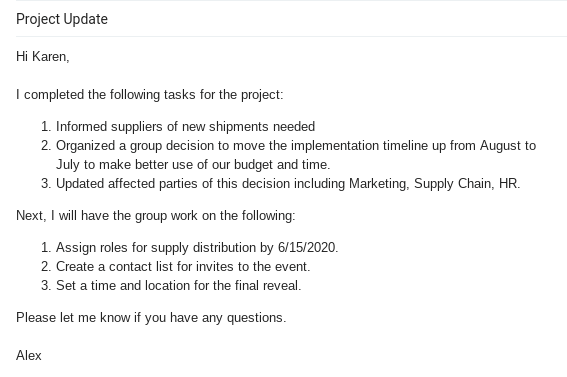
This conversation can be a bit more casual over the phone, but the same elements apply. The last thing you want to do is to come to your boss and bluntly ask, “what would you like me to do?” It gives the impression that you have been sitting on your hands this entire time, even if that is not the case. Don’t give someone a reason to think you’re not useful. Show them your value.
“I just haven’t had the time to…”
Let’s face it; we are all strapped for time, including your boss. And trust me when I say that she, too, has let things fall through the cracks due to the cruel hours that fell off the clock. Just don’t expect that to grant you any forgiveness for this excuse.
Here’s the thing, an excuse is nothing more than an improperly explained reason.
When using the phrase above, you’re right. You did not have time to accomplish a specific task. But you’re also wrong. That wasn’t the real reason you didn’t get to it. The real reason, if you’re working correctly, is that you spent your time on the tasks that you had already placed in order of importance.
There is a myriad of ways that you can prioritize your tasks or projects, but my favorite is the Eisenhower Matrix shown below:
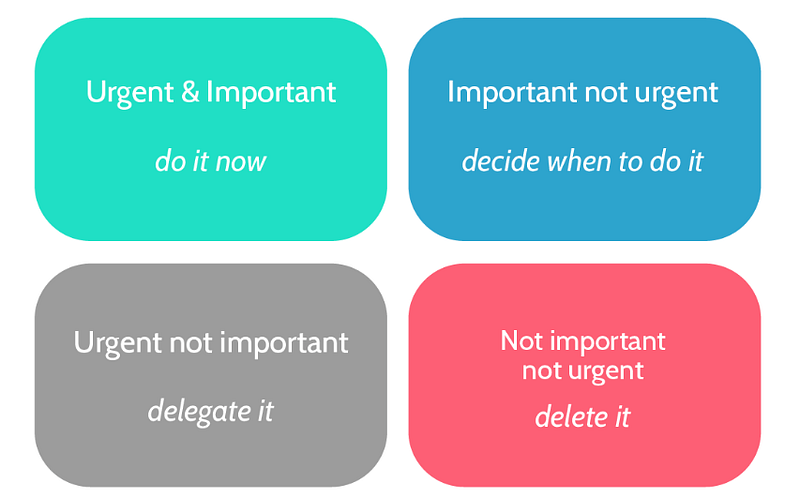
At any point in time, you should be able to hand your boss a list of items your working on, governed by this matrix. If you can’t produce this list, you will again give the perception that you have been doing nothing. We both know this is often not the case.
Your boss can coach you through your order of importance only after you have explained what you worked on and why you worked on it. If you can produce this, you’ll show her how much you accomplished while keeping the bigger picture in mind.
“I’ll let someone else take this one…”
Do you ever feel like you volunteer for everything? That’s great. It shows your boss that she can count on you.
Here’s the crummy thing. The one time you use the phrase above, it will tear down all the credibility you worked to build.
Here is how you can approach the situation if you have too much on your plate to take one more project. I call it “The show and tell” approach.
Show your boss the list of items you are currently working on and reiterate their importance. Explain the timelines for each and where you are in the process.
Tell your boss who you think would be an excellent fit for this new project and why he or she would make a significant impact. It not only shows that you have your priorities in order, but that you are also aware of certain qualities in others.
With this simple technique, you will create two lasting impressions on your boss; You not only work effectively, but you also take the time to view others and determine where they best fit. These are two highly-sought-after qualities of a future leader.
Final Thoughts
Refraining from the three phrases above is incredibly tricky. I find myself wanting to use them more and more as I struggle to make it to the end of long workdays from home. In the office, it was forgiven. I could show my disdain for my use of these phrases in person and quickly communicate what I meant to say.
It’s is no longer the case.
We all have to adapt to our new way of doing business. Words now carry more importance than ever. Use them wisely.