
3 Misunderstood Writing Fundamentals I’ll Never Stop Practicing
Simple but powerful basics for better content

We are often so focused on the "bigger picture" that we forget to focus on the little things. I am here to remind you of three misunderstood writing fundamentals.
Fundamentals that I practice every single day.
They save me on days when writing is a chore burdened by obligation. They save me on days when writing feels as nebulous as chasing a half-forgotten dream.
Here are those three fundamentals.
The Underappreciated Practice of Defining Things
One of my core beliefs is that you don't really understand a subject until you can simplify it. It took me nearly three decades to unravel a definition for a story.
Once I understood and integrated the definition, my writing improved by 100% almost overnight.
The same is true for my definition of writing.
What is writing? After much thought and soul-searching, here is my definition:
Writing is the choice and arrangement of symbols.
My early draft of this definition sounded similar: "Writing is the choice and arrangement of words."
But then I realized that writing is more than words. It also includes punctuation, numbers, and sometimes visual images. My first definition simply didn't provide a comprehensive and satisfactory mental map of writing.
A few weeks later, it hit me—words, letters, punctuation, and images are all symbols.
Hence, my definition of writing.
Why does this matter?
Defining a concept makes it concrete. You can suddenly hold it in your hands, turn it over, and examine it from various angles. You can iterate and improve the concept, which is a lot like playing with a ball of clay until you've molded something that feels right.
“All I need is a sheet of paper and something to write with, and then I can turn the world upside down.” — Friedrich Nietzsche
Most people don't know how to define writing because they never tried.
Their definition became one of those thin things we're told when we're young. That’s a definition by default. That’s a definition that doesn't impact what you actually put on the page.
Therefore, the first writing fundamental is the mental practice of defining symbols.
To refine what you do, you must first define it.
How Do You Practice Defining Things?
You can start with anything—the definition of your story and its various elements, the meaning of a word, or just the meaning of writing itself.
Then you:
- Take the concept apart element by element
- Strip the concept of everything but its most basic core meaning(s)
- Brainstorm new, comprehensive explanations
- Shorten those explanations to a single sentence
- Test out the explanation to find any holes in the meaning (is it missing anything?)
- Apply the definition to see if it helps you take practical and significant action
The simple but powerful beauty of this exercise is that it helps you see the essence of things. It's like finding several different color crayons in a box full of black and white.
This fundamental is a chance to break out of a mental rut, which is always a good thing when writing.
The Choice of Symbols
If writing is a choice of symbols, then there is power and magic in the choosing.
The words, punctuation and other symbols you select either imbue your writing with precision and power or they drain your words dry.
Make no mistake, what you choose matters immensely.
“The difference between the almost right word and the right word is really a large matter. ’Tis the difference between the lightning bug and the lightning.”―Mark Twain
Boring writing is, at its core, boring word choice.
Nearly any topic is fascinating when gilded with interesting words. For example, you could say, "I planted potatoes in my garden," which is boring. Or, you could make the same experience more engaging by describing it this way:
I carved a hole in my garden with a shovel, dug up some dirt, dropped potatoes into the dark pocket of the earth, and gave each tuber a quarter turn to make sure it would grow.
Inspired word choice saves your writing from the mundane.
Some symbols deserve more than just consideration—they require special attention and nurturing.
How Do You Practice Choosing Symbols?
You practice symbol selection by playing around with different symbols.
You drop different words into a sentence. Essentially, you see how those different words and punctuation feel in a sentence, paragraph, and larger piece of writing.
For example, you can write a sentence in three different ways:
- Charlie looked at the stranger at the bar.
- Charlie eyed the stranger at the bar.
- Charlie glared at the stranger at the bar.
The first sentence is neutral, the second sentence uses a stronger verb to create a feeling of wariness, and the third sentence uses the weighty connotation of "glaring" to create a palpable sense of restrained violence.
Thesuaurus.com offers a free and automatic way to generate multiple sentences with various words.
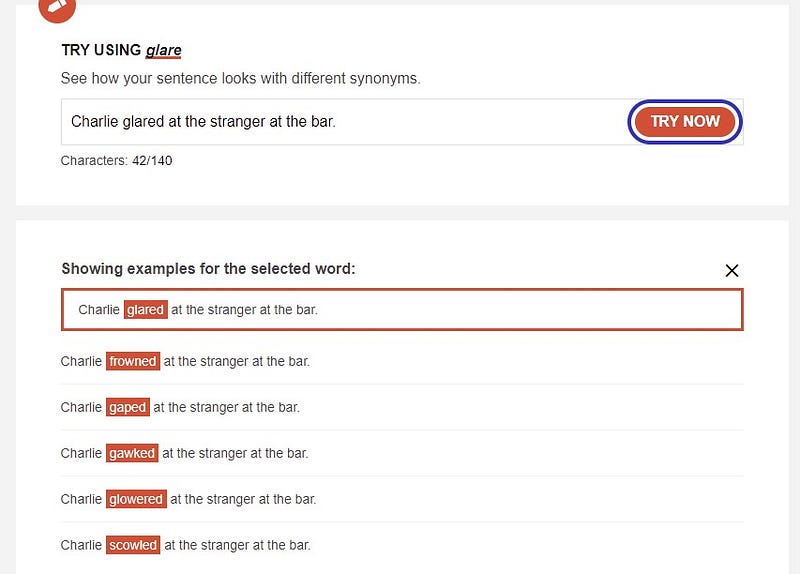
However, I recommend that you practice this fundamental skill "manually" with only your mind and a blank screen.
The Structure of Language
The third fundamental writing skill focuses on the "arrangement" of symbols.
Since it's been a few hundred words since you've read the definition of writing, here it is again: "Writing is the choice and arrangement of symbols."
When you write, you not only select the right words, but you also arrange those words (and other symbols).
The arrangement is the order, organization, and combination of symbols.
You figure out:
- Where does this symbol go in this sentence?
- Which symbol goes first, second, and third?
- How do the symbols merge into a cohesive meaning?
Arranging symbols incorporates both word combinations and sentence structure. What words do you put together? How do you introduce those words?
As a simple example, you could write one of the two following sentences:
- The killer turned out to be John, the man they all loved and trusted.
- John, the man they all loved and trusted, turned out to be the killer.
The first sentence has a chronological order ( killer → John ), while the second sentence has a somewhat inverted order ( John → killer ).
Which sentence sounds better?
The answer is subjective, but many people prefer the inverted order because it creates added suspense and tension. The big "reveal" is placed at the end of the sentence, where words usually pack a bigger punch.
Of course, if you always put the most important word at the end of a sentence, your writing becomes pedantic and predictable. Arranging symbols is connecting ideas through variations of sentence style, length, and structure.
Takeaways
Here is a summary of takeaways from this article:
- The three fundamental writing skills are defining symbols, selecting symbols, and arranging symbols.
- Defining symbols is how we make meaning. It sharpens the mind and empowers the translation of insubstantial ideas into concrete words.
- Symbol selection is the choice of words, punctuation, and images (or other sensory elements).
- Symbol arrangement is the order, organization, and combination of symbols. It also involves the cohesive meaning of symbols.
Practicing these fundamentals will help you to improve your writing craft. Practicing them repeatedly over years will help you master it.
Final Thoughts
To go completely meta, the act of defining something requires you to select, arrange, and compress meaning into symbols.
Thanks for reading!
Read this next: How I Make $1,500 a Week Writing About Hard Topics
If you want to support my writing, become a Medium member. If you do, I will get a small commission. Thanks!


