
3 Minute Pitch — Ladytron’s ‘Light & Magic’
The electro album of 2002, or the first of a New Wave of New Romanticism?

My motivation to write about specific albums has two typical objectives:
- I get a deeper appreciation of said recording through this process. The deeper the appreciation, the greater the rush.
- If someone is wrapped up enough in an album to sit down and write about it, there may be something in it for me. If I connect with their ideas, it may allow me to see a record in a certain light, one in which I gain from the listening experience. This is my effort to contrive such an outcome. In other words, records that have inspired me over the years, may have the same effect on you.
Here we go. The 3 minute pitch for Ladytron’s Light & Magic.
They only want you when your “Seventeen”, when you’re Twenty One, you’re no fun
I stumbled across a Youtube documentary recently that traced the New Romantic sound of the earliest 80s to a single origin — “Fade To Grey” by Visage. Not only is it a song that is equally stirring as it is mournful, it is an acceptable hypothesis when tracing the Ladytron inception story. This isn’t to suggest Ladytron’s objective for 2001 was to lead the New Wave of New Romanticism; rather that the elements that generally comprise their musical scaffold can be overlaid onto this template.
The band’s name was lifted from Roxy Music’s 1972 debut. A source rather than an overt musical parallel.
The most obvious, big bang theory can be traced be Kraftwerk. “The Model” as good a reference as any. In the spirit of too much information, I saw Kraftwerk perform at the January 2003 Big Day Out here in Australia. A force, despite their stylised, staid facade. The mechanics of a Ladytron performance reinforcing this notion — synonymous with the characteristic of performing electronic music where the generation of sound mandates the performer be proximate to the device. Their aesthetic, uniform in a manner that Gary Numan would have endorsed; one that their Deutsch contemporaries equally renowned for.
2002 Light & Magic.
I’m one of those people who’ll tell you that I like lots of different kinds of music. Maybe it’s true. Ladytron is a suitable example of something that I wouldn’t have typically reached for at that time. I saw the clip for “Seventeen”, late one night on the feted Australian music show Rage. Must’ve been 2002. The clip was unremarkable, but that song! Immediately hooked and obsessed till this day — as long as I pretend their story concluded in 2008 and the release of Velocifero was the resolution to their perfect discography. The curse of making faultless records is that when an artist delivers something comparatively less exhilarating, that even where it exceeds the mean for good, it’s impossible to deny the feeling that it doesn’t compare. Everyone has their limits.
Ladytron — what is it?
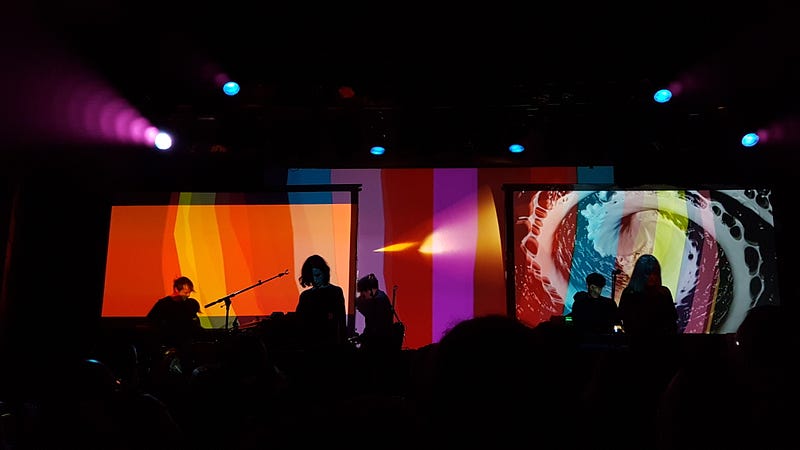
The media gave Ladytron labels like electro-pop, experimental, electroclash, and these categorisations offer enough of an indication of the musical environment in which the UK troupe did their fieldwork.
Lyrically quirky, these are personal, yet abstracted sentiments delivered, often in tandem by vocalists Helen Marnie and Bulgarian born Mira Aroyo, who lends her native tongue to selected tracks also. Not alien to Kraftwerk’s account of “The Model” but again, intended to be analogous rather than if you like X, you’ll appreciate Y. It has an urban sort of grit, something you’d find on the first couple of Specials LPs, but more notional, less vivid in the experiential sense and arguably by design. It’d be erroneous to suggest the approach wasn’t calculated or incomplete. It’s compatible with the texture and expression of the arrangements. The nature of their musical construction.
How does Ladytron sound?
The songs have an incredible flow. I don’t necessarily mean from one track to the next, but there’s a stunning fluidity to these arrangements where the listener feels this perpetual force. It’s a characteristic prominent across their first four albums.
Melodies are dropped into calculated sections of the arrangements, explicitly electronic, chattery, and boosted — punctuating sections of the song. If poorly executed, they’d be distracting, but the injection of these contrasting passages serve to elevate. Unexpected, yet welcomed. Vocals are often ethereal, chorus-ed, and positioned at various points on the emotional continuum. Always fitting.
Not everyone was sold on their second album.
Reviews from 2002 positioned Light & Magic as a retrospective future-songs that intentionally go nowhere. Ladytron were a band to dislike. They ruffled feathers of tastemakers who saw themselves as arbiters of style and substance. And as is generally the case, these people don’t speak for the fans, for the zealots. Devoid of those self appointed adjudicators, a music fan can experience and interpret the artist as their emotional current dictates. That Ladytron went on to increased success is indicative that they had more to offer than selected opinions could conceive.
Light & Magic is as bewitching now as I’ve ever found it to be. Maybe the 20 years later reflections might also reveal a different perspective.
I’d love to hear your impressions. Please comment below.