
3 Life Lessons Of The Man Who Shamelessly Cloned Warren Buffett
How to succeed in life by copying other people’s ideas
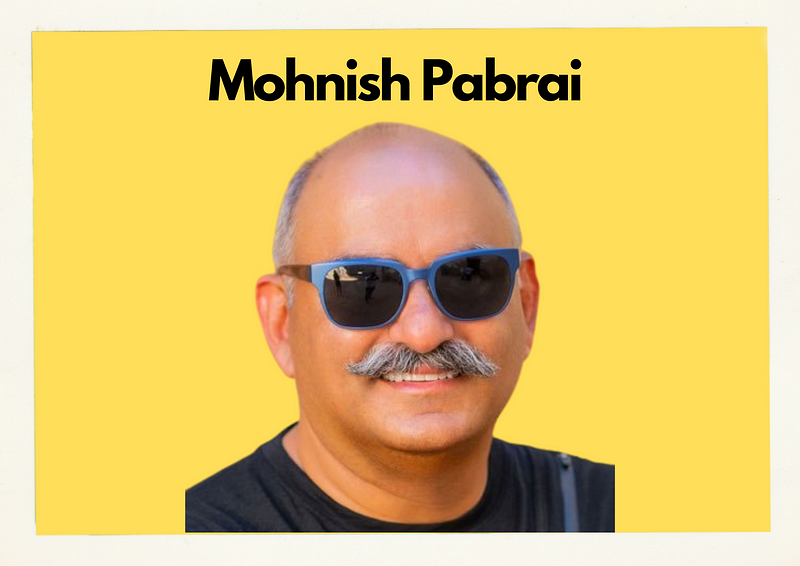
In the world of investing, everyone knows Warren Buffett is the GOAT.
But there’s another that Buffett reveres with praise and is one of the greatest investors of his generation — Mohnish Pabrai.
Born in 1964, Mohnish spent the first ten years of his life in Mumbai (formerly called Bombay). He later moved to New Delhi and Dubai. He arrived in the US as a penniless student in the 1980s to study computer engineering at Clemson University in South Carolina.
After college, Pabrai worked at Tellabs. He then went on to build an IT consulting service business called Transtech, which he bankrolled with $70,000 in credit card debt and $30,000 from his 401k.
Transtech thrived. Pabrai managed to grow revenue up to $20 million, and he ended up selling the company for $6million.
Later that year, while waiting around at Heathrow airport, he purchased One Up On Wall Street by Peter Lynch. It was in this book he first read about Warren Buffett. He was impressed to learn that Buffett managed to rack up investment returns of 31% annually over forty-four years.
Pabrai concluded: Buffett was not a dumbass and had mastered the game of investing.
This got Pabrai thinking — could he figure out how Buffett picked his stocks and mimic the strategy?
Armed with the war chest he received for selling his company, Pabrai set aside $1million to try and turn it into $1 billion.
In Richer, Wiser, Happier, Pabrai tells William Green:
“The driver for me is not to get wealthy. The driver is to win the game. It’s exactly the same for Warren, which is to show through the results that I did the best and I am the best because I played the game by the rules, fair and square, and I won.”
Pabrai’s approach is an important lesson for us all, not just in investing but in life too:
Identify the most skilful player of a game, analyse why they were so successful and then copy their approach.
Pabrai calls this process cloning.
By cloning Buffett and later Charlie Munger, Pabrai became one of the best investors of our time.
From 2000 to 2018, Pabrai’s fund returned 1204% compared to the 159% of the S&P500.
If you had invested $100,000 with Pabrai in 2000, it would have grown to $1,826,400 by 2018.
Pabrai is a relentless cloner, and here are the ideas worth cloning that he uses to succeed in life and investing.
1. Shamelessly Clone
When Pabrai first discovered Warren Buffett, he devoured all the available resources on Buffett. This included Berkshire Hathaway’s annual letters and books such as Buffett: The Making of an American Capitalist by Roger Lowenstein.
The more he read, the more he became convinced that Buffett and Munger had laid out a proven principle of investing.
Buffett’s style of investing was so simple and powerful. But when Pabrai studied other money managers, he was perplexed to find the others didn’t follow Buffett and Munger’s principles.
To Pabrai, it was like “meeting an entire set of physicists who don’t believe in gravity… whether you believe in gravity or not, it’s gonna pull you down.”
He goes on to say, “Humans have something weird in their DNA which prohibits them from adopting good ideas easily… When you see someone doing something smart, force yourself to adopt it.”
Pabrai’s unfair advantage is that he doesn’t care what you think about him. He cares about what works.
And openly admits everything in his life he’s cloned from other people and has no original ideas.
He believes to be a great cloner, you have to leave your ego at the door.
2. Be In Alignment With Who You Are
In July 2007, Pabrai had the opportunity to meet Warren Buffett.
Along with his best friend and fellow investor, Guy Spier, entered a charity auction to bid for a lunch with Buffett.
They placed a bid for $650,100 and won the auction.
On 25th June 2008, Pabrai and Spier were finally going to meet their guru.
They had lunch at the Manhattan Steak House, Smith & Wollensky.
The conversation ranged from Buffett’s favourite company to the person he’d like to meet most.
Pabrai walked away with two unforgettable lessons. The first is about how to invest and the second on how to live.
The first question came when Pabrai asked Buffett, “Whatever happened to Rick Guerin?”
Rick Guerin came from the same school of investing as Buffett and Munger. He had a superb investment record, but his downfall came when he used margin loans to leverage his investments because he wanted to get rich quick.
Guerin was margin called, causing him to suffer disastrous losses.
Buffett and Munger were never in a hurry to get rich quickly because they knew they would be enormously wealthy if they avoided catastrophic mistakes and continued compounding over many decades.
But what resonated the most for Pabrai was how true Buffett was to himself. Buffett was a man who lived in alignment with his personality and principles.
Over the dinner, Buffett said how he and Munger always measured themselves by their inner scorecard.
Instead of caring about what others thought of them, they focused on living up to their own standards.
“Would I rather be the worst lover in the world and be known publicly as the best, or the best lover in the world and be known publicly as the worst?” — Warren Buffett
We spend so much time caring about what the world thinks of us.
Fuck what the world thinks.
3. Take A Simple Idea and Take It Seriously
We are seduced by the complexity whilst underestimating the importance of simple ideas.
Pabrai doesn’t fall into this trap.
He believes that when you take a handful of simple ideas and obsessively apply them, the cumulative effects make you unbeatable.
Compounding is a simple idea.
Cloning is a simple idea.
Telling the truth is a simple idea.
Measuring yourself against your inner scorecard is a simple idea.
The trouble in the modern age is people commit half-heartedly to simple ideas. We discover a powerful principle, trial it out and then forget about it.
For us to succeed, we have to take the simple ideas and stay 100% committed to them.
Despite his success, Pabrai is humble enough to know that all of his smart ideas have been shamelessly borrowed from others.
Originality is overrated.