3 Libraries, 3 Stories
Old, electronic, and legally encumbered
Ellie Jacobson asked us to “Share a specific memory that took place in a library.” Since I couldn’t choose, I’m sharing three.
4th-grade book report
My local library growing up was a beautiful edifice of learning. It was covered in Vermont white marble, with sweeping marble steps leading up to the grand wooden doors. It is considered one of the best examples of the Italian Renaissance architecture in the US.
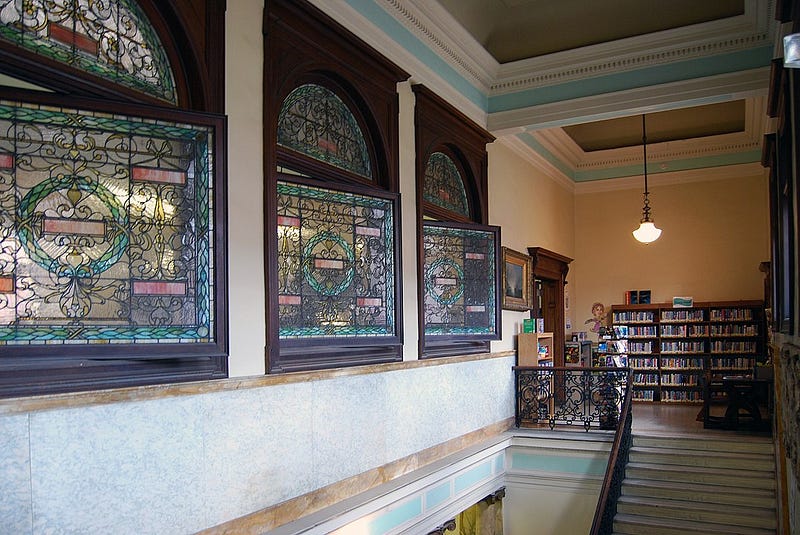
In keeping with the Italian theme, the upstairs featured a large Tiffany stained glassed panel depicting the Venetian scholar and printer, Aldus Manutius. There was also a series of decorative stained glass windows over the stairs. I’m not sure if they were always interior windows, or if at some time since it was built in 1897, the library expanded into the building next door.
The children’s room was on the first floor, containing those books that the library expected to be torn and/or chewed on by small children who didn’t know any better. I vividly recall the day I exchanged my blue children’s library card for the white general library card that gave me access to all the books. I had been judged worthy of honoring and protecting the knowledge contained on those shelves.
I thought our library contained books about everything. It certainly seemed that way in the 60s and 70s. The library managed to keep abreast of most modern innovations, with books covering the latest social, political, and technological changes. Some of the books, however, must have been donated to the library when it was originally built in 1897.
In 4th grade, I was asked to write a report on the United States Constitution. Not satisfied with the information in our American History textbook, I went to the library to see what else I could uncover about the topic.
I eagerly checked out a book with the promising title “The United States Constitution.” Then I saw the subtitle. “Will it last longer than the Articles of Confederacy?”
The book had been written in 1789.
I was hoping for something a little more modern than that.
Live at the Library of Congress
It doesn’t get much more modern than electronic books. When they first came out, they posed a real conundrum to librarians. Books could be read hundreds of years after they were written. But e-books required computers capable of interpreting their digital files. What was the best way to store them? How could patrons check them out without risk of illegal copies being made?
I’d just written a book that won the EPPIE award for best science fiction novel of the year that was published electronically. I was also the editor of the Science Fiction Romance newsletter.
As a result, I was invited to speak about science fiction romance at the Library of Congress, in Washington, DC. At the end of the question and answer period, before they took me and my agent out to dinner, the woman who had invited me to speak thanked me for coming.
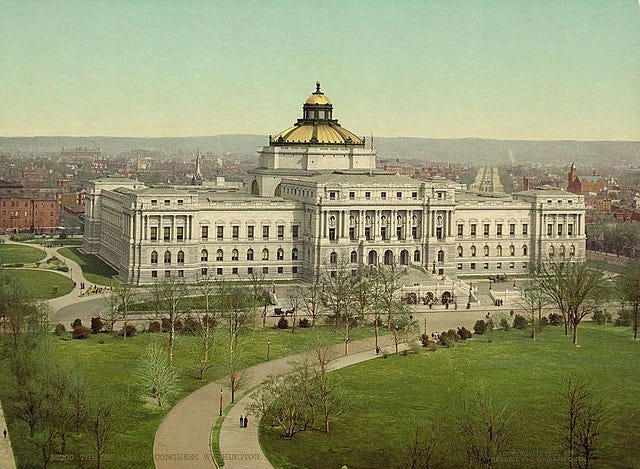
She also dropped a bombshell on me. The library was using my book as a test subject for how to catalog electronic books! My novel was going to be the first electronic book in the Library of Congress!
They later determined that their mission of storing important books in archival format was not conducive to the ever-changing e-book formats. If an e-book was considered important enough to archive, they would use one of the two paper copies that were submitted to the copyright office. (In the 20 years since, they’ve changed their policy.)
Sadly, my novel was not considered important enough to archive. So while it was the first book to go through the e-book cataloging process, it wasn’t the first e-book the Library of Congress kept.
Anything for money
The final library story comes midway between 4th grade and speaking at the Library of Congress. I was touring college campuses, and I was fascinated by the inside information the guides shared about their libraries.
Harvard’s Harry Elkins Widener Library was named after a Harvard graduate who loved books. He searched out rare and unusual books throughout Europe. And, upon finding one particularly excellent volume, he was so excited that he cut short his trip and booked the fastest ship back to America.
Unfortunately, that ship was the Titanic.
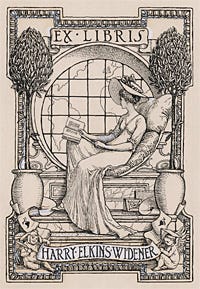
The way the guide related the story to me, the library was founded from a gift by his mother, and initially stocked with her son’s prodigious book collection, as well as Harvard’s existing library books. She had two stipulations to her gift, however.
First, she believed that her son would still be alive if Harvard had taught him how to swim. Therefore, to get the money, Harvard students had to pass a swimming test before they could graduate. (This is apparently an urban legend. While Harvard did start teaching swimming classes in the 20s, they were never required, and were not connected to the library gift.)
Second, she didn’t want to pay good money to get an ugly building. Instead of simply giving them the funds to build the library, she orchestrated the building herself, meeting with the architects and overseeing the project directly. Therefore, if Harvard ever did anything to change the outside appearance of the library, they would lose the library, and it would revert back to her.
As a result, when Harvard wanted to connect the library to the newer Houghton Library, they built the bridge to connect through one of the Widener Library windows. (The bridge was later demolished in 2004, well after my college tour.)
That may have been a mix of fanciful falsehoods and truth, but it was certainly entertaining! It just wasn’t enough to make me want to attend Harvard.
Read all of my best writing stories here. Medium offers amazing content from thousands of unique authors with wildly divergent outlooks and world views, who are funny, scholarly, and everything in between, for only $5/month. Subscribe via my referral link and I’ll get a small commission, at no additional cost to you.
Thanks Adrienne Beaumont for the invite to respond.