
3 Key Things Seaspiracy Gets Wrong
The facts the Netflix documentary ignored
Full disclaimer that I’m a veterinarian with a degree in marine biology and although I don’t eat fish, I have absolutely nothing against people who do. Now that I got that out of the way, let’s talk about Seaspiracy.
I was curious about the documentary since the topics interest me deeply. It talks about a lot of important issues, but it tries to talk about so many different topics for only 90 minutes. It gives you no context for the facts it throws in your way. Mostly, it tries to oversimplify issues that are far too complex.
What I liked about Seaspiracy
Here are some really important facts Seaspiracy talks about:
- Fishing removes 3.7 trillion fish from the ocean a year. If we continue at this rate, Sylvia Earle says there will be no fish by 2048;
- Plastic is everywhere in the ocean, it’s killing marine animals, and about 46% of that plastic comes from fishing nets;
- About 50 million sharks are killed every year because of bycatch and for their fins to be used for food consumption. This is mostly a problem in Asia;
- Japan is still killing whales. And dolphins. This is happening despite international pressure for both to stop and despite «The cove» documentary (from 2009);
- Bycatch is a huge problem for dolphins, and sea turtles. The tuna industry is one of the most responsible for this because they use longlines (although there’s no mention in the documentary of different types of fishing which is a huge fault of the documentary);
- Slavery exists in shrimp and prawn fishing boats in Thailand.
I appreciate the documentary talking about these important issues. Some scenes, such as whale hunting in the Faroe Islands are truly heartbreaking. I think some of these issues needed a lot more context and time to be addressed rather than a few minutes or even just seconds.
What I didn’t like about Seaspiracy
1. It doesn’t address privilege
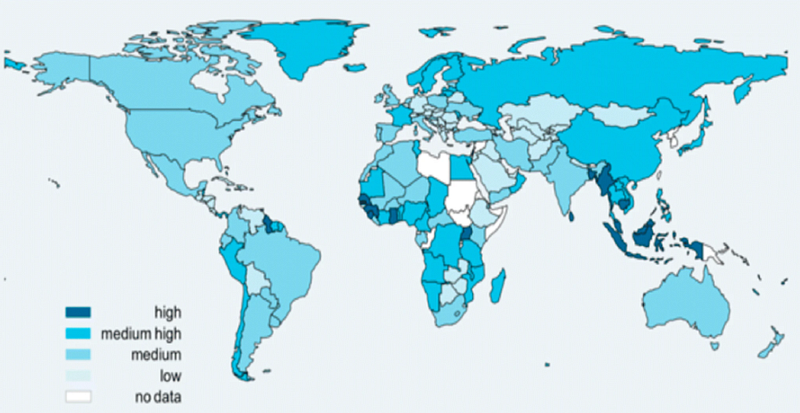
Fishing is an important means of survival for about 120 million people around the world. In Africa, about 35 million people depend wholly or partly on fishing to survive. I understand that the target of the documentary is people who can probably not eat fish and still have access to other protein sources, but that’s not true for everyone. About 3 billion people rely on fish as a primary source of protein.
In the map below you can see that the countries depending mostly on fish are African countries and Southeast Asia.
2. It doesn’t address scale
Most of the problems addressed come from companies making millions. What about small and medium-scale fishing? There’s no mention of that.
There’s a moment in the documentary where a huge boat is fishing in the African coast and a fisherman is on a small boat next to it asking for food. I hoped the documentary would dive further into this subject but no, just like with every other thing, it moved right along to talk about a different topic.
3. It doesn’t address local vs. global
The more I learn about conservation the more I realize that global policies are fundamental to get certain things done but the only way to achieve sustainability is to address problems at a local level. I’ll give you a few examples of what I’m talking about:
- At the islands of Saint Thomas and Prince in west Africa, there was an issue with fishermen killing sea turtles for meat consumption. There was interest from biologists in monitoring the sea turtles, protecting their nests, collecting data, and relocating eggs from risk areas to incubation centers. Therefore, a project was started where fishermen were trained to start monitoring sea turtles. Instead of making money from the sea turtles, they started monitoring them and making touristic activities like sea turtle watching.
- In Portugal, there was a need to protect marine prairies at Sado. A project was started called “Guardians of the sea” where the women fishermen were trained to become monitors for the marine prairies and educators. This also helped solve an unemployment issue within the fishing community because of a lack of fish.
Seaspiracy moves a lot around the lack of a concept for what sustainability actually is. I think it is evaluating a problem and coming up with a solution that benefits everyone involved, including the fishermen. It’s collaborative work where fishermen teach environmentalists what they know and the other way around.
Ultimately, I think Seaspiracy is a valid documentary that aims to start a conversation about a lot of important issues. I won’t claim I have solutions to shark finning, whale hunting, dolphin killing, or slavery in the shrimp industries. All of these issues are heartbreaking and, quite frankly, should have been solved by now.
However, as it concerns fishing I don’t think the way forward is to demonize the fishing industry. I think we need to support small and medium-scale fishing, get fishermen on our side, and find the most sustainable solutions for each particular community. Sometimes, that means re-training fishermen to become wildlife protectors. And honestly, it’s absolutely incredible that such projects exist.
In short, if you’re concerned about the issues in Seaspiracy here’s what you can do:
- If you eat fish, buy it locally (on the local market preferably);
- Join a local organization (that does beach cleaning, for example, or volunteer at a local rescue center for marine animals or wildlife in general);
- Decrease plastic consumption (I’ve become the annoying person that writes emails to supermarkets letting them know that putting individual teabags in plastic is unnecessary). It’s hard to get rid of plastic entirely but try to avoid it as much as you can.