
3 Key Steps You Can’t Miss to Make Your Meetings Productive
A simple and practical Framework for meetings: The OFQ Framework created by Ro Fernandez
— “That meeting was a waste of time!”
You probably had the same thought a few times this week already, and probably you were not the only one who left the meeting feeling that way. Meetings are extremely important and, when used properly, can propel your team and your work. But the majority of the time, we are scheduling meetings that are unnecessary, and secondly, we haven’t mastered the skills to be good at leading meetings.
You are probably excellent at leading conversations or even meetings where you share a PowerPoint presentation and share information, but what about the meetings that are actually collaborative and are meant to gather insights from all stakeholders and team members? How do you lead those?
It’s interesting that most of us are good at leading informative meetings — the typical ones where you are the main speaker and share your screen — when those were categorized by companies as unnecessary and recommended employees to turn those into emails or asynchronous sessions.
So, if those meetings are the ones that should be turned into asynchronous communication or just into emails, how can you lead better and more productive meetings and help your team do the same?
The basis of productive meetings is simple. In fact, there are just 3 things you have to remember!
(O)bjective
(F)eelings
(Q)uestions
All meetings need to clearly define the objective of the meeting. What are you trying to achieve with the meeting? Secondly, during all meetings, you will have to be able to read the room and get a sense of how people are feeling about the discussion. Are they concerned? Do they think you are moving in the right direction? Are they burnt out or feeling stressed out? And third, the person leading the meeting needs to ask at least 3 questions to encourage all participants to share their input and for the leader to evaluate their own assumptions. The objective is never to be right, but quite the opposite — to spark something in participants’ minds so you find the gaps, risks, and in a way, prove yourself “wrong” to avoid mistakes and mitigate risks early on.
This was created as a framework by Ro Fernandez, our CEO. The OFQ framework is a simple structure designed to ensure all team members can remember the three things they have to prepare before a meeting. Giving teams an easy framework that will improve the way they lead meetings and the results from them. This framework was created specifically for discussions, also known as opinion meetings. Meetings in which team and stakeholders meet with the purpose to share their knowledge, discuss ideas and alternatives, gather input from stakeholders, and in a way to share their opinions and perspectives. It can also be applied to informative meetings, but in that case, the number of questions can be reduced to one. It can also be used for decision meetings (meetings in which you meet to make a decision), but then it will have to include a Decision phase in which the person leading the meeting, in this case, if that is you, will have to ask people to try to summarize the discussion and get to make a decision.
Let’s go over the details of the framework:
1 — Define the Meeting’s (O)bjectives.
Start by defining the meeting’s objectives. Specify when you need to make a decision or when feedback is needed, and explain how these decisions impact participants and the relevant project or initiative.
The meeting’s objective typically looks like this:
“The objective of this meeting or session is to: ___________”
- review this design/initiative/concept
- discuss this proposal/idea/concept
- brainstorm about [what] and create a backlog of ideas for [what purpose]
- share an update with you on [what] to achieve [what purpose]
- review the finalized version of [what] and get this approved by [whom?]
- or — “At the end of the meeting, we will have/know/do ___________.”
2 — (F)eeling.
Read the room. Evaluate how people feel about the topic or objective to better adapt the work and to ensure fears, concerns, etc., can be addressed in the future.
A few questions that can be asked are:
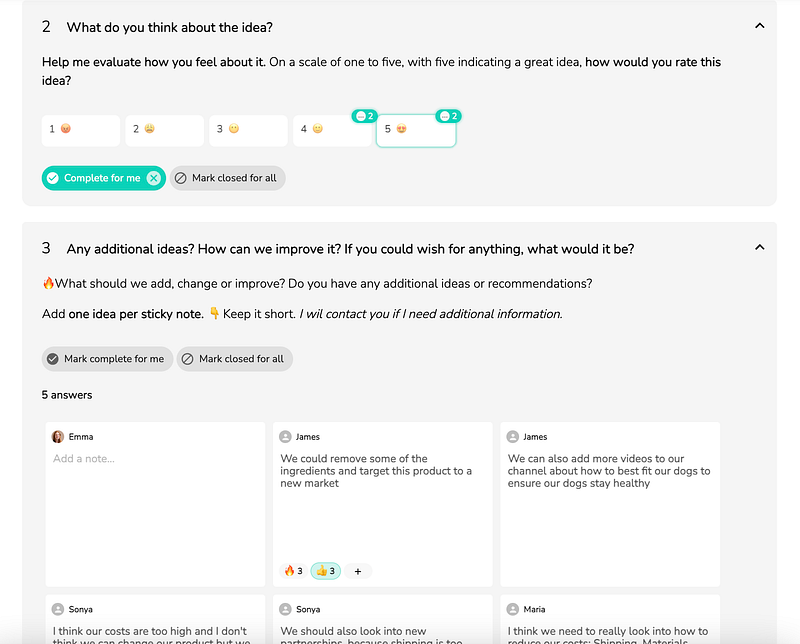
- How do you feel about this [topic, design…]? From one to 5, and five being really excited or in support of this [topic/idea/design..], how would you rate this?
- How do you feel about this [topic, design…]?Help me understand what the common perception and feeling about it are so I can address concerns or continue in the same direction if everyone feels excited about it.
- How is everyone’s energy?
3 — Ask Specific (Q)uestions During Meetings.
Avoid asking vague questions like “Any comments or questions?” Discover the art of asking the right questions to tap into everyone’s knowledge and reduce the need for additional meetings.
We recommend to encourage your team to proactively facilitate their meetings by asking questions that ensure all participants provide relevant input (after all, why are they there?). The goal is to obtain enough input during the meeting to make informed decisions without the need for additional meetings or follow-ups.
Here are a few examples:
- How can we improve it? If you could wish for anything, what would it be? Use the framework: “I wish …”. Please add your wishes on sticky notes.
- Are there any things we should avoid, and why?
- Keeping our constraints and requirements in mind [a], [b], and [c], what would you add or remove from this initial idea?
- Are there any risks or considerations? Are there specific limitations or constraints to keep in mind during the review?
- While considering [specific use case] and prioritizing [specific feature/design/project] in this [design/proposal/etc], have we taken into account extreme or unique use cases that our [product/business] often encounters?
- How useful and important do you consider this [proposal, idea, ..]?
- What conditions must be met, and what resources will we need to succeed?
- What is convenient or how can we leverage existing resources to make this more efficient? Are there any untapped opportunities within this [strategy, proposal, ..]?
Here is a quick video.
If there are other meeting facilitation skills that you want to improve, our team has created a course that is now free and available on our YouTube channel or on our website. This course includes not only tools like this one but also walks you through some practical ways in which you can better lead meetings and even help your organization improve its meeting culture. You can access it here.
Additionally, you can join Nova and get access to all the templates for free and even learn about asynchronous meetings and how to lead those effectively.
If this is a topic that is interesting, we invite you to follow us, as we are continuously sharing tips on how to increase productivity, lead better meetings, and collaborate effectively.
All our resources are free, and our mission is to create practical resources and content so you can instantly use the knowledge and apply it.
If you have any questions about this framework or any of the tools we have shared or even want to learn more about how to implement Nova, feel free to contact our team.
We are here to help!


