
3 Important Things to Prioritize When Strength Training For Hypertrophy
Do These Things and Grow Bigger Muscles
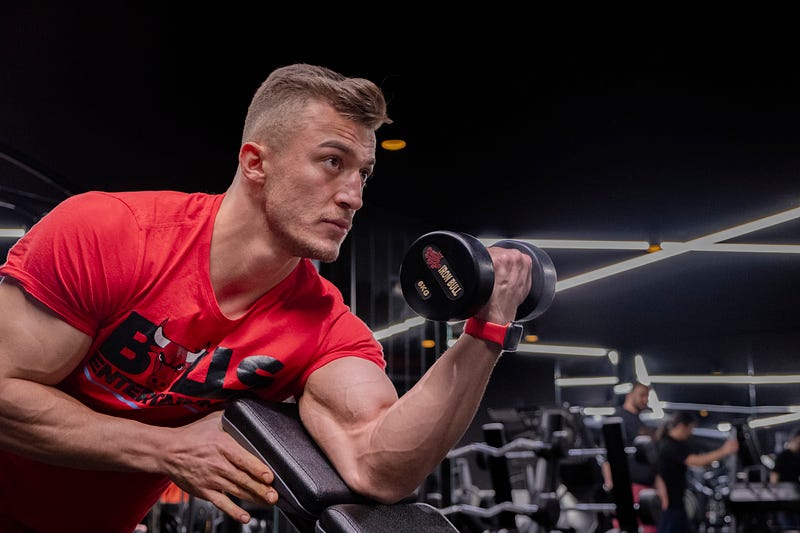
Hypertrophy (increase in muscle size) is a common goal for gym-goers. People lift weights with the intention of building big biceps, pecs, and quads.
There are literally thousands (if not tens of thousands) of articles, social media posts, and other forms of content that provide individuals the information they need to experience hypertrophy in the gym.
So why another article on the topic?
Because so much of that other content is overcomplicated, outdated, or flat out incorrect. Building muscle isn’t necessarily easy, but the concepts are simple. When lifting weights for building bigger muscles, doing crazy exercise variations, taking the strongest preworkouts and supplements, and spending hours in the gym aren’t necessary. What’s necessary is consistently implementing the most basic training principles each day you step foot in the gym.
Below, I discuss the three most important training principles you need to include in order to get bigger muscles in the gym.
Principle #1: Compound Exercises
Squats, deadlifts, presses/pushes, pulls, lunges, carries. These movements should make up the bulk of your training.
The hallmarks of every effective hypertrophy program are the big compound lifts. There really doesn’t need to be much variety. In fact, there probably shouldn’t be.
Prioritize heavy compound lifts, master the technique, then perform them over and over and over again.
Lower body exercises including squats, deadlifts, lunges, and split-squats should take up most of your training program. Variations of these exercises can be included, but the basic movement should remain the same. Isolation exercises can be included, but should only make up 20–25% of your total workout for the day, and be performed after completing the compound movements.
Similar principles should be applied for upper body workouts: emphasis should be on bench presses, rows, and overhead presses, with isolation work supplementing the heavy compound movements.
Yes, you’ll gain muscle with isolation movements, but not to the same degree as with compound movements. Compound movements hit more muscles in less time, promote greater muscle breakdown and re-synthesis, and trigger greater hormonal adaptations necessary for muscle growth.
Emphasize the big compound lifts, and make everything else supplemental.
Principle #2: Choosing the Right Training Parameters
Now that you know which exercises you should be doing, the next step is to determine how much you should be doing. A lot of people leave muscle gains on the table because they’re not choosing the right parameters for their training.
Extensive research has been done that highlights the effect of training parameters on muscle hypertrophy, strength, power, and endurance. Overall, the results show that any amount of training volume can promote muscle hypertrophy. However, the research does conclude that there is a best level of training volume for maximizing muscle gains.
The parameters described below are the consensus-best parameters to use when strength training for muscle hypertrophy (sourced by the National Strength and Conditioning Association (NSCA):
Per muscle group per week:
- Frequency of training: 2–3 times per week
- Intensity of training: 65–85% of your 1-rep max per exercise
- Sets: 3–6 per exercise (12–20 per muscle group)
- Reps: 6–12 reps per set
- Rest: 30–90 seconds between sets
These parameters should be implemented to maximize muscle gains, and should be anywhere from a 6–8 on a modified Borg RPE scale of difficulty (on a 0–10 scale overall).
This does not mean heavy sets of 1–3 do not build muscle. Same with lighter sets of 15. These programs DO build muscle. However, the parameters described above are better.
Principle #3: Progressive Overload
This principle is the most important of them all. If you are not progressive overloading, you will not get bigger muscles. Simple as that.
By gradually increasing the load placed on your muscles, your muscles will adapt by getting stronger and bigger. Increasing the load occurs when you increase your training volume, intensity, and/or frequency. This should be done in a slow, gradual manner to prevent overtraining and increasing risk of injury. This should also be done in a structured, periodized manner to ensure efficiency in training and to maximize muscle gains.
If your training isn’t progressively increasing in demand, your muscles will not adapt and get bigger/stronger. If your training progresses too much or too frequently, your body will not be able to handle the demands placed on it, and you’ll increase your odds of injury or burnout. But your training must be progressive if you wish to gain muscle.
Bottomline- TL;DR
There’s a ton of information about muscle hypertrophy on the internet and on social media platforms. While a lot of it is really good, useful, and interesting, a lot of it is also overcomplicated and unnecessary.
If your strength training program does not prioritize compound lifts, implement appropriate training parameters, and progress gradually over time, you will not build muscle the way you want to.
Make these three principles the backbone of your training program. Anything else you decide to add to supplement these things should be no more than just that: a supplement.
Thank you for taking the time to read my work, I appreciate you more than you realize. If you like what you’re reading, there are a few ways I can help you reach your health and fitness goals.
Follow me on Medium for more articles about fitness, injury rehabilitation, and athletic performance. Click here to subscribe, if you don’t already.
Apply here for online coaching or a one-time consultation, where I can help you lose weight, get stronger, recover from injury, and/or improve your athletic performance.
Check out our E-products. Our FREE Nutrition Foundations Guide covers key concepts about the basics of nutrition with practical applications. Our Training Foundations Guide is a fully customizable strength training program for beginner to intermediate lifters, and is less than the cost of one personal training session at an average gym.