
3 Eye-Opening Mental Models to Help You Find Out What You Want
Realistic, self-tested, and easy-to-use mental models to figure out your next move

Do you always know what exactly you want? How do you make decisions?
We are so bombarded with information and influences that we have lost connection with ourselves.
Algorithms know us better than we do.
Social media is messing with our worldview, self-image, and self-worth. It often leaves us as confused as a distorted reflection in a funhouse mirror.
“Who am I?” has become a valid question.
Most people blindly follow some influencer, society, or their parents. It’s a safe recipe for mental health issues.
I have found help in mental models that help me understand myself and others better. I use them when I have to make critical decisions.
Here are 3 mental models that help me figure out what I want and what move to make.
“If you don’t build your dream, someone else will hire you to help them build theirs.” — Dhirubhai Ambani
The Uffe Elbaek Model to Know Yourself
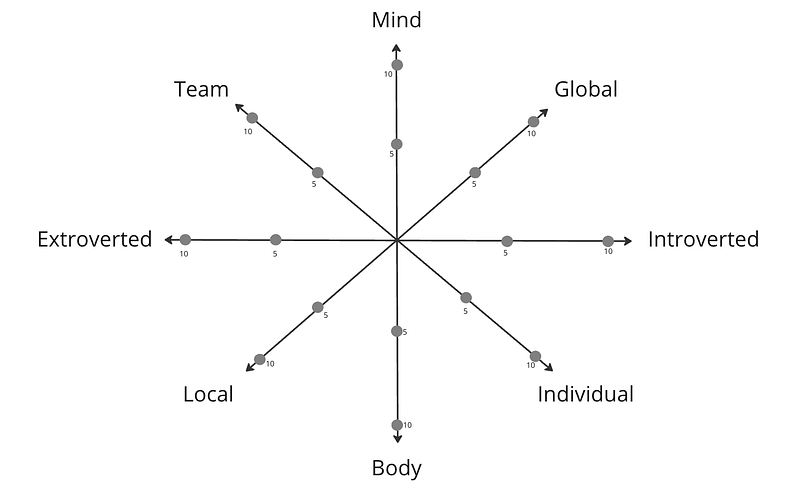
I use this model to get a better understanding of myself or my partner.
The idea behind it is that you are subject to 4 different perspectives:
- How you see yourself
- How you would like to see yourself
- How others see you
- How others would like to see you
How it works
Firstly, create a barometer as depicted below with 4 or 5 dimensions that are important to you.
For example:
- Are you more team-oriented or more individualistic?
- Are you more extroverted or more introverted?
- What matters to you more: The body or the mind?
- Do you feel more global or more local?
Secondly, for each dimension, decide where you are today on a scale from 1 to 10 and draw it into the diagram. The sum of an axis should always be 10.
For example, if you score a seven on introverted, then it has to be a three on the extroverted side.
Thirdly, use a different color to fill it out with how you would like to be, or ask a friend or partner to fill out how they see you.
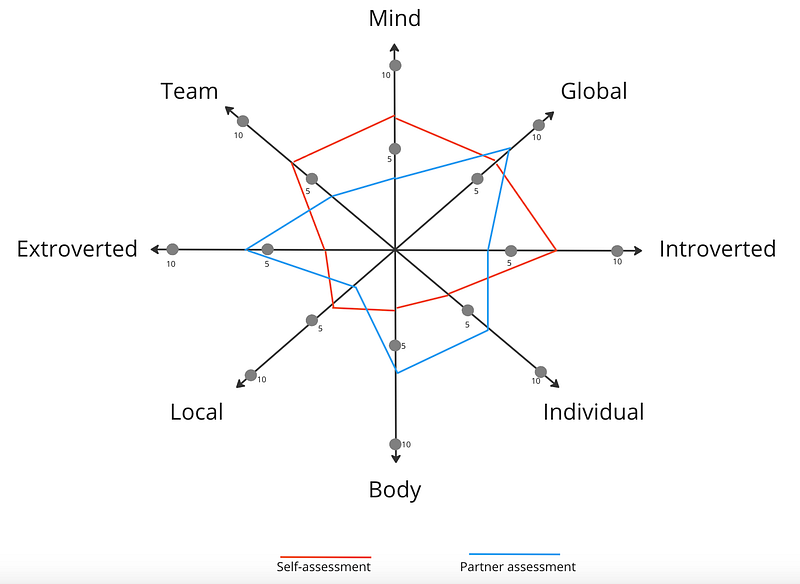
Finally, reflect on the results:
- What’s stopping you from being the way you want?
- Why do others see you differently?
- Why would others like to see you in a certain way?
I, for example, saw that I had perceived myself as quite a team player — unlike my partner. We discussed this and figured out things I could do better for my team at work and in my partnership.
The Personal Performance Model to Assess Your Satisfaction
This one served me well when I was deciding whether or not to change a job.
The model provides a way to measure your satisfaction in a given environment over time. I, for example, used it to assess my job satisfaction.
You can also use it for assessing anything else such as friendship or a place to live based on what matters to you.
How it works
Using the example of job satisfaction, for 2 or 3 weeks every day after work ask yourself the following three questions:
- Have to: In how far are my tasks being imposed on me?
- Able to: In how far do my tasks match my abilities?
- Want to: In how far do the tasks I’m doing correspond to what I really want?
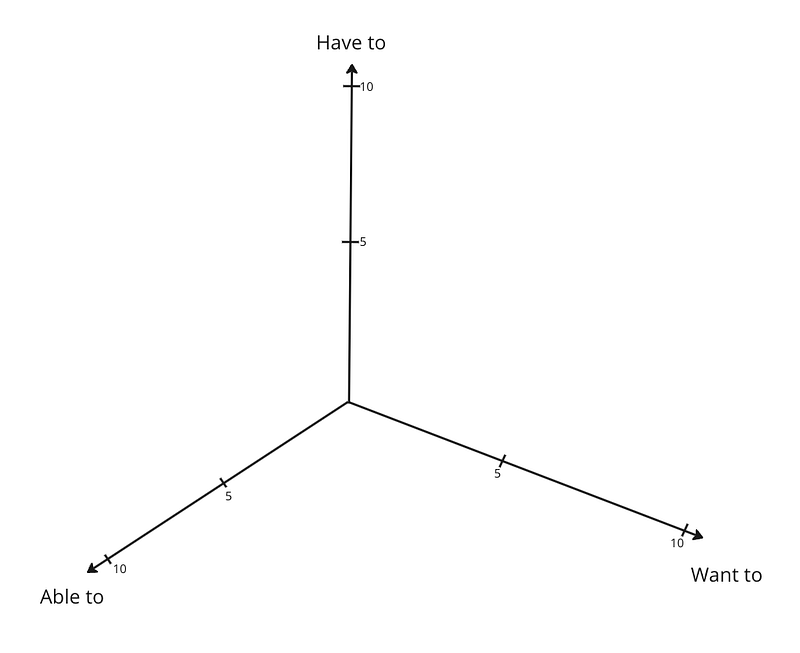
For each question, answer with a number between 1 (doesn’t apply at all) to 10 (fully applies).
After a couple of weeks analyze the different diagrams that you have produced over time.
If the resulting triangle is changing its shape a lot, your job offers variety. If it remains the same, there seems to be a lack thereof.
For example, for a previous job, I had a triangle looking as follows with little movement over two weeks:
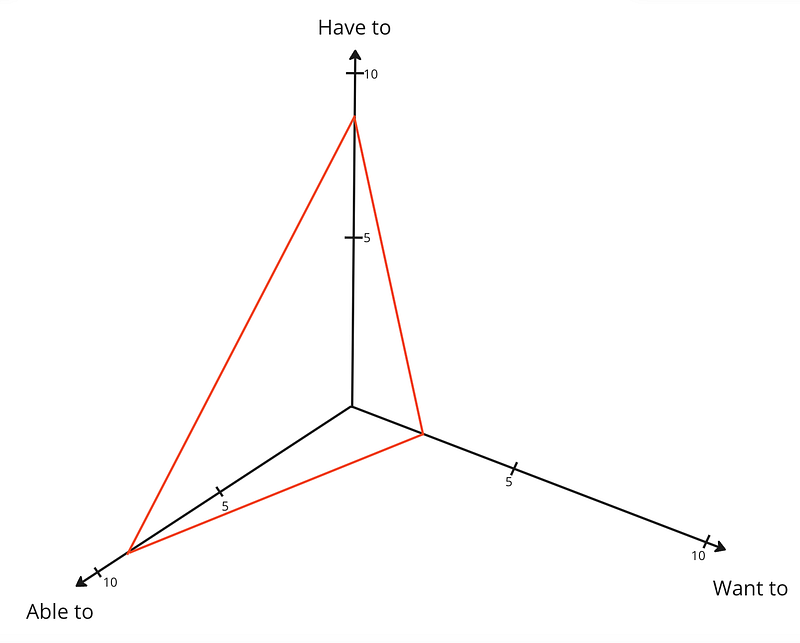
As a creative person who values his freedom, this was a clear indication for me to make a move.
Love it, change it, or leave it.
I tried but couldn't change the way I work at this job. So I had to leave it.
Ask yourself:
- What tasks do you enjoy?
- Are you able to do those tasks?
- How much do you value your freedom? And how much freedom do you have?
You can also use this model for different circumstances by adjusting the dimensions. For example, for assessing a partnership you may ask:
- Am still doing the things I want to?
- Are my needs being satisfied?
- Am I able to support my partner?
The Crossroads Model to Know Your Next Move
Which way should I choose in life? What is my next move?
I used this model recently at a deciding crossroads in my life. It helped me understand my options and find direction.
The powerful thing about this model is that it sheds light on why you are where you are.
It consists of 2 main steps:
- Where have you come from?
- Which directions can you take now?
Part 1: Where have you come from?
Answer the following four questions to understand where you are.
Question 1: What beliefs and values are important to you?
Without much thinking:
- Make a list of 10–12 values, beliefs, and principles that matter to you
- Now, cross out the 7–9 least important ones so that only 3 remain
This doesn’t mean that these values don’t matter to you. It is just a trick to focus on the most important ones. Having too many focus points makes deciding difficult.
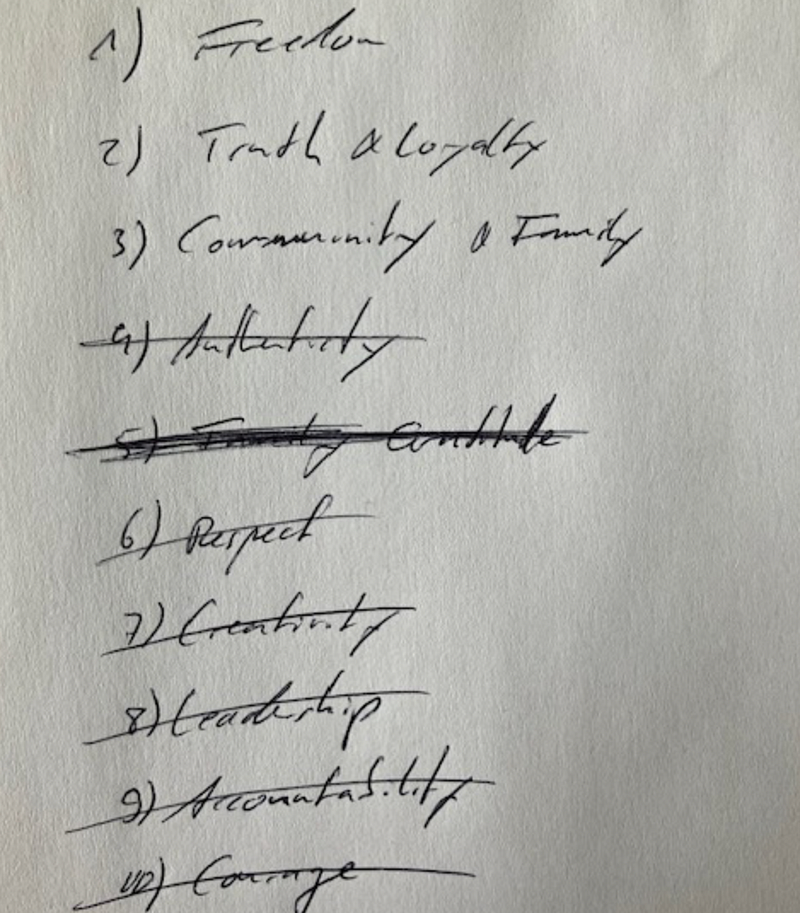
Prompts to get you started:
- What were the happiest moments in your life? And Why?
- What were the saddest or angriest moments in your life? Why?
You can also use the above-mentioned Uffe Elbaek Model to find more principles, such as freedom vs. safety or family vs. individuality.
Question 2: Who is important to you?
Think about the following questions:
- Whose opinion do you value? Why?
- Who values your opinion?
- Who gives you energy?
- Who drains your energy?
- If you had to spend the rest of your life on an island, who would take you with you? And why?
Question 3: What is hindering you?
Ask yourself the following questions to find out what’s holding you back:
- Do you have clear goals?
- Are they really your goals, or have they been imposed on you, for example, by society, parents, or a partner?
- Are you prioritizing your goals? If not, why?
- How much time do you spend on things that matter to you? Why not more?
Question 4: What are you afraid of?
Be honest with yourself: What things, people, or circumstances do you worry about? Who is robbing your energy? And why?
If you don’t acknowledge these things you’ll never be able to find solutions.
Part 2: What roads lie ahead of you?
There are 6 typical ways you could follow:
- The road you have already been down: This means not changing anything — low risk, low reward
- The road that has a magical pull on you: Maybe it’s something you never dared to tell anyone, such as becoming a video game tester or ice cream inventor. What have you always wanted to try?
- The road you imagine in your wildest dreams regardless of feasibility: Maybe you want to start your own business or become an artist. What would you do if couldn’t fail?
- The road that seems most reasonable: This is the road that people whose opinion you value would suggest, such as getting a job with a good salary and starting a family
- The unknown road: The road that you have never thought of. How might life be as a sailor in the Caribbean?
- The road back: The way back to a place you once felt safe such as going back to your family or reviving old friendships.
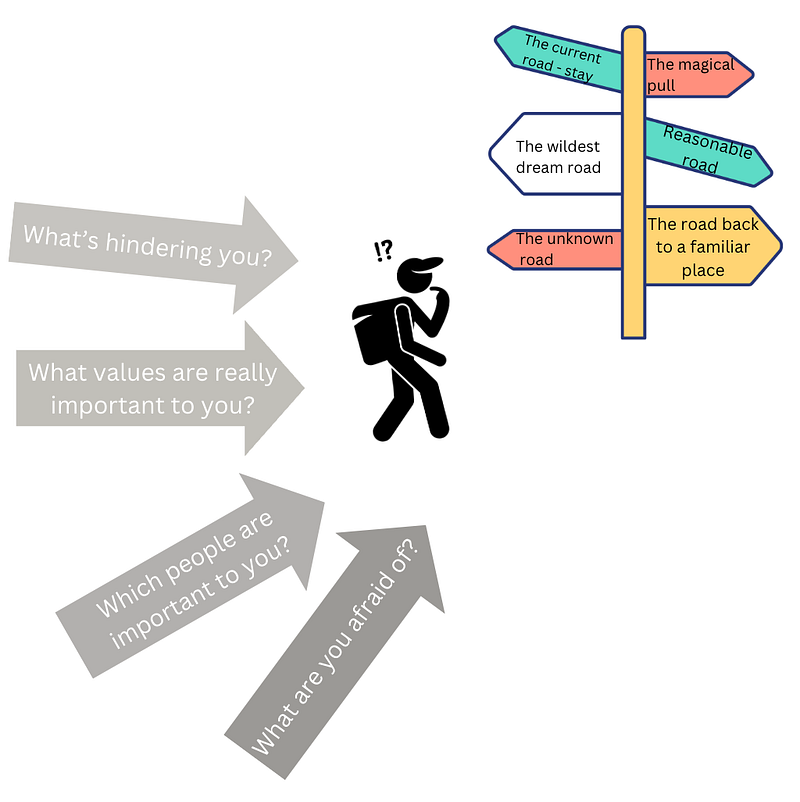
Imagine how life would be on each road.
What would be the consequences? Which one aligns best with your values?
Reflect on these questions alone or with a friend.
Key Takeaways
We are subject to influence almost all day long. Understanding ourselves and knowing what we really want is not easy for many of us.
A simple mental model will help you to figure yourself out and to make better decisions in work and life.
Try the following three models to understand yourself and others better:
- The Uffe Elbaek Model to better understand yourself or your partner
- The Personal Performance Model to assess how satisfied you are in a given environment, such as your job
- The Crossroads Model to understand your motivators and better decide on the next step at important crossroads points in life
“To be yourself in a world that is constantly trying to make you something else is the greatest accomplishment.” — Ralph Waldo Emerson
How will you figure out your next move?
Join us for valuable insights on decision-making at Lead & Succeed!


