
3 Coping Strategies For Living With Bipolar Disorder
Let’s agree to keep the ‘disorder’ out of it.
Disclaimer: This article is for informational purposes only and should not be considered as medical advice. If you are experiencing symptoms of bipolar disorder, consult with a healthcare professional for a proper diagnosis and treatment plan.
Living with bipolar (Bipolar disorder being the medical term) can feel like navigating a ship through a tempest, where manic highs are towering waves lifting you to dizzying heights, and depressive lows are dark, engulfing troughs that pull you under. Just as sailors use a variety of tools — compasses, maps, and anchors — to journey through turbulent waters, individuals with bipolar disorder can use a medley of coping strategies to steady their vessels and chart a course toward calmer seas. These strategies don’t replace the essential guidance of lighthouses and harbormasters, which in this metaphor stand for medication and professional healthcare; rather, they take my own professional experiences to complement them, providing additional layers of stability and control over the ever-changing tides of emotion.
By adopting a holistic toolkit, you don’t merely treat symptoms; you reclaim agency over your entire emotional landscape. This is your expedition, after all, and while bipolar disorder may be an inherent part of the ocean you traverse, you can still learn to be a more skilled and resilient sailor. Below, we explore some of these coping techniques that can help you find your balance amidst the highs and lows, giving you the power to sail more confidently through the stormy yet beautiful sea of life. Let’s get started.
Three Coping Strategies
My time working in mental health, as well as dealing with it from time to time, lead me to find and use certain coping strategies to…well…to cope. A coping strategy is exactly as it says on the tin. You open that tin and use what is inside at your leisure to better handle yourself.
For example, one coping strategy for someone experiencing mental distress could be to meditate. Perhaps meditation helps you relax, maybe even focus. Whatever that strategy might be, I’m now going to give you some of what I have used professionally and personally. But if you would prefer to get straight to the resource, you can scroll down to the bottom :-)
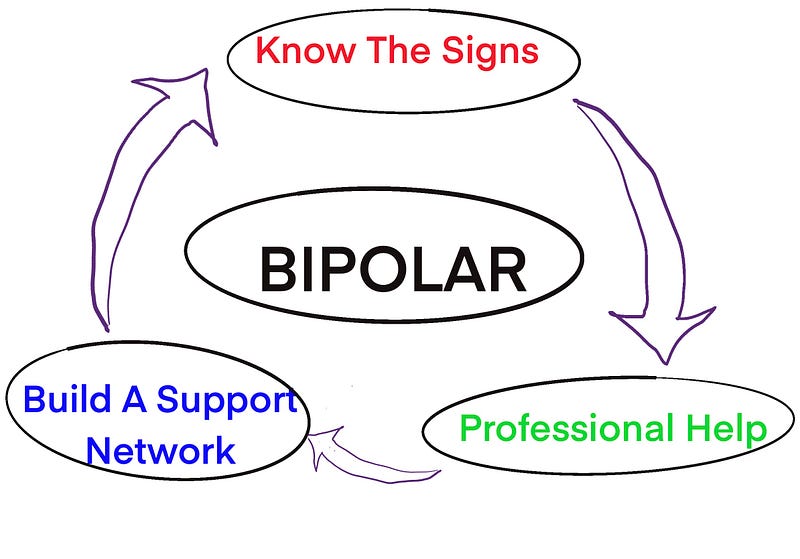
1. Know the Signs
Recognising the early indicators of a manic or depressive episode is like spotting dark clouds on the horizon before a storm hits. With this foresight, you can anchor down and prepare for the emotional tempest that may be coming. A mood journal serves as your weather log, detailing the atmospheric conditions of your emotional landscape, allowing you to see patterns, predict disturbances, and make course adjustments before you find yourself in the eye of the storm.
2. Professional Help
Psychiatry and therapy are the lighthouses in the often foggy journey of managing bipolar disorder. Just as a sailor wouldn’t ignore a lighthouse’s guiding beam, sticking to prescribed medications and engaging in cognitive behavioural therapy (CBT) or other therapeutic techniques is essential. These professionals are skilled cartographers and navigators who help you map out safer routes through the choppy waters of your emotional sea.
3. Build a Support Network
Friends and family act as your lifebuoys and safe harbors in the turbulent sea of emotions that come with bipolar disorder. They offer invaluable emotional support that helps keep you afloat when you feel like you’re sinking. Peer support groups, either online or in-person, serve as fellow fleets sailing alongside you. These communities provide a comforting sense of belonging, like finding a convoy of ships that understand the complexities of the waters you’re navigating. With them, you can exchange navigational tips, weather warnings, and perhaps most importantly, the affirmation that you’re not sailing this challenging voyage alone.
By utilising these three key strategies, you’re essentially learning how to read the winds and tides. You’re not just passively drifting on the currents of your mood swings; you’re actively steering your ship, ready to adjust the sails or seek safe harbour when needed.
Tyler, Give Me Some Inspiration
Sure thing, a positive quote goes a long way. It shall be my part one of my gift to you today and one I tell myself every day.
Remember, in life, we’re faced with many situations. But, no matter the situation, remind yourself, “I have a choice.”
How About One More Freebie?
Okay, my reader. Here’s something I drew up just for you. Sure, it’s not much, but the simplest of things can sometimes be just the right compass when we feel those waves getting choppy. Below, I have drawn up a simple table you can use in your life when something happens that you feel may have caused an imbalance.
Look here:
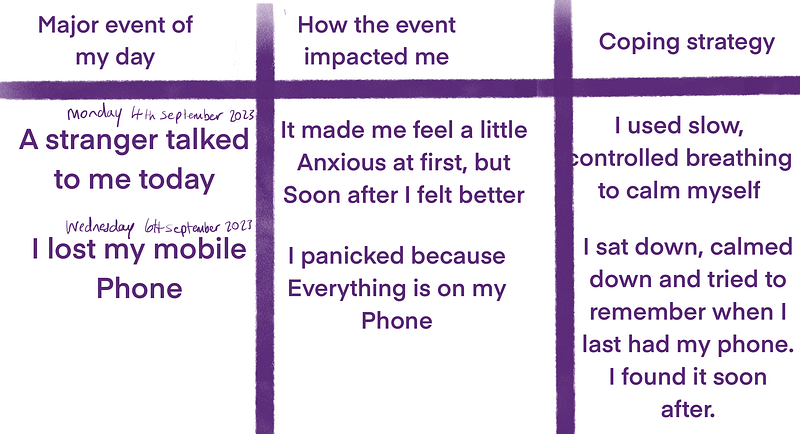
As you can see, I’ve merely provided a couple of days for you, and my strategies were more like self-preservation strategies as opposed to the ones I mentioned above. But I hope by now you can see my point…
Mental Health Is A Very Personal Thing
Yep. That one is a no-brainer. What’s in your head is only in your head and no one else's. Sure, maybe the person next to you experiences similar things from similar events, but their strategy to cope with it may be different to yours. Or, maybe they don’t have a coping strategy. That’s when you can share this simple resource or simply draw one up yourself.
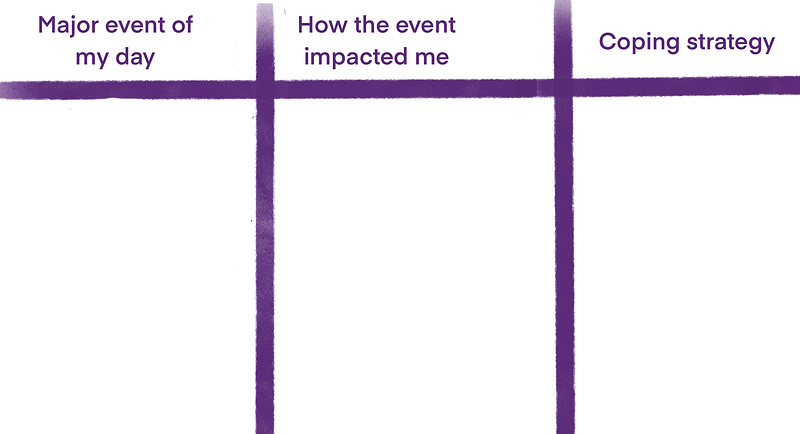
Now, as part of the same freebie, I present to you the clean version of what I provide above so it's easily accessible to you. Reader, I ask only one thing from you:
If you implement this chart, or you have your own or become inspired to draw up your own, I’d love to see it here. Moreover, I’d love to hear some of your own strategies on how you cope with certain things and lessen the impact something has on you.
Here you are:
That’s all from me today.
Until next time,
~TW~