
3 Actors Involved in Urban Forestry
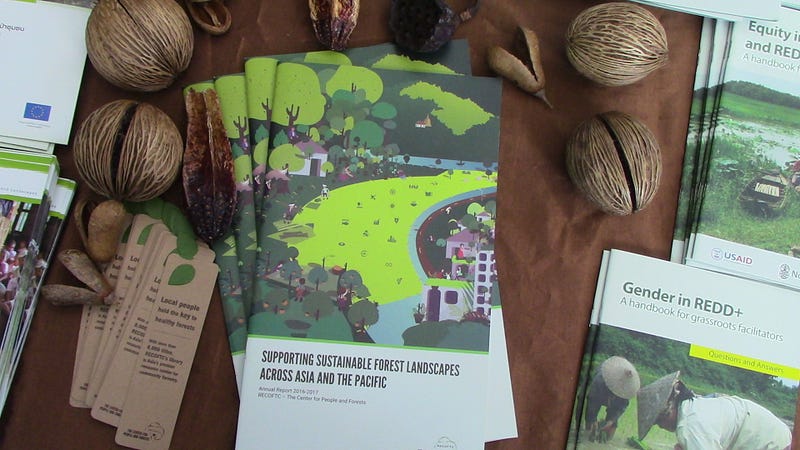
Last weekend, I participated in a forum organized by The Center for People and Forest that explored the connection between urban consumers and forests. I had the chance to sit down with three participants to learn more about their expectations and expertise. I also asked them if they could provide any advice to those young people interested in forestry and rural development. .
Dr. Tan Puay Yok: “I want to share what Singapore achieved in urban forestry”
Dr. Tan Puay Yok is a professor at the National University of Singapore. His research focuses on the role of the trees in the city, for example how trees can improve urban peoples’ health and social bonds. “We have a study looking at Flickr photo database. We want to know what people take photos of, what kind of trees, insects or landscape,” Dr. Yok told me.
Dr. Tan Puay Yok has a background in horticulture and started his career working with the Singaporean government on the project “Greening Singapore”. Only later did he decide to join academia to pursue research. Now he wants to share Singapore’s journey with the hope of inspiring other cities across Southeast Asia. “People think greening city is expensive but it has great benefits, much more important than the money invested”.
Dr. Tan Puay Yok really believes that urban forestry will play a more important role in the future. He predicts an increasing demand for highly skilled professionals in urban gardening since cities are becoming more green. “Gardening is seen as a low paid profession, but there will be lots of opportunities to be professional in this sector in the years to come,” he predicts. The professor advises young people to look into these opportunities. He also point at the International Society of Arboriculture which trains professional tree carers and teaches them about tree ecology, health and management.
Tul Lekutai: “every people dream is a picture”
Tul Lekutai was setting up his drawing material when I asked him for a short interview. He kindly accepted and in a few minutes he convinced me of the importance drawing has in bringing environmental messages to people.
Tul Lekutai is an architect by training and has been drawing since he was a child. Five years ago he started to work as a visual storyteller for different organizations at various events. Primarily, he focused on global issues, forests and nature conservation. As an artist, he feels very connected to nature and likes hiking and trekking. “When I travel I prefer to visit rural areas rather than cities. I also often go out in the countryside since I live only 30 min away from the mountains”.
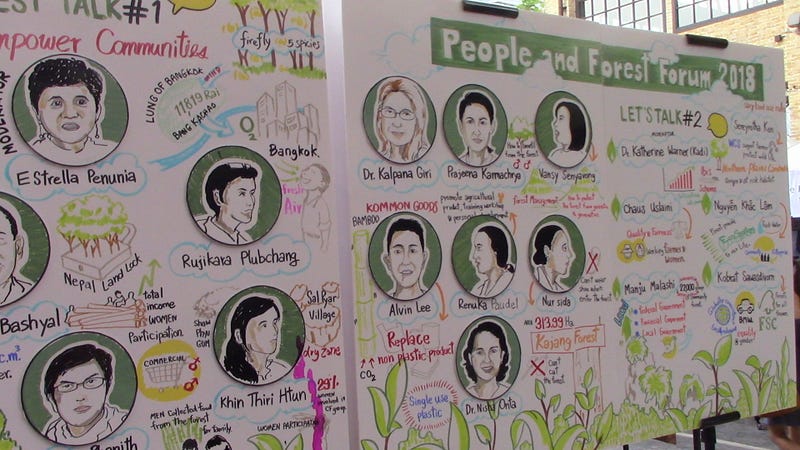
Tul Lekutai shares with us the importance of drawing to communicate. “Pictures are an international languages, if I draw a forest or a tree people know what is it. Pictures are more attractive than text, they are fast and easy to understand. Images also give space to the imagination,” he stated.
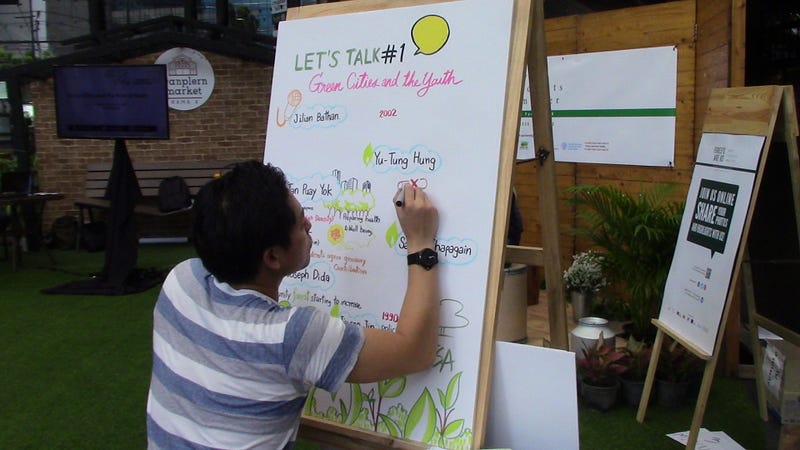
Tul has had great feedback about his drawings. He is often contacted to come to conference and report speaker’s thoughts with his pen. “At conferences, people come to see my drawing, take pictures of it and share it on social media. I often see them discuss the drawing”.
Miscommunication can make companies lose a lot of money, therefore companies have great benefits to learn how to communicate visually. Tul organizes workshops to teach people how to communicate with simple drawings. “It’s not about how beautiful is the drawing, but how efficient is the communication”.
Just before the start of the conference, Tul Lekutai shared some wise thoughts about realizing one’s dream. “Everybody has a dream. However a big dream is not easy to achieve, it needs discipline and consistency. It can’t be achieved in few days, you have to do a bit everyday. A dream without a good plan of action is nothing”.
Paing Htet Thu: “learn first and apply then”
Paing Htet Thu is a program assistant at the Myanmar Environment Rehabilitation Conservation Network (MERN). The MERN is a hub of a network of 27 non governmental organization engaged in agricultural, rural development and nature conservation. MERN is engaged in policies about forest and coastal management such as United Nations program to halt deforestation REDD+.
Paing Htet Thu came to this forum about people and forest to learn about other countries’ initiatives. “I want to get new experiences from other countries to apply them to Myanmar, my home country”.
To the youth, he advises “to read and learn as much as you can, and then apply it on the field. You should also participate in events to exchange with others and learn more”.
To better understand the role of forest in the global environmental issues such as climate change, we need to exchange as much information and knowledge as we can. The access to information is a key factor to solve complex problems. In a future post, we’ll try to understand how to cope with the lack of access to the information.
Written by Thuan Sarzynski & Edited by Jeffrey Williamson