
Off Brand
Why TJ Maxx Doesn’t Need E-Commerce to Survive the Pandemic
Forget contagion, bargain shoppers want the thrill of the in-person treasure hunt
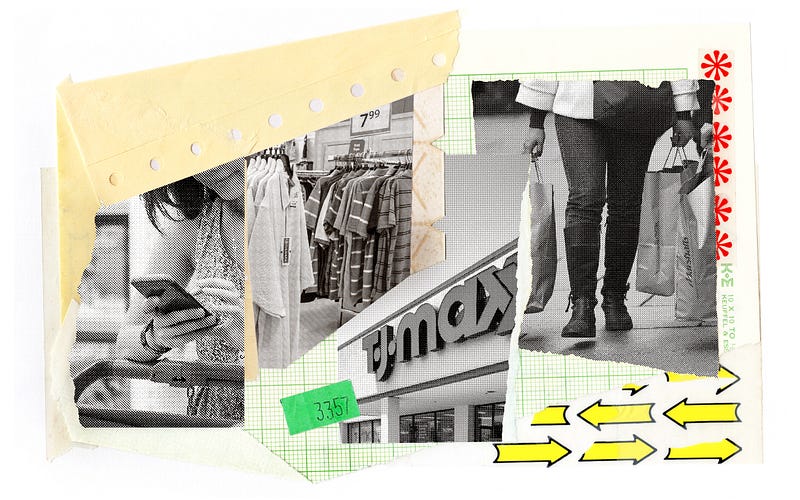
The retail reckoning that’s been turbocharged by the Covid-19 pandemic shows little sign of letting up: Marquee department stores like J.C. Penney and Lord & Taylor and mall stalwarts like J. Crew have declared bankruptcy; titans like Macy’s and Gap are looking wan. Even with lockdowns (mostly) ended, foot traffic is often at a whisper.
But in certain, perhaps less flashy, corners of the retail world, there’s a different picture: determined bargain-hunters combing through the ever-changing merch mix at a discounter like T.J. Maxx, dead set on tracking down, say, a Calphalon skillet or a pair of Lucky jeans for 40% off.
For off-price retailers, shopping is a real-world experience that has as much to do with the hunt as the kill — and the hunt happens in the physical world. This flies in the face of the savvy conventional wisdom, embraced by the likes of Nike and Lululemon — even Starbucks — that surviving the pandemic requires pivoting toward an ever-heavier emphasis on e-commerce.
Like all retailers, the off-price chains took a major hit during the lockdown period that started mid-March and lasted in many markets into early June. But when stores reopened, the off-price consumer was ready.
But off-price retailers like TJX Corp (owner of TJ Maxx, Marshalls, and HomeGoods), Ross, and Burlington are practically living in an alternate reality. This category has resisted any meaningful embrace of e-commerce throughout the internet era, even as pretty much every other consumer-facing business scrambled to offer an online alternative. This isn’t because off-price chains are Luddite businesses, or in denial about the future. It’s because they believe that, even post-pandemic, their customer isn’t looking for a digital option; they want the real-world thing. And so far, this focus on the in-person shopping experience — even amid a pandemic — is working surprisingly well.
Like all retailers, the off-price chains took a major hit during the lockdown period that started mid-March and lasted in many markets into early June. But when stores reopened, the off-price consumer was ready. These treasure-hunt enthusiasts had been pent up for months, not only from shopping but almost any other form of out-of-home fun. T.J. Maxx and Burlington said their initial sales when lockdowns began to lift in June tracked above last year’s numbers. (Although spiking Covid cases in July in several large states cut retail foot traffic in general, and parts of California returned to lockdown.) “The bigger-picture takeaway is we’ve been pleasantly surprised,” says Janine Stichter, an analyst who covers retail at Jefferies Financial Group, particularly considering that many assumed people would be scared to go back in stores. “We’re not seeing as much of that as we had expected.”
Wall Street has taken note. Shares in TJ Maxx parent TJX Corps plunged from a high of $63 per share in February to about $36 in mid-March, but has since rebounded to about $53 per share as of August 5. TJX may have the strongest position in the category, because its stores carry a higher percentage of housewares and furniture. (The work-at-home lockdown months have resulted in more demand for home decor and other nesting upgrades.) But shares of the more apparel-centric Burlington and Ross have followed a similar pattern. “It’s a true testament to the off-price model given how quickly customers returned to all three of the off-price models once stores began to reopen,” Gordon Haskett analyst Chuck Grom recently told Barron’s.
It is, ultimately, a form of shoptimism — converting the act of buying into a form of comfort and satisfaction, and an act of faith toward a more normal future.
As Jefferies’ Stichter explains, it turns out that what the off-price chains lack in glamour and cultural prestige, they more than make up for in other ways. “A lot of retail has become commoditized — there’s really no reason to get something in store that you could get online,” she says.
The off-price shopping experience is different: an unpredictable journey that rewards a combination of determination and serendipity. Who knows what delightful brand-name garment you’ll find at a deep discount? For some, it’s almost a sport. And for off-price customers, who tend to be extremely loyal, the appeal has only been magnified by the lockdown. “It’s a little bit of joy at a time when there aren’t that many things you can do to entertain yourself outside the house,” says Stichter. It is, ultimately, a form of shoptimism — converting the act of buying into a form of comfort and satisfaction, and an act of faith toward a more normal future.
The off-price stores do little to no e-commerce business for two reasons. One is that many of the bigger brands who use these channels to move excess inventory don’t want easily discoverable online evidence of just how cheaply you can buy certain Nike or Michael Kors or Balenciaga goods. For such brands, the whole point of working with these chains is that they can spread the merchandise out over hundreds of locations, so there’s never a huge “Nike for sale” display.
“People are making fewer trips, but with more purpose. If you go to a store, you probably want to come home with something.”
The other reason is that, at best, e-commerce cannibalizes in-store sales, without truly replacing the in-store experience. That’s true for any retailer. But while many customers of department stores or other retail are perfectly happy to skip the in-store experience altogether, loyal off-price shoppers actually enjoy visiting the stores. “Which is really rare in retail right now,” Stichter explains. TJX has the most developed online store in the category — and it accounts for only 2% of sales.
Several factors help explain off-price retail’s current advantages as an in-store experience — and one of them, interestingly, traces back to the last big financial crisis. Hunting down killer bargains has obviously been around forever, but the practice acquired a borderline “cool factor” during the Great Recession, Stichter contends. At the very least, you didn’t have to be ashamed of shopping at TJ Maxx if it resulted in a brag-worthy find. (Off-price fans are a broad group; past Jefferies’ research found that many TJ Maxx customers, for instance, routinely “cross shop” at places like Neiman Marcus.)
The fraught pandemic reopening period has also helped these discounters. Department stores like J.C. Penny are largely located inside malls, which are suffering now partly because other mall attractions like movies and dining are curtailed. Off-price retailers are more likely to be in stand-alone locations across the parking lot from grocery stores or Home Depots that even cautious consumers still visit — making it easier to rationalize a shopping-as-reward expedition.
And as Stichter points out, for both off-price and for retail in general, actual sales numbers are doing better than foot-traffic numbers right now: “People are making fewer trips, but with more purpose,” she says. That means conversion rates are higher; shoppers are more likely to buy, and buying more when they do. “If you go to a store, you probably want to come home with something.”
Stichter believes all of this may add up to new shoppers turning to off-price in the months ahead. “People are going to be more value-conscious,” as the economic downturn grinds on and many will have less money to spend, she continues. Until a vaccine arrives, the traditional mall visit — spending hours going from store to store, taking in a movie, having some food — may still seem risky. And the simple thrill of finding a bargain looks more attractive, to more shoppers, than ever.