
When the Desert Comes Alive
The transformation of one of the most unique landscapes in the world
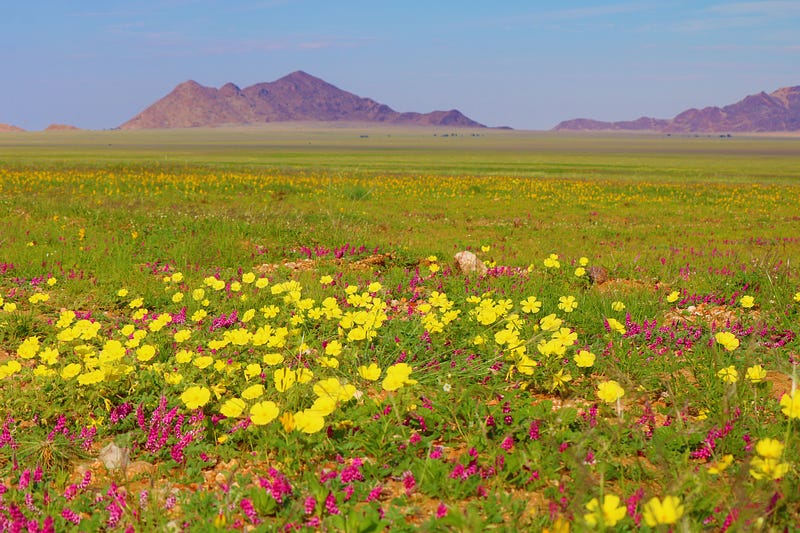
The smell. I will never forget it. The beauty of the landscape. That view. The sound of the insects. Everything together. The whole picture. Words won’t justify the beauty of it. The beauty of the blooming desert.
The Namib desert
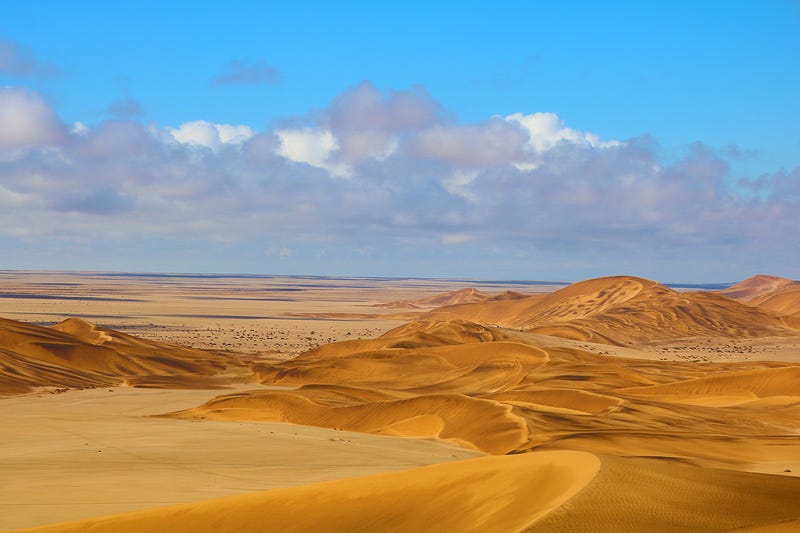
I’ve spent a few years living and working in the Namib desert. A desert located in southern Africa. And I love the sand dunes. The vast landscapes. Gravel plains as far as the eye can see. The winds. And the emptiness of the desert. I did fall in love with all of it. Because it is just so different from everything I grew up with. It’s basically the opposite of everything I grew up with.
And that is what attracts us, humans. Something different. We like anything that is different than what we know. We like variation and change. Or I do at least.
While I am describing this landscape as breathtakingly beautiful my partner would say “it’s dead”. There’s no water anywhere in sight. There’s barely any life possible. And he grew up in it. He did farming over there. He knows what struggle it is to grow anything out here. For him, this landscape means something totally different. Because he’s used to it. And he knows what it means living with it. It’s challenging. For humans and animals. It’s a struggle to survive in it.
But this is not the point of this article. I want to talk about the moment this landscape changes.
The rain
It doesn’t happen very often, but sometimes it does rain. It does rain in the desert. Not a lot. But it does. The Namib desert is said to receive around 5 to 10 millimeters of rain per year in the area I lived in. Per year! That doesn’t mean that it rains every year. Its an average precipitation. In some of the years I’ve lived there it didn’t rain at all. And in one year they received 20 millimeters of precipitation. Within a couple of days.
The Namib desert would be the second driest desert in the world. Just behind the Atacama desert. But if you add all the water it receives through the fog, then the Namib would be the wettest desert in the world.
Lots of animals and plants adapted to this type of precipitation. The fog. They learned to get water from it. But if it does rain once in a blue moon. Then everything changes.
The first change happens right after the rain. The dunes look completely different. They look clean. When they’re wet. No dust and sand is blowing around. There are clean lines going through the sand dunes. It’s beautiful. Because different.
The transformation
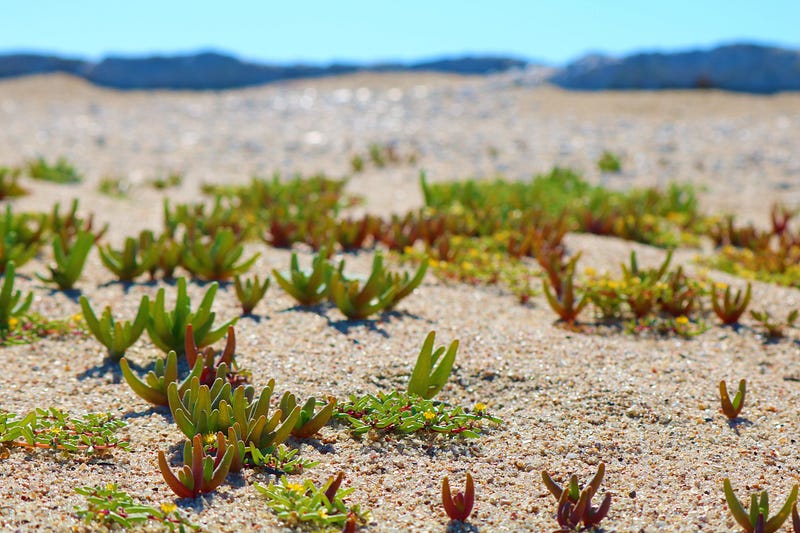
And then about two to four weeks later the real change will happen. You will see tiny little plants coming out of the sand. Grass. Succulents. And other survivors. You question yourself how on earth any seeds survived in the sand for so long. Because it has been a few years since anything grew here the last time. But they remain in the soil. Untouched. Protected only by sand.
And then all of a sudden they come up. Quietly. Peacefully. They just grow. With a maximum effort. With all the water they managed to soak out of the sand. They will push through and withstand the beating sun. They will be strong. To make it to the stage of blooming. To reproduce. And then they will disappear again.
A field of flowers
And once in a decade or less, you might be able to witness the most amazing phenomenon. But the timing has to be everything. You have to be at the right time in the right place. Most probably you can’t plan it. You just have to be lucky. Just like me. I was lucky.
It happened to me in 2018. I went on a road trip with a friend of mine from Germany. It was about three weeks after the desert received some rainfall. But the Namib desert stretches over such a massive territory that it obviously doesn’t receive everywhere the same amount. And most probably you won’t even know how much one specific area received because it is inhabited and there was nobody who could have measured it.
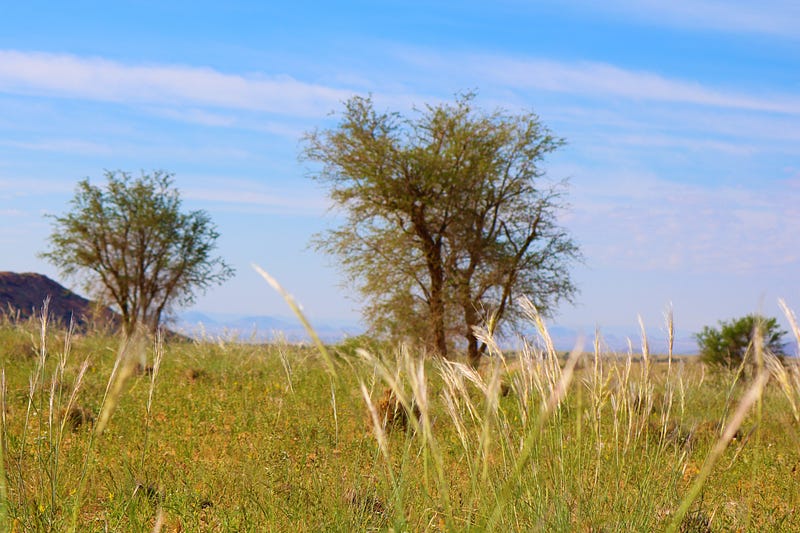
We slept the night somewhere in the mountains at the edge of the Namib Naukluft Park. It was a beautiful spot we chose. Wild camping of course. And then we drove south the next morning. The area we camped in was already pretty green. For its relation. But we were about to drive through the drier parts of the desert. And the vegetation did change. It vanished almost entirely. You could see that it did rain. In some parts more. In some parts less. In some parts not at all.
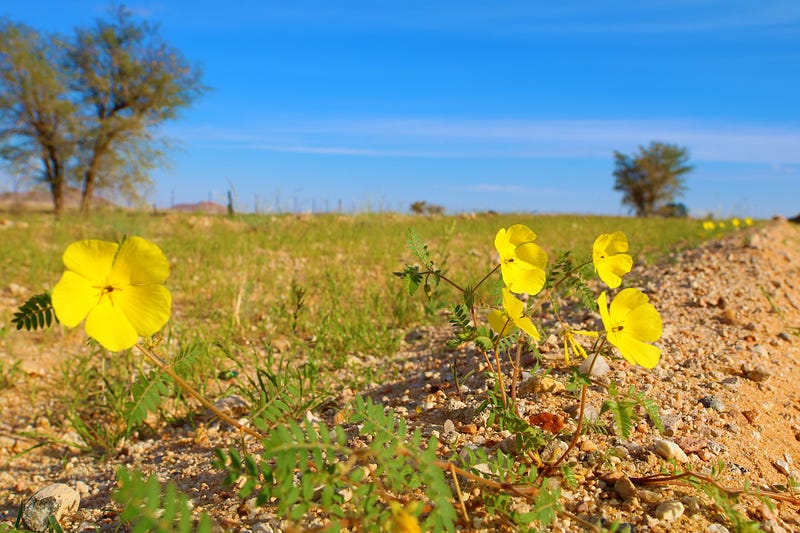
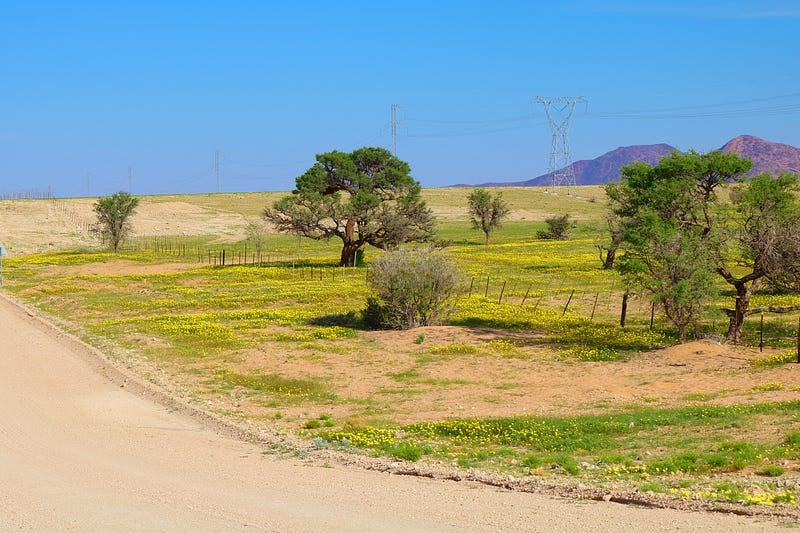
We would see some fields covered with thin grass. Already something special in this area. And then there would be a part of the road with a line of yellow flowers on the left and right side. These yellow flowers are the first ones to come out after the rain. It’s beautiful. It was such an amazing drive. I loved it. And I stopped every few hundred meters to take a picture.
The moment
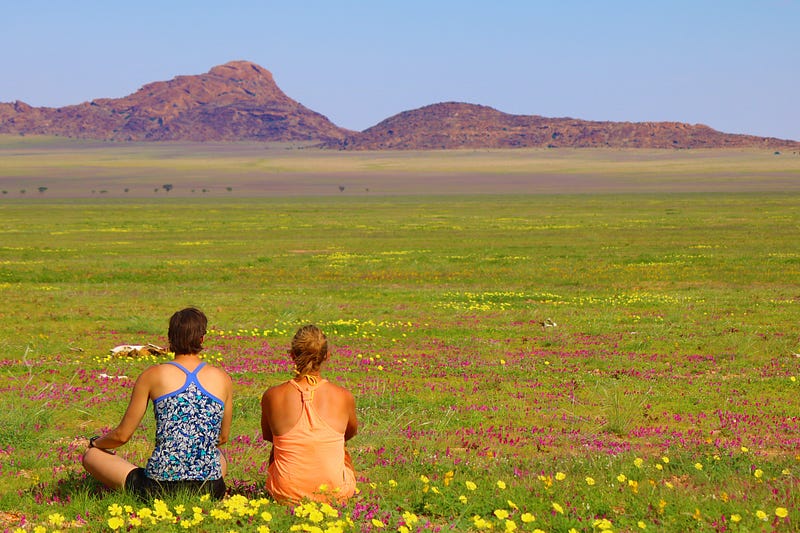
But then it happened. It was as if we drove through a magic door. Around a bend. All of a sudden a field of flowers stretched across a vast plain. It wasn’t a landscape of nothingness anymore. It was a field covered in flowers. Up to the horizon. I’ve never seen anything like it. Never. Never even imagined that it would be possible. Such a transition. A change in the landscape that is hard to believe it’s not a dream.
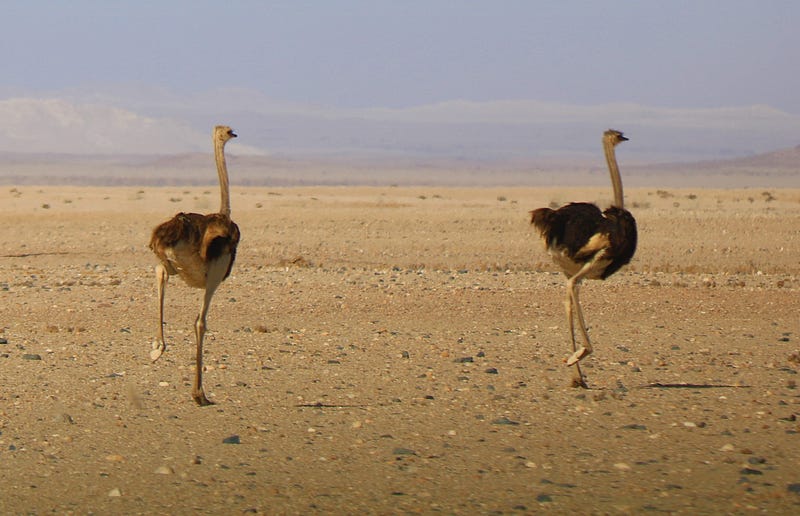
Just scroll back up for a moment and look at the picture of the desert with the ostriches. It’s the same landscape. That is how this part of the country usually looks like. Always looks like. It’s unbelievable. The change that happens.
I stopped the car. We got out. Stood for a while on the gravel road staring at this beauty. Trying to realize that this is true. That this is not a dream. Antelopes are grazing far on the horizon. Some zebras are to spot. It’s unbelievable.
I literally do not have words to describe it. You have to experience it to understand it. To understand the appearance of it. The smell. The sounds. The feeling. Everything.
It’s mesmerizing.
We walked a couple of meters into the field and sat down. Right there. Quietly. Listening to the insects. And birds. I don’t even know where they came from. There isn’t any tree in sight. I guess that doesn’t matter. All the wildlife comes together all of a sudden.
I can smell something. It smells like thyme. I’m picking some leaves trying to figure out which one it is. But the smell is overwhelming. It’s intense. So many different weeds. Herbs. Plants.
We sat there for a while. I don’t know how long. I just wanted to soak up as much as possible from this moment. I knew I would most probably never experience something like it again. Ever.
Soak it in. Close your eyes. Save it. Save the memory of it.
And I still see it in front of my eyes. Today. I still smell the thyme. I hear the insects. Whenever I think about it.
Life and death
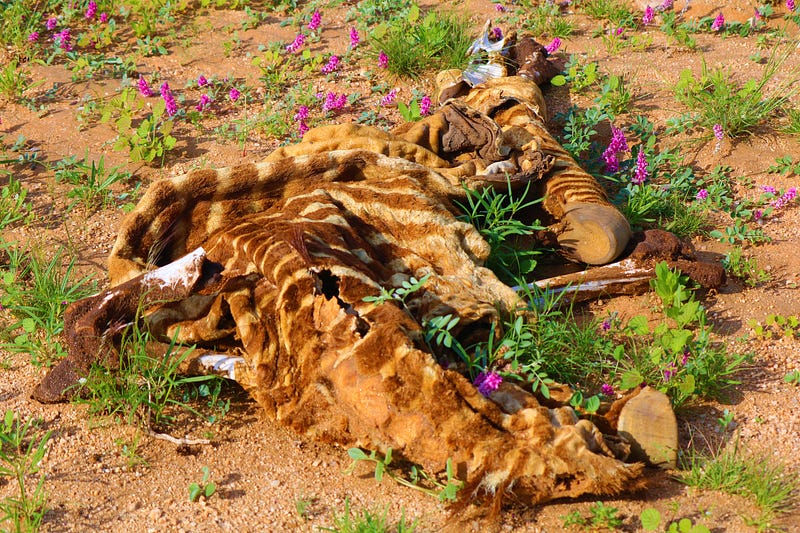
Once again this was also a moment that showed us how close life and death hang together. As we got up we saw a skeleton lying in front of us. It was a skeleton from a zebra. It feels so wrong to see a dead animal in a landscape where it has everything it needs. All the nutrients.
But it actually has been lying here for a while already. The grass and flowers partly covered the bones. Nothing but the skin and bones are left of it. Most probably it became a victim of a leopard. It’s leopard territory here. And this is part of life. Out here. In the desert.
Survival of the fittest.
“It is not the strongest of species that survive, not the most intelligent, but the one most responsive to change.” — Charles Darwin
If you should ever get to witness something similar to this you will understand my feelings. Why I rave about it. Why I am so enthusiastic about it. Because it’s so unique. And beautiful.
Thank you for reading!
Here are some more pieces about the beautiful country of Namibia and life in the desert.


