

28. Slowdown landscapes: Small pieces, loosely joined
How the virus reinforces the value of different patterns for our social infrastructure, infrastructure, farming, and habitation. From the eco-feminist robots of pixel farming to inverting San Francisco’s sewers as gardens.
“Patterns are the work of the human hand but their mission is to make nature even more natural. Skilful patterns are not created as a display of human pride and glory, but as a hymn to the mysterious power of nature. Through patterns and their deep humility and simple modesty, humankind is revealing its devotion to the laws of nature.” — Yanagi Sōetsu, ‘The beauty of everyday things’
Design not only articulates what we stand for when it produces particular instances of things, spaces, or experiences. Design can also articulate and describe these broader abstract formations, these wider systems, as repeating or generative patterns, dynamics, scales, and conditions. Recall Victor Papanek’s classic framing of design as “the conscious effort to impose meaningful order”…
“The order and delight we find in frost flowers on a window pane, in the hexagonal perfection of a honeycomb, in leaves, or the architecture of a rose, reflect man’s (sic) preoccupation with pattern, the constant attempt to understanding an ever-changing highly complex existence by imposing order on it.” — Victor Papanek, ‘Design for the Real World’ (1971)
Papanek chose these examples as they precisely define what is not design, however: “Though they have pattern, order, and beauty they lack conscious intention” (emphasis added). In design, pattern is an articulation of meaning and intent, politics and ownership, the social context or cultural history, or the dynamics that produce its growth, whether the architecture of a honeycomb or the spread of invasive species like Japanese Knotweed or Uber.
Papanek unfurls his redefinition of function beautifully of course, his “six-sided function complex” surpassing Louis Sullivan’s simplistic form follows function along the way.
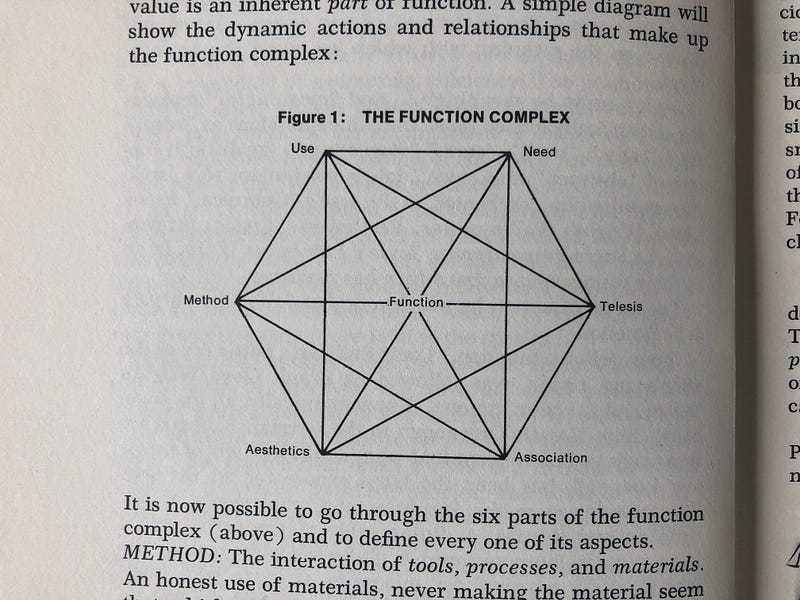
Yet his sights were essentially trained on industrial design. His primary motivation was the negative impact of carelessly scaling careless products. Recall the famous opening line of his book: “There are professions more harmful than industrial design, but only a very few of them.” This is understandable, given the context, still reeling from the Mad Men-era explosion of consumer products, all Thunderbird fins, Barbie dolls, and plastic tableware.
Yet Papanek rarely addresses another tangle of professions—urban planning, architecture, urban design—which are arguably harmful to a greater degree, and certainly were during the period of Papanek’s key works.
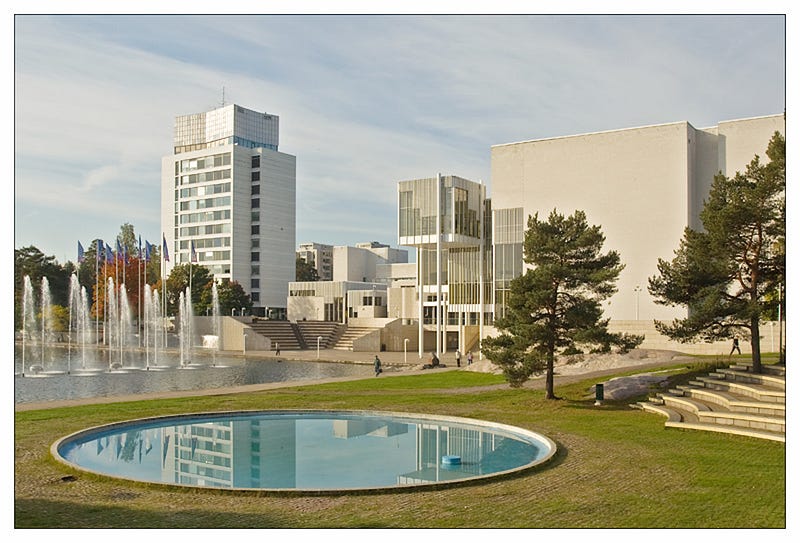
Although he is fully aware of the symbiotic relationship, Papanek’s focus is the automobile rather than the freeway. Save a brief discussion of Frank Lloyd Wright’s Broadacre City model, and one-word nods to Tapiola and Strøget, there are few patterns in ‘Design for the Real World’ that indicate how small pieces of space and infrastructure can combine, when loosely joined, to large systemic effect.
Yet his function-hexagon of ‘use, need, telesis, association, aesthetics, and method’ can equally be imagined as a kind of kaleidoscopic lens, useful when squinting at parking lots or hovering over entire cities and regions. Assessing how our tools and methods sprout new uses and aesthetics, or uncover new needs and associations, can enable us to identify new patterns emerging from what Papanek called our “ever-changing highly complex existence,” suggestible in alternate models for the everyday infrastructures around us.
A local code of small green spaces, loosely joined
‘Local Code’ (Princeton Architectural Press, 2016) describes experimental work by Nicholas de Monchaux and his then-team at UC Berkeley. The book comprises of essays punctuated by 3,659 drawings of digitally-located interventions for vacant public land in San Francisco, Los Angeles, New York City, and Venice, Italy.
In the Californian case studies in particular, De Monchaux’s work describes how distributed systems of small-scale tactical interventions, placed strategically and developed iteratively, can combine to greater effect than traditional infrastructure planning. The research indicates how distributed and care-ful infrastructure approaches might achieve similar performance levels as the heavy, single-use infrastructure projects typically in the regional playbook. Yet these alternate approaches produce that performance at a fraction of the cost, with greater agility and resilience, and with a far greater range of value produced, across multiple indices.
This innovative distributed approach is newly enabled by digital tools, such as parametric modelling, responsive GIS, and data visualisation. Yet more importantly, over and above mere technique, the work conveys a broader conception of design’s agenda, including direct and stated ethical concerns, described as “a digitally prolific, open-ended approach to urban resilience and social and environmental justice”. This ‘North Star’ not only makes clear the links between climate and social justice, but helps guide the work towards landscapes of care, and is designed to specifically manifests itself in the everyday infrastructures and spaces that surround us and, to some extent at least, define us.

De Monchaux describes the $1.5bn bond measure approved to upgrade the capacity of San Francisco’s combined sewer system, apparently necessary due to the increased intensity of storm water in the region hitting the state’s ageing infrastructure. (Such extreme weather is in turn due to a climate crisis in part produced by the ‘heavy infrastructure thinking’ epitomised by many aspects of California’s development.)
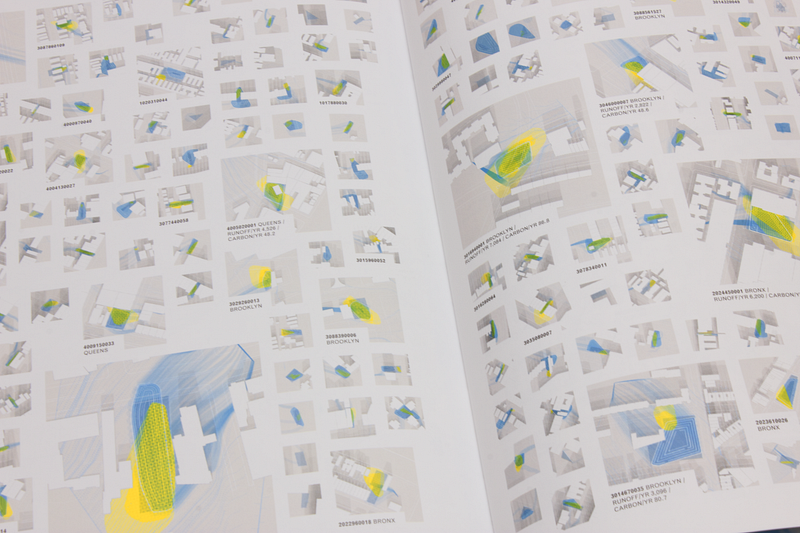

De Monchaux’s team suggested, as an alternative strategy, the careful greening of approximately 1500 small plots in San Francisco. Found in vacant or underused spaces, these plots are the kind of ‘urban junkspace’ common to ‘nonmaintained streets’ (in the language of the municipal spreadsheets), found around flyovers, billboards, and parking lots, and identified via everyday geographical information systems (GIS). Parametric models enable hard and soft landscaping to be precisely tuned, per site, to address water flow, solar gain, and wind movement. In parallel, De Monchaux’s team developed tools and practices for community design and collaboration.
In producing this network of pockets of distributed green infrastructures, the team estimated that between 88 and 96 per cent of the bond investment could be replaced by the surface spending, at half the cost of the underground work — and crucially, with many more forms of value produced.
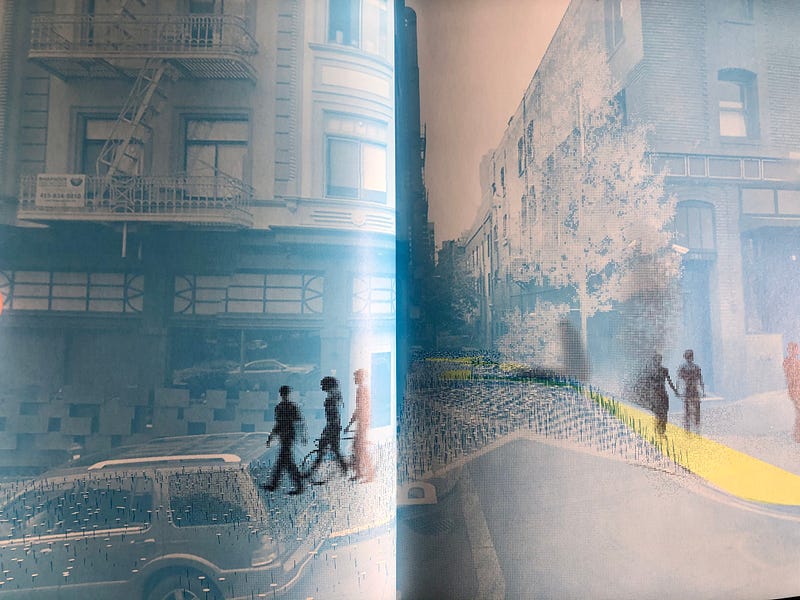
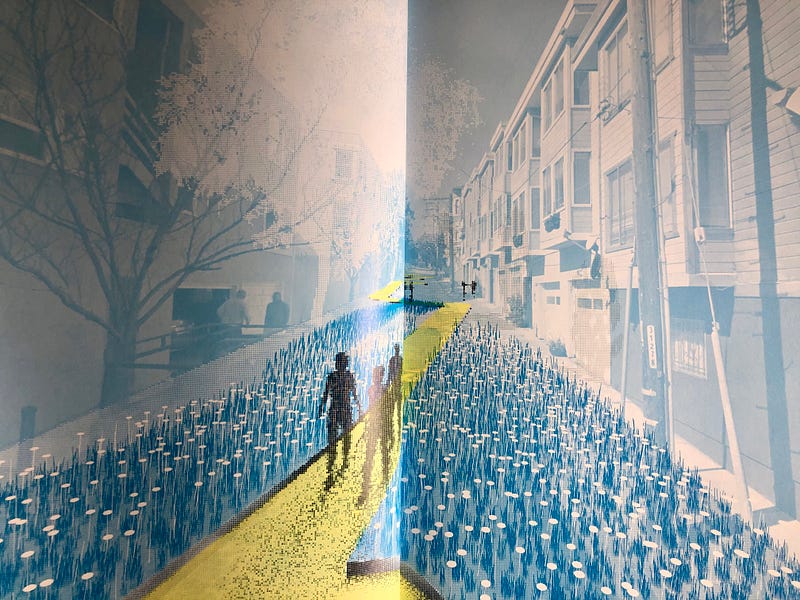
Although De Monchaux only nods to the potential cascade of co-benefits, this distributed ‘polka dot’ pattern of greenery could work as community gardens, effectively, with all the attendant benefits in terms of social interaction, mental health and wellbeing, playspaces, local food production, and so on, as well as the more infrastructural benefits of stormwater runoff mitigation, improvements in air quality and carbon reduction, biowaste creation to feed anaerobic digestors, reduction in urban heat island effect, and so on.
One can imagine kids playing in this kind of ‘infrastructure’, as it can largely be composed of active and productive greenery. Plus, it’s California. Gardens in that climate are places where life gives you actual lemons to make lemonade with.
Whereas a sewer is a sewer is a sewer; over-expensive, slow to build, destructive to the environment, inflexible, single use, cumbersome. Nor do you really want kids playing in it. That would be a little off, even for Trump’s America.
Importantly, this distributed ‘landscapes of care’ approach requires the community to effectively, and probably literally, own these spaces, taking care of them, as one must a garden — but also reaping the multiple benefits, from therapy to vegetables, as one does with a garden. The mapping, when overlaid with other layers of public information, indicates that these existing sites represent a kind of cartography of the care-less, are precisely those that need improvement and maintenance, and could thus begin to help resolve health inequality and social justice issues, not simply stormwater.
“As is the case in many other cities, data on public health and crime in San Francisco reveal abandoned sites to be prescient located in areas most in need of a safe and healthy environment — and off the map of the city’s existing investments. Perhaps also unsurprisingly, further data reveal these sites to center on areas most burdened by energy inefficiency, poor water management, and airborne contaminants.” — Nicholas De Monchaux, ‘Local Code’, (2016)
The team worked out that scale of this network of small urban spaces would “rival that of Golden Gate park”. This again indicates the active choice we must make about the patterns in play: one Central Park versus multiple pocket parks. But also, the potential of these approaches, conjuring a Golden Gate Park-equivalent out of what is effectively dead forgotten space, in a city where more obvious land is at a premium.
“Such a system would not only be able to improve urban thermodynamic performance, but its distributed, modular, and incremental nature would vastly increase the resilience of the city’s existing, essential infrastructure.” — Nicholas De Monchaux, ‘Local Code’, (2016)
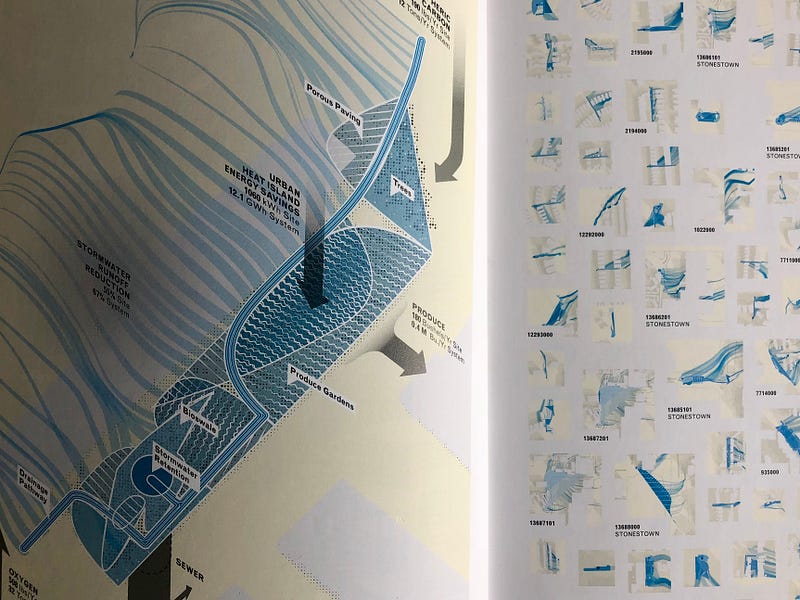
De Monchaux’s approach, despite the obvious, quantifiable and diverse benefits, still tends to be filed in the ‘too hard’ basket by most governments, local and otherwise, who have got out of the habit of building interdependent and shared relationships with communities around super-local infrastructure. In fact, it is no longer technically hard at all; simply a muscle that can be trained quickly and effectively via accessible software. De Monchaux’s work indicates that it’s a ‘known-known’, in terms of identifying spaces, calculating their output and performance, just as pre-cooked recipes exist for shared ownership and operation of such spaces, forged between communities and municipalities. It is just not standard practice, yet, as the mental model does not fit. I’ve worked with municipal governments all over the world, from Stockholm to Sydney, and most still shy away from this kind of engaged working, fearful of the commitment it implies.
In Les Misérables (1862), Victor Hugo wrote, “The sewer is the conscience of the city. All things converge into it and are confronted with one another. In this lurid place there is darkness, but there are no secrets.” A California framed by Mike Davis or The Maltese Falcon has secrets aplenty, and the idea of an infrastructure tucked away, producing a city of dead spaces, has plenty of options as to where to hide them. That idea of engineering-led urban planning can be seen emerging in Hugo’s Paris, as one of the archetypal cities of modernity.
Yet this alternative approach — of citrus trees and playgrounds as infrastructure, within a biodiverse and culturally-diverse pattern of small pieces loosely joined — brings that conscience to the surface in perhaps a different way to Keeanga-Yamahtta Taylor’s words implied, yet still with the possibility she suggests: pulling “what is hidden and buried on the bottom to the surface so that it can’t actually be ignored”.
Or, as Hugo had it, “all things converge into it and are confronted with one another”, but here in plain sight.
Working with these basic levers — data to locate spatial acupuncture points; landscape design shaped by algorithms drawn from environment; nature-based tech as everyday infrastructures; community to design, own, part-maintain and derive value— could enable entirely different forms of organisation of the city, springing up and flourishing in the gaps leftover by careless 20th century infrastructure. The dynamic is slow and fast, participative, digital plus physical, building a landscape of care and ongoing maintenance, gardening, attentiveness, empathy. The pattern is distributed, networked, with consistent scaling layers underpinning highly-distinctive super-local layers.
A distributed social infrastructure of small playgrounds, loosely joined
This is a quite different understanding of infrastructure, in fact closer to Eric Klinenberg’s definition of ‘social infrastructure’ than to sewers, even though the starting point was stormwater mitigation. De Monchaux’s pocket parklets, community gardens, and porous side-streets are clearly also physical places that can grow and knit together social fabric.
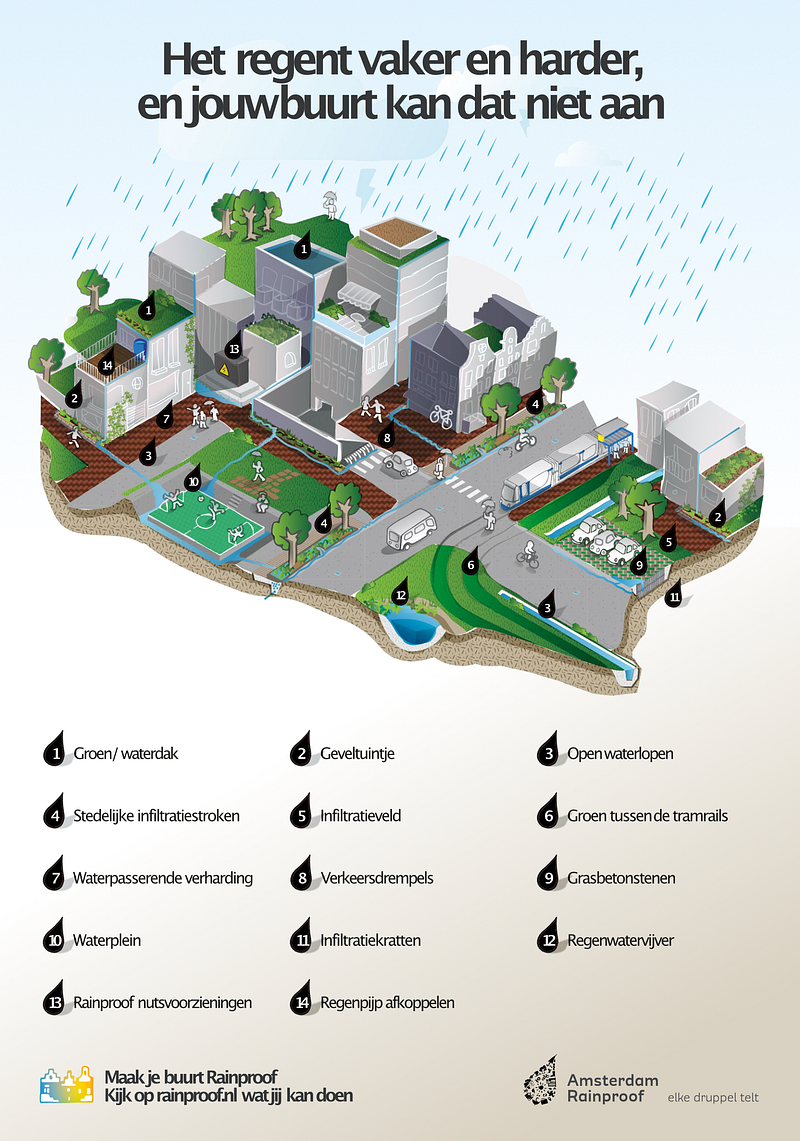
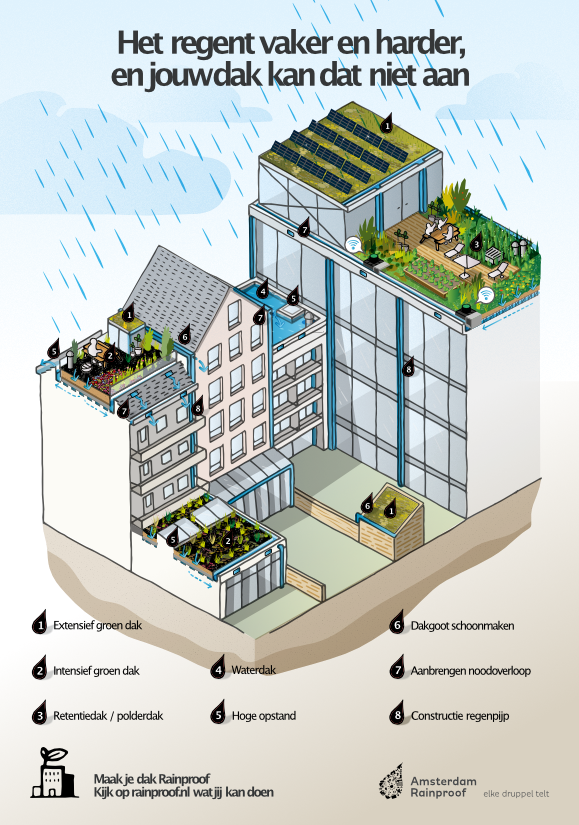
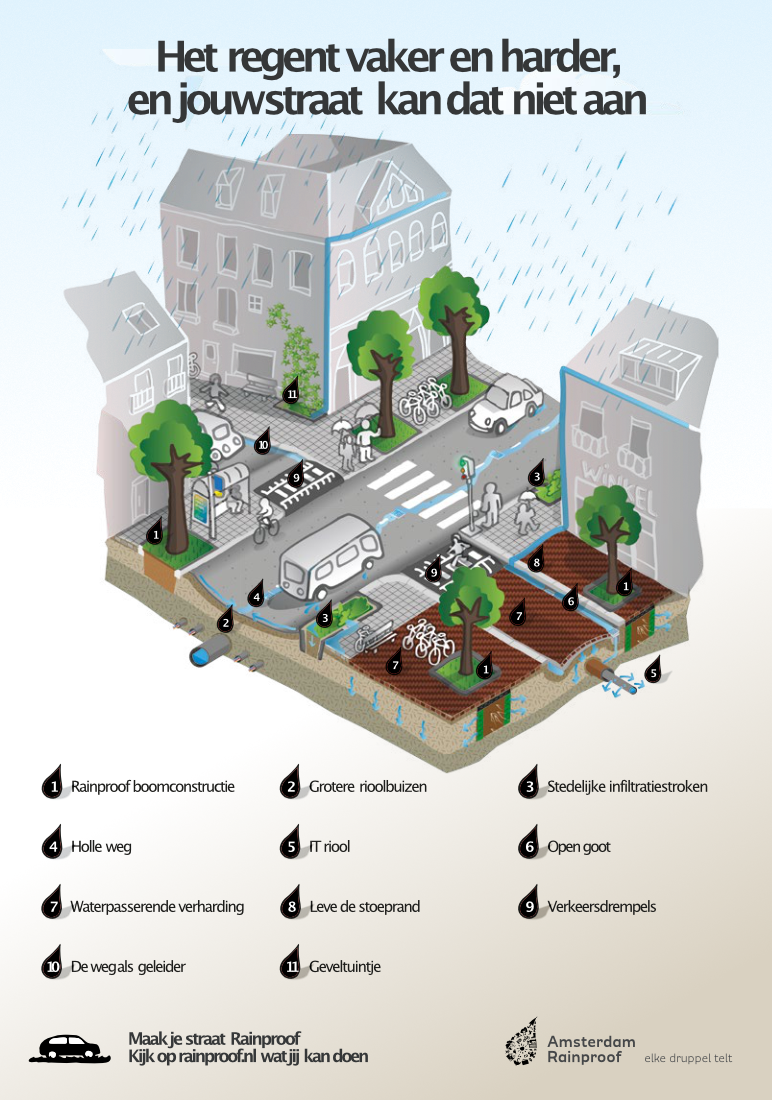
Locating in shared spaces may be the subtle step-forward beyond the otherwise excellent ‘Rainproof Amsterdam’ strategy. The pattern of Rainproof is also a distributed infrastructures of small plots, encouraging community engagement in stormwater-mitigating sponge city strategies. Yet it is largely aimed at private spaces, like front gardens, rooftops, and forecourts, tending to fit snugly within private plot boundaries. Whilst recognising that it is still ambitious, and highly valuable, this approach makes it easier to pursue, in a sense, but ignores the more complex, indeterminate and liminal shared space. (Similar infrastructural principles are at work in China’s Sponge City programme (2014–), of course, yet these are largely aimed at larger-scale deployments, such as permeable pavements, large parks, commercial rooftops. Thus find themselves locked in a battle with quantified ‘grey infrastructure’ and apparent lack of space, suggesting mental models have not shifted. De Monchaux’s approach does not attempt to fight on that battleground. Instead, it makes its own field, in previously ‘low-value’ space.)
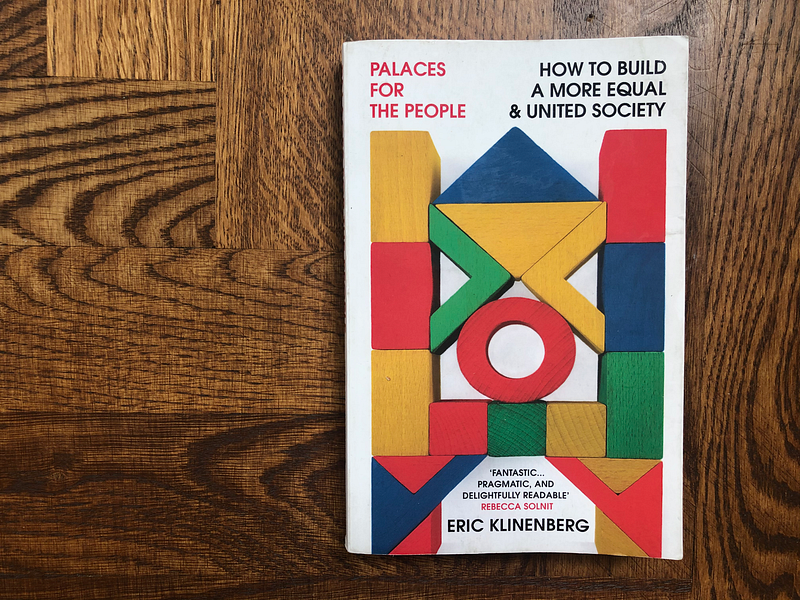
Klinenberg defines social infrastructure as:
“The physical places and organisations that shape the way that people interact … the physical conditions that determine whether social capital develops. When social infrastructure is robust, it fosters contact, mutual support, and collaboration among friends and neighbors; when degraded, it inhibits social activity, leaving families and individuals to fend for themselves.”—Eric Klinenberg, ‘Palaces for the People’ (2018)
Klinenberg’s set of social infrastructural elements are usually things like libraries, community gardens, pools, parks, markets, and so on, which he states are “crucially important, because local, face-to-face interactions — at the school, the playground, and the corner diner — are the buildings blocks of all public life.”
His work, forged in the deadly Chicago heatwave of 1995, itself a precursor of the conditions we are facing everywhere, should be recognised as a breakthrough in urbanism, and part of this great repositioning for the slowdown. These elements of social infrastructure should indeed be our primary building blocks, in that they fundamentally nurture social growth, the primary motive drive of the slowdown.
Yet de Monchaux’s absorptive gardens also do the job of hard infrastructure, and so it extends Klinbenberg’s definition via a very different kind of open-ness, accessibility and malleability. It replaces hard with soft, but it still performs hard’s tasks just as effectively, in this case by amplifying the softness of biodiversity. This softness not only absorbs stormwater, but community interaction, care, and the light-touch maintenance of pruning plants.
Equally, the patterning of the green pockets is important in itself. In its extremely distributed nature, it is akin to thousands of micro-libraries rather than one central library, borrowing a Klinenberg touchpoint. This means that surface area for potential difference is increased, affording the social dimension of the infrastructure the potential for massively increased diversity.
This can be thought of as a ‘small pieces, loosely joined’ approach, to borrow David Weinberger’s descriptive internet design pattern, which was highly influential in web design circles in the late 1990s. The internet was initially predicated on this form of resilience, with IP networks based around the idea of purposeful redundancy engendered by networks of multiple nodes, indicating a tech precedent for this pattern from well before parametric modelling, and equally built around a form of diversity, at least in the early days of the web.
Weinberger’s ideas for the internet have dated considerably (as have his metaphors concerning the ‘New World’). Two decades on, the internet has calcified around its own centralised corporate structures, unable to break free of the wider economic and political context, just as we have discovered that spatial and social characteristics do play out along the lines of “the real world”, the world that Weinberger thought would not define the Web.
“Our social connections until now have almost all been constrained by geography and atoms: the real world … Our every social act implicitly conforms itself to the geographic and material facts of the real world. But the Web is an unnatural world, one we have built for ourselves. The facts of nature drop out of the Web. … The Web has no geography, no landscape. It has no distance. It has nothing natural in it. It has few rules of behaviour and fewer lies of authority. Common sense doesn’t hold there, and uncommon sense hasn’t yet emerged.“ — David Weinberger, ‘Small Pieces Loosely Joined’ (2002)
The optimistic, perhaps naive visions that many of us shared in those days have turned out to be rather more complex, with all kinds of real world ideology and materiality leaking through and pervading discourse on the Web, hugely problematically. The internet has turned out to be just as likely to embody centralised and corporatised dynamics, the deeper cultural, economic and political patterns shaping the last few decades. And so, “real world” power structures were only reinforced as the Web began to meaningfully pervade “geography and atoms”, whether through smartphones, Uber, Airbnb or WeWork.
But Weinberger’s speciality is in the organisation of information itself. An information architecture of ‘small pieces, loosely joined’ still holds up, and it seems obvious how broadly equivalent to many urban narratives this is, whether a ‘theory of loose parts’, adaptive design, vernacular architecture, or in polynodal urban planning and post-traumatic urbanism.
For there are precedents that emerge from the soil decades before the patterns drawn by Weinberger’s or De Monchaux’s technologies. As I described previously, in Slowdown Paper 15, the hundreds of playgrounds that Aldo Van Eyck designed for post-war Amsterdam worked as a kind of ‘post-traumatic urbanism’, healing many of the scars on the city left by the Second World War, in precisely the same patterns as De Monchaux—and arguably Weinberger.
The ‘post-traumatic urbanism’ I referred to in Slowdown Paper 11 is Adrian Lahoud’s concept, detailed in Architectural Design Vol. 80 Issue 5, derived from cities where trauma has led to an inherent resilience forming around distributed networks with multiple repeated nodes, to ensure a form of backup. It is predicated on deliberate yet unplanned network redundancy: it is not efficient but it is effective, resilient, and produces greater character, and thus greater value.
These network redundancy patterns powerfully deny the logic of 20th century urban planning, which had their peak in the middle and end of the last century, as high modernism descended into a more disappointing bureaucracy of traffic planning (which in turn was largely driven around the needs of white men).
This form of ‘logic’, according to Michael Sorkin, “answered not simply to a paradigm of efficient movement but … a city that sought to distribute everything and everyone to its proper place in all four directions.”
Despite the claims of cyberneticians like Jay Wright Forrester, who claimed he had reduced the problems of the city to 200 parameters arranged over 150 equations, when such planning is driven by the technocratic instinct to optimise data to find a solution, it responds to only those variables that can be counted and correlated. These not only tend towards mundane efficiency measures (“How many people use this street?”) rather than something more meaningful (“Is it any good?”) but also entirely the betray the prejudices of the systems and institutions doing the data-gathering.
Lloyd: The IBM 360 can count more stars in a day than we can in a life-time. Don Draper: But what man laid on his back counting stars and thought about a number? — Mad Men, S07,E04
Van Eyck’s playgrounds exemplify instead a ‘polka dot’ of distributed accessibility, openness, and local public life, building blocks dropped into the detailed complexity of neighbourhoods and street corners, rather than the planner’s typical viewpoint, hovering a kilometre above entire districts, as if allergic to the ambiguity found at street scale. Humble but clever, adaptable and customisable, they mirror Weinberger’s design philosophy of distributed networked spaces, but rendered in the post-war material of the social democratic Dutch city, and thus fully rooted in the “real world”. It is an open structure, effectively ‘finished’ by the street itself. Given that the primary mode of engagement is play, invention is guaranteed, baked into the entire proposition.
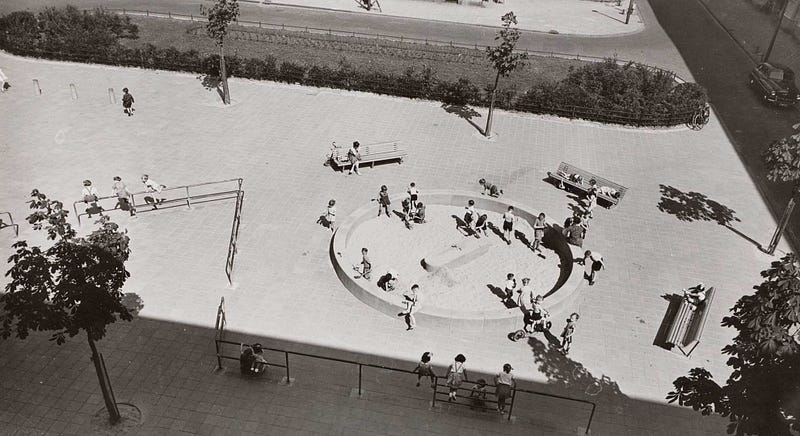
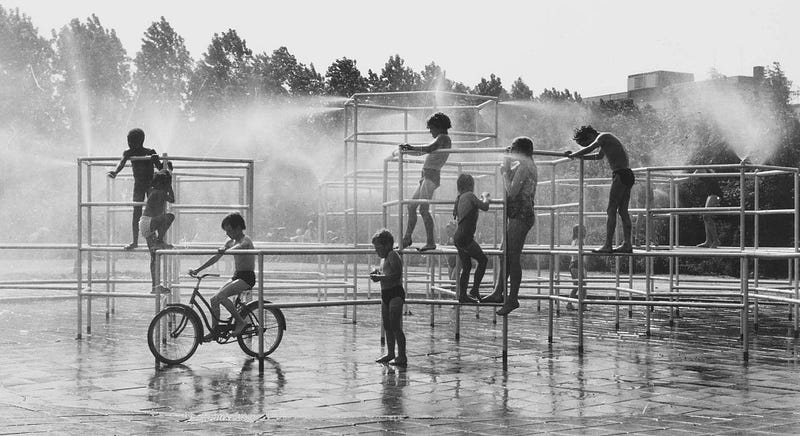
Commissioned by Gemeente Amsterdam’s Jakoba Mulder in the Public Works Department, over 700 playgrounds were realised between 1947 and 1978. Constructed in the near-random distributions of ruins and bomb sites originally, the web of small playgrounds helped stitch together communities and neighbourhoods, eschewing a centralised model of grand civic gestures — the great parks of Central Park or Hyde Park, perhaps, or a large playground like Copenhagen’s Tivoli — in favour of discreet spaces, tucked into corners, pockets, and the ends of streets. Lefaivre and Tzonis (1999) called this a “starry sky” of over seven hundred play spaces, yet by exerting itself in the dusty material of the ground plane, the programme helped suture the city back together. They claimed the street space for people and play, at a time when the another contemporaneous battle for the city — this time with cars rather than Nazis — was beginning to be intense.
In their reliance on the community effectively ‘finishing the job’, by bringing life, play, and ownership of the space, and in time modifications of the kit, within a distributed, polynodal pattern, it traces what I call a ‘non-grid’ pattern (as a more civic-minded extrapolation of Banham, Barker, Hall and Price’s ‘Non-plan’ proposal of 1969.) This smaller, distributed pattern also necessitates a fundamentally different relationship with the neighbourhoods such networks are embedded into; one of care, repair, adaptation, maintenance, engagement.
Tech in, city out
Across both De Monchaux and Van Eyck, the outcome is network of playful, green and engaging spaces, sprouting in a bed of super-local social interaction, whilst also affecting hard infrastructure. But it’s almost impossible to produce the scale and diversity of de Monchaux’s approach without the availability of digital tools and, we might argue, a ‘small pieces loosely joined’ non-hierarchical political dynamic derived directly from an early philosophy of the internet. Although Van Eyck might have recognised the pattern of the play, the new tools make this different landscape now genuinely possible.
We can think of De Monchaux’s approach as ‘tech in, city out’, where the outcomes are far more important than the technology, and yet the use of technology is fundamental to achieving transformative outcomes for the city. With this approach, one could imagine deploying robots to humanise the street whilst allowing nature its head—it is entirely counter an approach predicated on technology’s own terms; the city (human and nonhuman) comes first.
This purposeful engagement with the real world of diversity at street level, whether adapted by people or vegetation, is a far more open proposition than typical urban planning: primarily, and fundamentally, it is open to social change, as well as to climate resilience. This makes it quite different to technology for technology’s sake, as we’ll see later.
As with post-traumatic urbanism, the scattered and heterogenous landscapes of Van Eyck and De Monchaux are organised via a kind of ‘polka dot pattern’ spread across the city’s fabric.
COVID patterns of small markets, loosely joined
Interestingly, a similar pattern is inadvertently being delivered in many places right now, due to the COVID-induced lockdown, as increasingly ‘mixed-use’ neighbourhoods are suddenly full of people working, learning, playing, and living. By shifting knowledge workers at least into mass home-working, the mobility patterns typical of towns and cities have been turned on their head, and the centre cannot hold. This distributed model is suddenly everywhere, with many people apparently discovering their neighbourhoods for the first time, and the idea of the neighbourhood itself shifting to rediscover earlier models, of the distributed mixed-use environment, balancing the more complex ‘greater than the sum of the parts’ demands of culture, commerce, conviviality, and community, framed within a more delightful and restorative ecological environment, and no longer simply an accumulation of residences.
Dutch designers Shift Architecture Urbanism’s proposal for ‘hyperlocal micromarkets’, noted in Slowdown Paper 16, could also be filed under ‘post-traumatic urbanism’. This is not surprising, given the corona-induced lockdown conditions it was produced under, yet they do not consciously make the connection. Their distributed model of ‘hyperlocal micromarkets’ is initially predicated on solving the challenge of social distancing in traditionally crowded food markets, describing cautious queuing strategies to enforce distancing, but the broader dynamic and strategic distribution implied by Shift’s proposal is far more profound and useful than the short-term tactical goal of distancing.
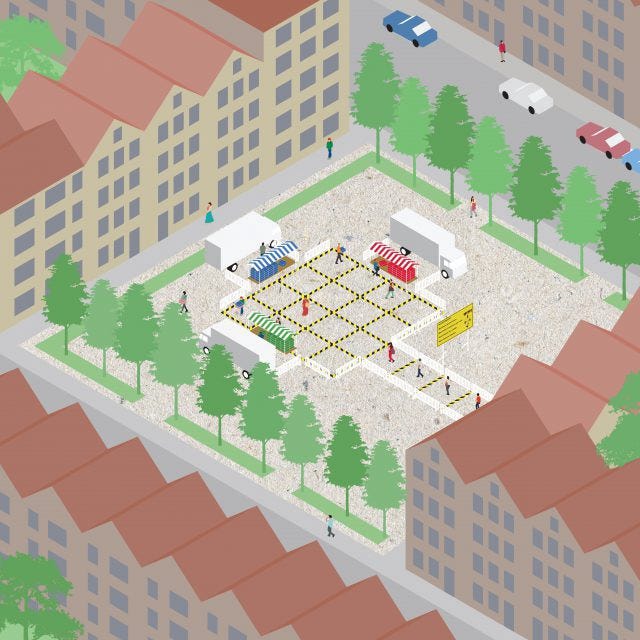
Using Rotterdam as its case, the hyperlocal micromarkets model takes the three large markets in the city and breaks them into smaller units, distributing market across the city, into multiple neighbourhoods-scale modular units.
In this way, distributed markets can reintroduce diversity, local engagement, provenance, and cultural identity into the city’s food systems, as well as increase access. In the midst of Black Lives Matter as well as the virus, we can see the value in the local cultural expression, responsiveness, and ownership that this increased surface area could afford.
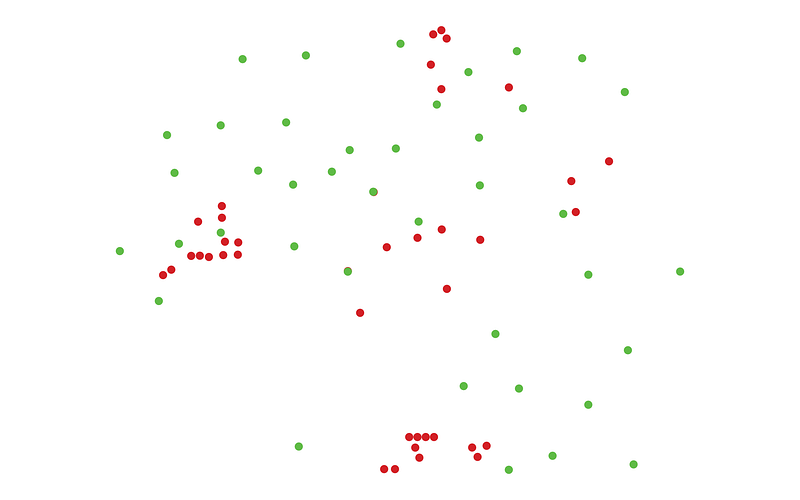
In perhaps subconsciously tracing their fingers over the scatterplot distribution of Van Eyck’s playgrounds, they’re in line with some broader impacts of COVID-19; destabilising the ‘CBD’ model, along with the overblown commercial property sector, and potentially refocusing on diverse, resilient neighbourhoods.
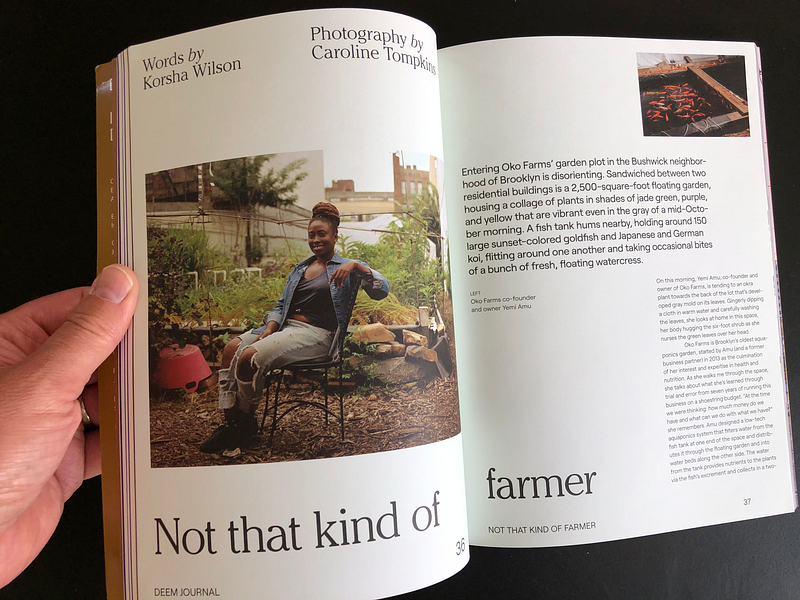
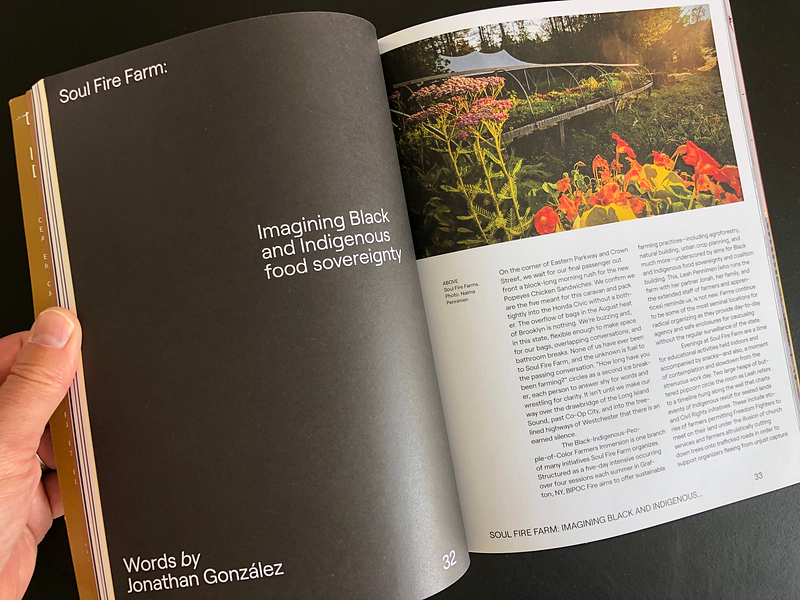
Pixel farming‘s small crops, loosely joined
In quite another context, a further example of this polynodal pattern can be found in the ‘pixel farming’ research conducted at University of Wageningen, by Lenora Ditzler and others, and described in AMO’s Countryside exhibition. The concept of pixel farming may be best captured in Ditzler’s description:
“A super complicated futuristic farming system that looks and acts like nature but can only be managed by tender swarms of tiptoeing ecofeminist robots that haven’t been invented yet …”—Lenora Ditzler, in Countryside: A Report, AMO (Taschen 2020)
As a form of intensified, highly distributed and diversified companion planting in 10cm by 10cm plots, only possible through alternate technology models, different notions of environmental care, and fundamentally reversed paradigms, pixel farming captures the different dynamics and patterns of this ‘small pieces loosely joined’ slowdown design sensibility.
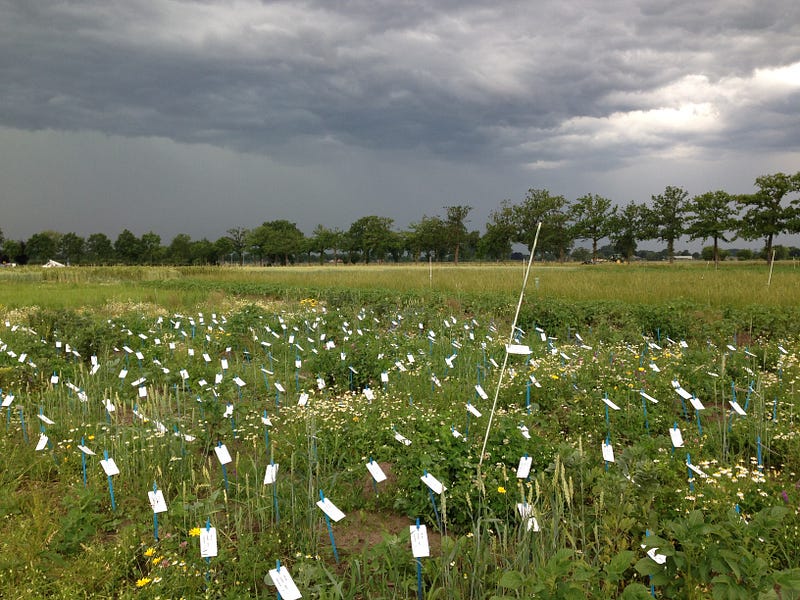
In AMO’s catalogue Ditzler describes how they “flipped the normative framework”:
“Rather than designing farming systems to control ecological processes in favour of mechanisation and efficiency, they argued that farming systems, and the technologies built to enable them, should be designed to support and enhance ecological processes. The pixel farming narrative put ecology first, and other outcomes (like food production) second: if you take care of the ecology, even with machines, the rest will take of itself.”— Lenora Ditzler, in Countryside: A Report, AMO (Taschen 2020)
Again this is a kind of non-grid networked distribution that enables massive diversification, an adaptation over time which is generative, regenerative, and resilient. As the pixel farms grow, Ditzler says “the grid is still there but it’s become hard to see”, inadvertently echoing the forms of organisation produced by De Monchaux’s junkspace-locating geospatial algorithms and Van Eyck’s near random distributions of bomb sites.
“Research has also shown that smaller field sizes and higher resolutions of diversity within the field (i.e. smaller-scale intercropping) can deliver more ecosystem services than bigger areas of sole crops (6–8). Inspired by this evidence, we initiated the WUR pixel cropping experiments to test ‘extreme’ levels of in-field crop diversity. We want to know if simultaneously introducing diversity in three dimensions (space, time, and genes) and at high resolutions can maintain good yields and also deliver other agro-ecosystem services.”—Pixel cropping, University of Wageningen
There is much to draw from in Ditzler’s approach, both literally and metaphorically. Although the idea of deliberately ‘co-locating companion species’ would be problematic outside of the context of vegetation, perhaps, the notion that cities can intrinsically generate companion species is appealing, working with forms of ‘extreme diversity’ within organic biodiverse grids. It’s worth noting that the more heavy-handed approaches to urban planning and governance have followed precisely this idea of co-locating groups of humans, but usually resulting in segregation rather than integration, a ‘safe’ lack of diversity rather than mixed companionship. And so little companionship emerged as a result.
There are alternate precedents here too, however, such as Singapore’s Ethnic Integration Policy for its extraordinary social housing infrastructure. Noting the fundamental differences between the species in question—in many ways, humans are not the same as potatoes—is there anything we might learn and develop from the more advanced, engaged, care-ful and precise models of companionship that Ditzler is prototyping in the context of agriculture?
To be clear, this is not a suggestion that we copy-paste the idea of algorithms selecting over different types of human, as if they were tomatoes and asparagus, and then tend to them with attentive robots (which is another Singapore move, perhaps). Instead, what might we draw from Ditzler’s practice of farming—or at a more prosaic level, gardening—which simply describes the value of this constant need for care, shaping, and nurturing and the pursuit of resilient and generative diversity, yet without the strict and segregating control mechanisms of previous approaches?
As with De Monchaux, Ditzler deploys spatial information systems, yet at a far finer grain, tuned to the scale of potatoes rather than parking lots. Her mention of “ecofeminist robots” indicates a subversion of technology’s hierarchy, undercutting the idea of control mechanisms, exposing the inherent prejudice previously built into agricultural machinery, and pointing tech instead at social justice goals as well as health and climate agendas. Again, this is a very different conception of robots.
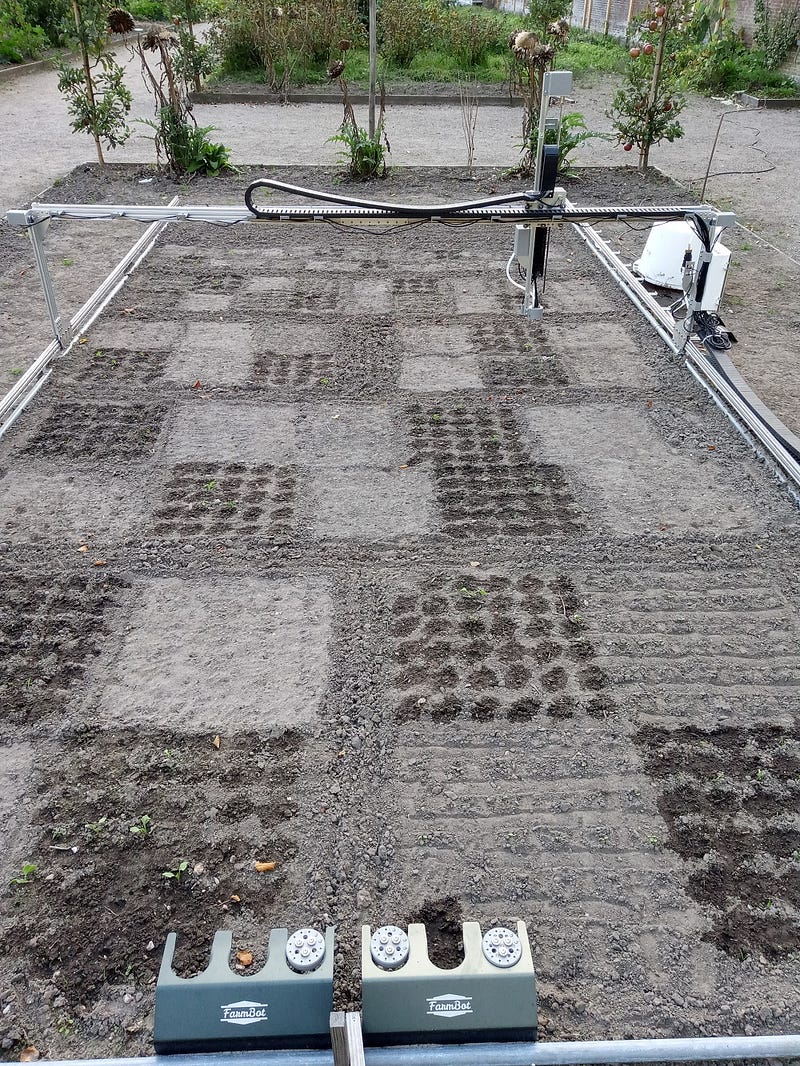
This ability to bend tech to work with a distributed fine-grain at-scale, aligned around societal goals that necessitates the involvement of humans and nonhumans, suggests ‘upstream’ patterns of agriculture that would fit in De Monchaux’s streets and Van Eyck’s playgrounds just as much as Ditzler’s fields. Given its potential to work in small, diverse spaces, what would pixel farming look like in the street, when aligned with the diverse community farming models now emerging in cities?
The One-Minute City of the street
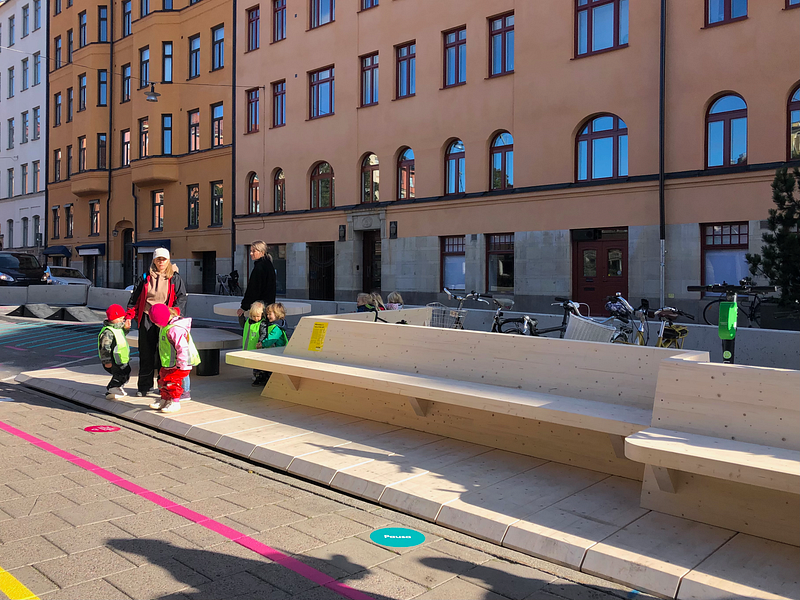
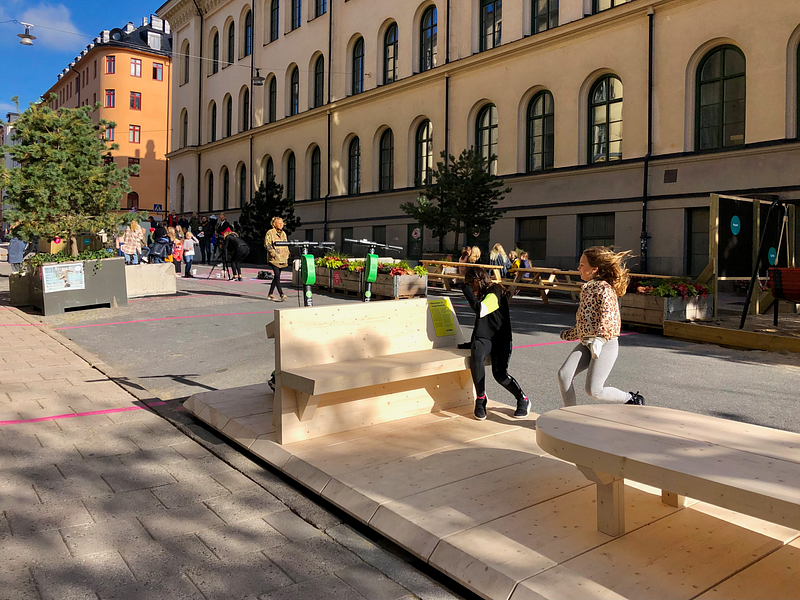
Finally, some of my own recent work at Vinnova is also predicated on using a ‘small pieces loosely joined’ model for retrofitting streets in Sweden. I’ll explore this in more detail in a subsequent Paper here, describing its focus on what I call the One-Minute City, and also in a separate entry at Dark Matter and Trojan Horses, describing the strategic thinking and practice behind it.
But in brief, the mission framed as retrofitting every street in Sweden, ‘repairing’ them to ensure they are healthy, sustainable, and full of life, of diverse human and nonhuman kinds. It seeks to take advantage of the fact that we’ve already built ~40,000 km of street in Sweden, fully distributed throughout our towns and cities, and thus can also follow this small pieces, loosely joined patterning.
In fact, the interventions proposed are literally ‘small pieces, loosely joined’, comprising a modular, adaptable kit of wooden street elements which can ‘eat’ parking spaces, transforming streets from motor vehicle-dominated spaces into socially diverse and biodiverse places, one parking bay at a time. The first streets launched in Stockholm this week, and it was incredibly gratifying to see the same schoolkids who had designed the street jumping up and down on trampolines, positioned in what used to be parking lots.
It too follows this adaptive, iterative, distributed pattern, working in the gaps left by previous modes of development, and emphasising social and ecological progress rather than propping up old economic paradigms or rusting governance frameworks.
In terms of patterning, it’s trying to exploit this pre-installed infrastructure of streets, recognising that on-street parking spaces are also a kind of ‘small pieces, loosely joined’ infrastructure. These spaces thus become a lever that the city can pull, changing the application that sits on top of this platform. These spaces do not have to have cars in them (although the Swedish Transport Regulatory Authority are part of our project team, so we understand what the law actually says about this—and what it may need to say in future.) Pulling the lever in this way, working with the existing infrastructure rather than new-build, enables us to change the use of these most fundamental of urban spaces for minimal cost and effort: where once it was asphalt and cars, now it is wooden seats, swing sets, bike racks and gardens – in the same space. It is the necessary first half-step towards transforming the street more fully.
In this, it is an extended idea of Klinenberg’s social infrastructure, but overlaid onto distributed chunks of hard infrastructure, exemplifying this shift from individual ownership (the car) towards shared ownership (the street), just as it materially evokes the shift from concrete to wood, from cars to bikes, from pollutants to plants.
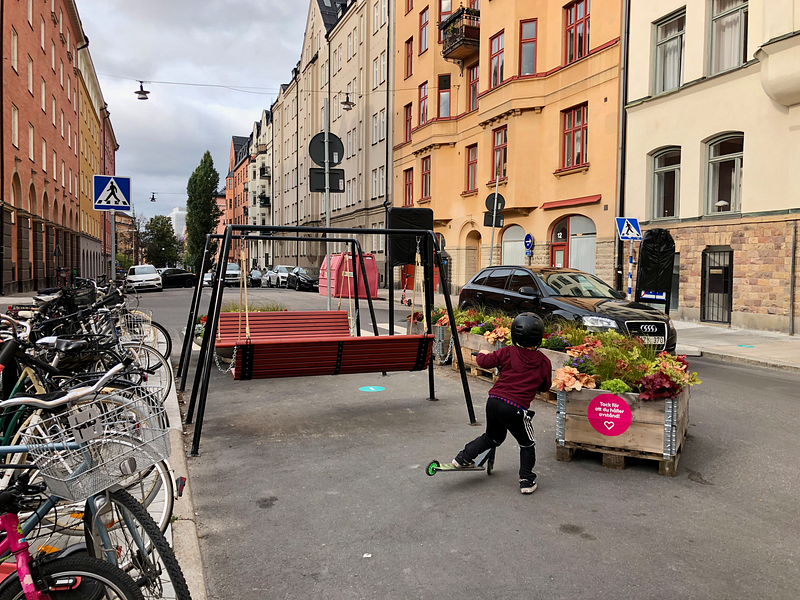
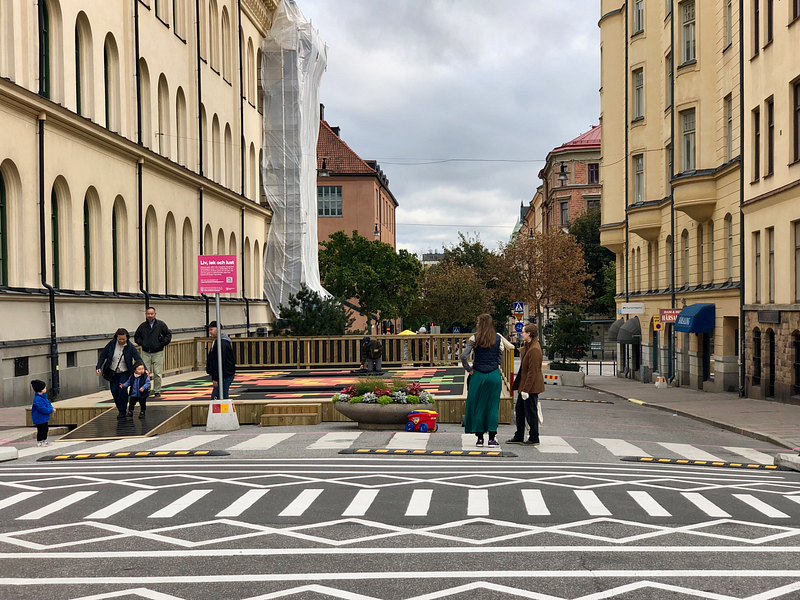
Urban planning has a nasty, brutish and long history of avoiding all of the above, in foregrounding the needs of a wider system, dislocated from place, in order to destroy local particularity, consciously or unconsciously. The most egregious example, especially clear given our present moment, is the mid-century freeway expansions across the USA, and their associated segregated urban development, which laid waste to long-standing African-American communities. This has left the discipline wide open to accusations that it was simply a tool of white supremacy. (This was not only happening in the USA, clearly: in other countries, urban planning often similarly laid waste to communities and histories; just different ones.)
We must remember—particularly given the context of apparently fervent interest in digital twins and data-driven planning—that these moves were framed entirely as the work of evidence-based professionals, often in public administration. Yet they primarily, and often exclusively, served the needs of white suburbs, and the fossil fuel and automobile industries.
Linda Poon clearly articulates why the Black Lives Matter marches occurring on some of these freeways — I-94 in Minneapolis, I-630 in Little Rock, Arkansas, I-40 in Memphis, Tennessee, and I-75 in Cincinnati, Ohio — is deeply symbolic. That these protests occupy these particular spaces make perfectly clear, in stark black and white terms as it were, that “highways and racial injustice (exemplify) the kinds of systemic issues that many protesters are now seeking to challenge. Policies that on their face may have appeared to be about easing transportation barriers and revitalizing cities were — and still are — often rooted in longstanding racial prejudice, and carried with them cascading effects that worsened pre-existing inequalities.”
The Minnesota Governor Tim Walz stated “It wasn’t just physical — it ripped a culture, it ripped who we were. It was an indiscriminate act that said this community doesn’t matter, it’s invisible.”
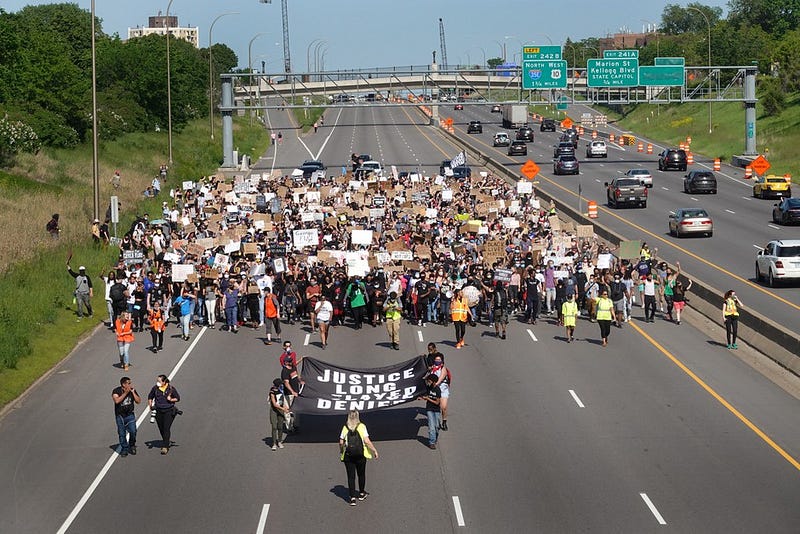
Kyle Shelton, of Rice University Kinder Institute for Urban Research, continues, “Given the fraught history and ongoing issue of highways dividing and demolishing black and lower-income communities across the United States in the name of improved mobility, protesting racial injustice upon those very lanes carries a greater weight. In these actions, public rights-of-way become far more than conduits for protest. They are contested sites where questions about access to — and safety within — public space intertwine with confronting police brutality, racial injustice and community disinvestment.”
Whether these highly specific protests were guided by urban planning historians, or by protestors simply implicitly understanding that they should occupy these particular spaces, as if a finger tracing an old scar in the flesh, is not clear. What is clear is that, until now, much urban planning, dominated by the mutually-exclusive and destructive dynamics of transport planning, has been discriminatory in essence and in practice — whether racist, as with these freeways, or sexist, in terms of foregrounding the desires of male car drivers over the needs of a more diverse population, or more besides.
A wonderful article by Sara Hendren describes how the simple ‘kerb cut’ in our streets physically represents this kind of battle, in this case for accessibility and against narrow ideas of norms.
“Streets have long been designed for working men with physically strong bodies and no meaningful caretaking responsibilities — no obligations to parents or ailing siblings or offspring — not the kinds of caretaking that create a clunky, inefficient, assistance-borne passage through city streets to get to the places a body needs to go.”—Sara Hendren, ‘The Forgotten History of How Accessible Design Reshaped the Streets’, Bloomberg CityLab
Moving forward cannot simply be a matter of trying harder, yet hovering at the same abstract scale of cities and districts, but finding a way to collaborate at the scale of the particular, the small, the local, the “down to earth”.

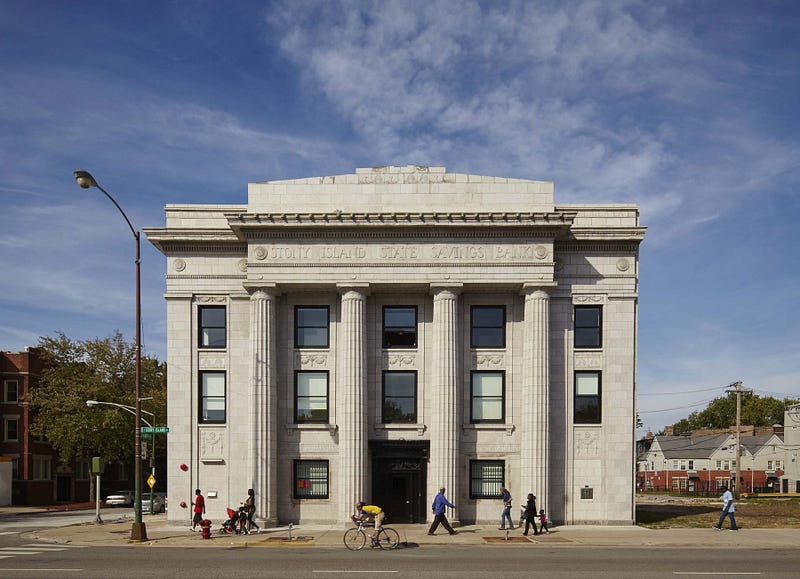
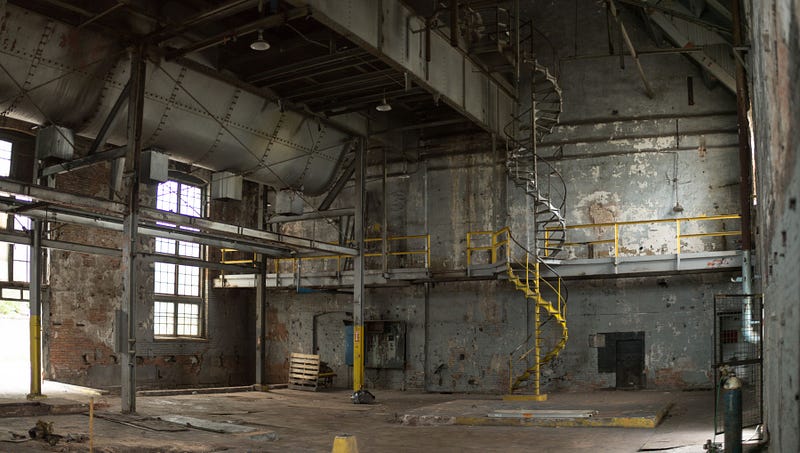
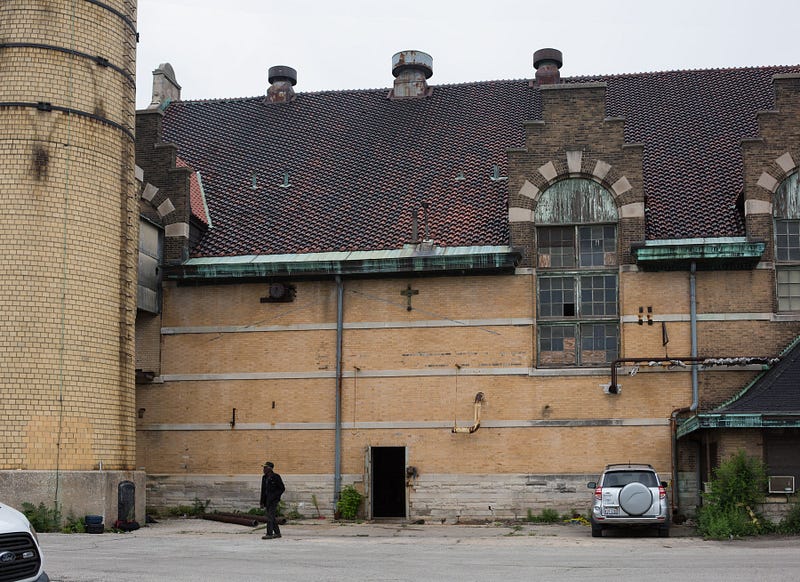
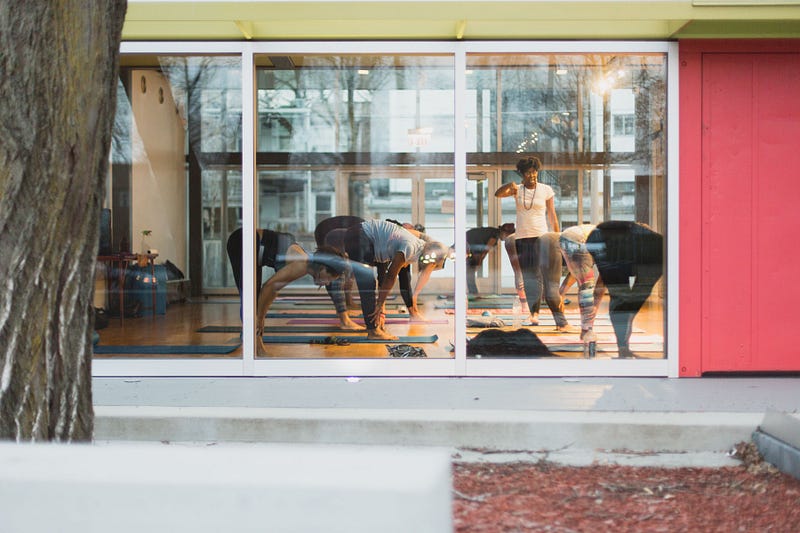
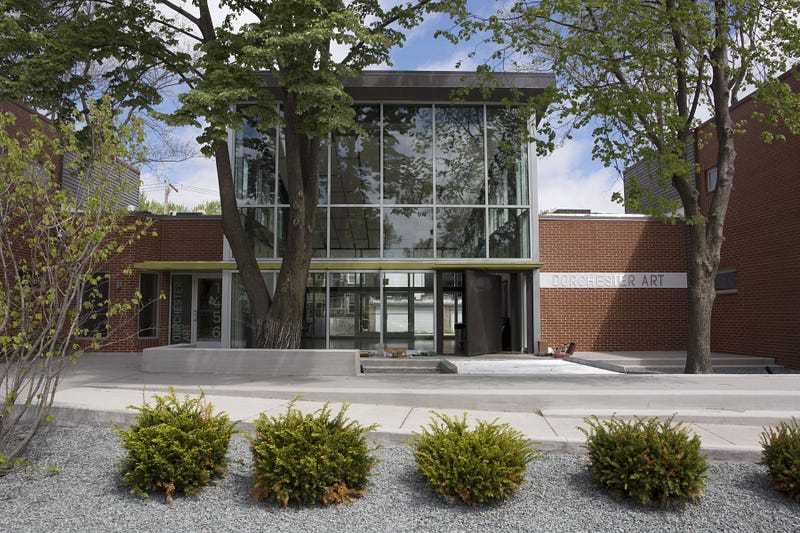
Since 2007, the artist Theaster Gates has worked with the University of Chicago to renovate block after block of the South Side of Chicago, now organising a ‘portfolio’ of over 80 previously vacant buildings, each reconditioned and repurposed for studio spaces, small scale manufacturing, gardens, and more besides. He describes this as “simplifying to start a new complex order”, perfectly capturing this sense of simplification (“It’s just a building”) in order to enable complexity to flourish (“It can be so many things simultaneously.”) Such projects include Stony Island Arts Bank, Chicago Arts and Industry Commons, and Dorchester Art and Housing Collaborative, each seeming to encapsulate a new logic of care and retrofit.
Artists, as with local communities, tend to be able to handle the constantly shifting figure-ground complexity of connected systems perfectly well, on the whole. It is our simplified systems of governance and economics that struggle here, perhaps due to their self-imposed abstractions. Those once apparently necessary over-arching structures, remaining absent from the reality of place, have been sliding issues like social justice, the environment, and public health under the carpet, rather than actually addressing them.
There is another ‘figure-ground game’ in play now, exemplified by the likes of Gates. We can remain directly engaged with the reality, complexity and detail of particular spaces and places, humans and nonhumans, whilst thinking at several scales simultaneously, aware of the impact of the particular on the general, and vice versa. It is not hard to redevelop a building, and think and work through the impact on the neighbourhood, the city, the region (recall the Saarinen Principle.) It seems easier to do this when working from the particular to the global.
This emphasis on culture, in the several senses of the word, helps convey how to develop a ‘small pieces, loosely joined’ pattern. In suggests a necessary engagement with the ground of streets and neighbourhoods, and the cultures that inhabit and embody them, as well as the big picture of cities. It means working with the reality of systems in places—recall Jane Jacob’s self-effacing line, “I just describe the things as they are”—and the way that people create them, adopt them, adapt them, use them.
Bryan Boyer, when planning the new Urban Technology course at the University of Michigan, describes this as a fundamental shift in planning and design, from focusing on making the city to using the city. This requires a zoom into the particular. The other way around, dropping policies and plans from the top down, just like trickle-down, has not worked, and will not work.
“Simplifying to start a new complex order”—Theaster Gates



With the forced and rapid evolution of streets under COVID-19, the urban planner Destiny Thomas has spoken forcefully of the way we must proceed. We must take care not leap ahead to a built form outcome, even with something so apparently intrinsically ‘good’ as open streets, without first assessing the power structures that build up or tear apart our cities and their people. There are reparations to be made here too, of a kind.
If institutional actors like urban planners and policymakers do not thoroughly re-examine a history of mere consultation, rather than genuine collaboration and participation, then even something as apparently self-evidently good as newly planted street trees can—and arguably should—be rejected by a community. Trees can produce more equitable places and communities, yet like any infrastructure and environment, they can divide as much as collide.
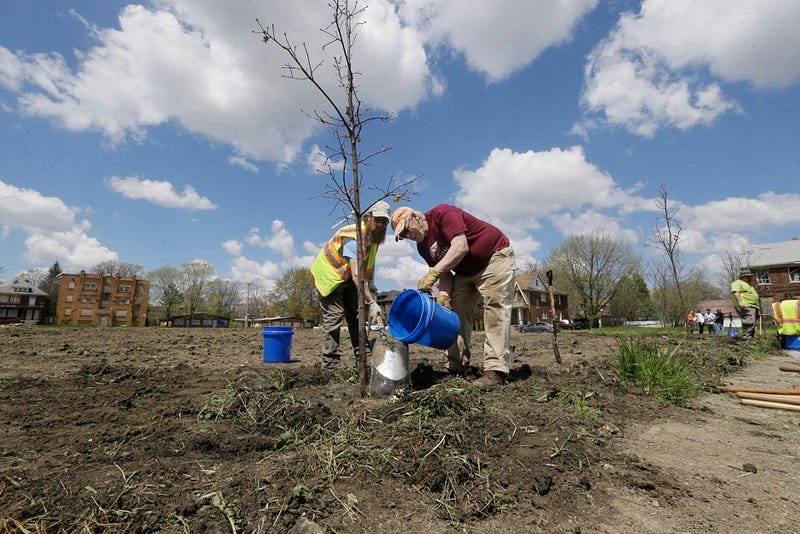
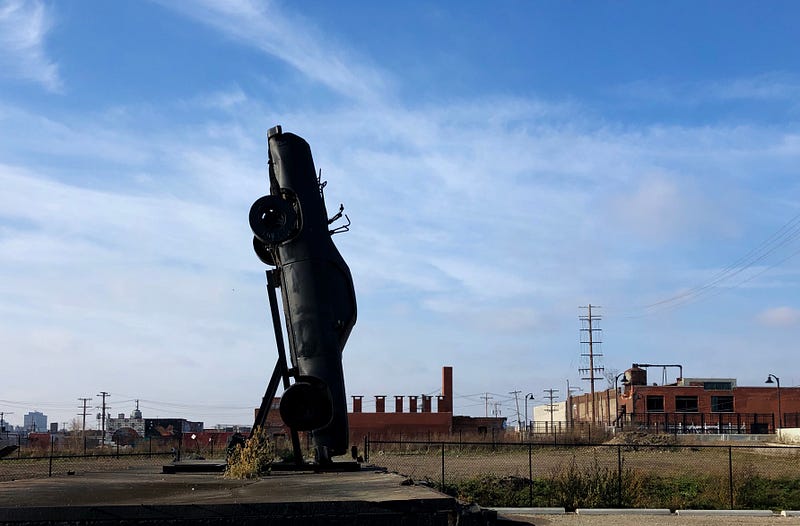
It is perhaps no surprise that this is precisely what happened in Detroit, at least to some extent, given its institutional and environmental history. Yet with that context recognised, the city could be the most powerful leader through this next transition, these crucial next few years, as an American Slowdown City avant-la-lettre—the epitome of the Great Acceleration, and first into the Slowdown decades ago.
Clearly, any such desires and drives must come from within the city; it a place, a people, rather than a petri dish for the rest of us. Yet its history over the last century does position the city as a proving ground for new dynamics of repair, maintenance, care, culture driving questions of urban growth and development. It will take a mammoth shift in practice. As Brentin Mock’s article describes, the powerful research by Christine E. Carmichael and Maureen H. McDonough—published in the Journal of Society and Natural Resources—indicates that shredded social fabric produces such mistrust that even the benevolent offer of re-planted streets becomes problematic, with entirely different folk and institutional memories about why Detroit’s trees were removed in the first place.
“They felt they should have a choice in this since they’ll be the ones caring for the trees and raking up the leaves when the planters leave. They felt that the decisions regarding whether to cut down trees or plant new ones were being made by someone else, and they were going to have to deal with the consequences.”—Christine E. Carmichael
“It’s not that they didn’t trust the trees; they didn’t trust the city.”—Brentin Mock
Streets are crucibles for these more fundamental questions of who we are, what we care about, and how we make decisions together. It’s absurd that we have relegated these potent places into the province of such numbingly tedious and pointless questions of traffic planning. And yet even the fact that merely trying to displace car parking becomes such a scrap—and so fierce, so rapidly—should indicate there is something more fundamental going on here.
This potency indicates once again that overly-quick pop-up ‘tactical urbanism’ is not enough. Whilst it can kickstart the process, it is not thorough, considered, representative or really, care-ful, enough for something as important as the street. In fact, some of the interventions could be unintentionally counter-productive. Sara Hendren again:
“Reshaping the built environment is never simple, and when it’s rushed, as in “quick build” efforts that are devoid of equitable participatory feedback, those efforts may backfire and reinforce the thick injustices — along racial, class-based, or ability lines — that they promise to mitigate.”—Sara Hendren
Others complain that transforming our streets is too simply slow a process, or that the approach does not scale. The latter can be quickly seen as absurd: streets are one of the pre-eminent examples of something scaling, perhaps the most widespread, in fact. As for the former, the slowness of streets, as solid chunks of city, is also their value. Streets last centuries, and transforming them can produce long-lasting systemic change, using faster moving layers (the applications that run on the street) to subtly change slower layers (the heavy fabric, the underground conduits, the trees’ roots) over time. Few other interventions could have such powerful long-term impact.
Rory Hyde, in Disegno’s Lockdown Papers, notes that London’s “ask for forgiveness, not permission” approach is welcome at first blush (for we all know many projects need not take as long as they do; it is generally not for good reasons.) Yet this approach perhaps inadvertently sends the wrong message about consultation, engagement, and participation, particularly at a time when ownership of the street is so fiercely contested, quite rightly.
“This implies that the work of engaging local communities is an impediment to the delivery of projects and is merely about gathering public support to ease the passage of schemes which have already been decided … (These processes) are critical for ensuring that any changes made are equitable, and that those who make the changes are accountable.”—Rory Hyde, Disegno
However, the changes themselves are only heading in one direction, just as street trees will return; the challenge is in making the changes equitably, with deep participation and therefore genuine local ownership of decision-making (at the street level itself), and finally ensuring that we prioritise social justice questions over traffic planning. Hyde has it about right when he concludes, “These issues are deep, and they will not be solved by urban design, no matter how progressive or enlightened it is. But equally, it would be wrong to dismiss bike lanes as merely the ignorant dream of privileged urbanists.”
Leaving aside the common American perception of bike lanes (they’ll figure it out at some point), you can start with the diverse streets as a way of addressing social justice, or you can start with broader aspects of social justice and at some point translate that into diverse streets. Either way, the material reality of streets — including what we do in them, how we move around, and the collective impact on the city and its peoples — drives inequalities and injustice, poor health and diminished biodiversity, or the very opposite of these things.
The street provides a proving ground for dealing with many complex questions facing us, across the landscape of climate, health and social justice. At Vinnova, we are seeing the street, as well as other archetypes in our ‘place-based missions’ approach, as just this kind of mechanism.
This reckoning with complexity incorporates what I would call a ‘soft eyes’ approach, after a memorable aside uttered by Baltimore homicide detective Bunk Moreland in The Wire (described here). The soft eyes approach deliberately blurs, zooms out, and drifts between multiple focal points, in order to better consider the big picture, the fundamental interconnectedness of all things. It is a counterpoint to the analytics-led data-driven ‘hard eyes’ approach, typical of many planning cultures. To follow Theaster Gates, it is “simplifying to start a new complex order”.
Soft eyes are perhaps better attuned to understand what Jonathan Raban memorably described as the Soft City, back in 1974. In this context, we might imagine ‘soft streets’, conjuring multiple sensibilities: subjective perceptions, evanescent social contexts, ephemeral events, diverse cultural expression, historical precedents, misunderstandings and recombinations, multi-species biodiversity, softer more pliable and flexible landscapes, more fluid and diverse patterns of activities and movement.
COVID-19 has inadvertently thrown open the window onto these softer streets, and the different approaches to making them happen, seeing them in new ways, with ‘soft eyes’.
Yet it’s the Slowdown that could fundamentally allow the street to be entirely reconsidered: something closer to ‘rambunctious garden’ than neutered rat-run, a place for politics rather than parking, an elongated piazza that generates fruit and vegetables as well conversation, conviviality, and culture, rather than simply bad air, fear, and isolation.
To some extent at least, COVID-19 has foregrounded the importance of these public spaces, as Nicholas de Monchaux described in the New York Times:
“Equal, accessible and resilient public space can promote civic health during a pandemic. Over the long term it will promote the health, welfare and equality of our cities for decades to come. For in the end, urban resilience is not purely a physical, nor a social, nor an economic goal. It is one, like well-made streets and sidewalks, that should connect every part of public life.”
Such urban resilience can be produced by precisely these ‘small pieces, loosely joined’ models — whether Shift’s markets, Van Eyck’s playgrounds, De Monchaux’s absorptive gardens, Lahoud’s post-traumatic urbanism, Sweden’s streets, or Ditzler’s pixel farming . This form of patterning suggests several aspects simultaneously.
- In each example, the surface area for potential difference is increased, lending them the possibility of both super-local diversity—cultural and environmental—and systemic change at scale.
- Each resists the paradigm of efficiency whilst being highly effective.
- Each addresses social justice and culture at the same time as climate and health, by consciously developing soft and social infrastructures rather than hard infrastructure, and relying on participation not as a tactic, but as a strategy.
- Multiple forms of value are produced, not simply the easily-measurable residing within a single silo.
- Each grows from the ground up, by starting with a ‘down to earth’ sensibility. Ownership is as local as possible. And yet each is recognised as being part of a system of impacts, so the key urban condition of producing something ‘greater than the sum of the parts’ prevents against atomisation and individualisation.
- Given the context of Slowdown dynamics focusing on social growth, each can thrive, moving upstream, to produce landscapes of care.
Next: 29. Slowdown landscapes: Street fight
Previous: 27. Events are not enough
Intro to third batch: 19. The waters draw back, only to return
Intro to Slowdown Papers: 1. Writing the coronavirus to memory
Index: All Slowdown Papers are here


