
Heartache In Cambodia — Remnants From The Khmer Rouge in Phnom Penh
The Dark Side of Cambodia— Past and Present
S-21 Prison, the infamous building in Phnom Penh where the Khmer Rouge brought in accused traitors, those that compromised the revolution, to be tortured and shipped for murder. Thousands of people came through these walls for arbitrary and unjust reasons. At its peak, 300 people a day were packed into trucks from S-21 and murdered half an hour away at one of the larger killing fields in Cambodia.
The museum itself is very modest. Frankly, if the level of tragedy should correspond to the prominence of the memorials that pay tribute to them, then the S-21 museum feels underwhelming. In a way, I’m not surprised. After all, this is the genocide that most don’t know about.
We pay ten dollars for a ticket and receive a twenty-year-old headset that guides us through the museum detailing the history of the tragedies that took place. It’s a somber setting, and most that tour the premise hardly make a sound, an everlasting moment of silence.
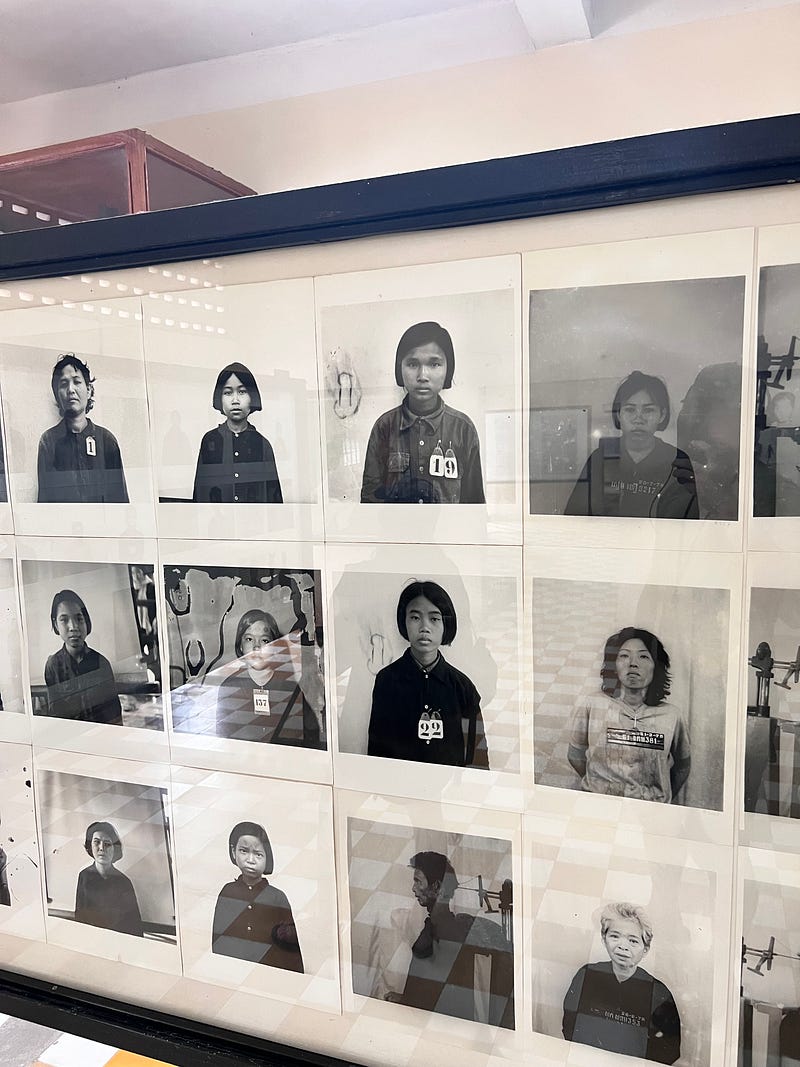
After walking through three stories of torture and interrogation rooms, we arrive to a large room with rows of images — much like passport pictures — of the people who came through the prison. Many of which, were women and children. As you observe each face, you can feel them looking back at you. You try to gauge their souls, it seems the least you can do. Some of the prisoners look defiant, others are tragically defeated. A few of the children appear naive, even smirking in the pictures, perhaps misled by the guards that things would be okay. Most though, appear quite aware of their harrowing fate.
When these pictures were taken, prisoners were known as just numbers, and these numbers were pinned to their black shirts like ear tags on cattle for identification. It was a tactic by the Khmer Rouge to dehumanize them, making the egregious acts by the guards feel purely objective and per the operation. Contrary to the original intentions of the Khmer Rouge, these images now serve the opposite purpose, and to any visitor familiar with the Cambodian Genocide, we can now see many of the faces that suffered, and it hurts. It hurts a lot.
“Bri, come look at this,” I whisper, “Is that what I think it is?”
She sees it immediately too and we both remain frozen in a silent shock.
The image in particular is one of a beautiful girl. At first glance her picture is not any more significant than the others, but to the left of her in the background was what looked like the same silly drawing we commonly see across bathroom stalls, high school desks, walls of graffiti, and dusty car windows across the world. We looked closer and it was unequivocal, in fact, another girl below her had the drawing in her picture too, and you could see an attempt to smear it off.
It’s a symbol of immaturity, yet even in adulthood we still reluctantly snicker at them like one might at a fart joke. When childish expressions like this transcend cultural differences in the most unfamiliar places, they connect us and make us feel as if we’re not so different after all. But when you find a crude sketch of a penis behind a girl pictured at a torture prison, a girl who was undoubtedly murdered days later, how are you supposed to feel?
The next day we endure part two of the genocide tour: the killing fields of Cheung Ek. To get there we take a taxi to the outskirts of Phnom Penh. On the way there, you can’t help but notice the massive development projects off the side of the highway. We saw model homes that resembled oceanfront properties in Malibu. A brand new mall comparable to ones we’ve seen in places like Tokyo, Hong Kong, and Singapore. Yet, once we got off the highway, the streets that led to the killing fields were ridden with potholes. The parking lot was nothing more than a dusty gravel yard.
We paid our entrance fee (which was $6 this time) and received a similar headset to the one from S-21. The narration provided was moving once more, detailing the number of bodies found in the burial grounds, the methods by which prisoners were killed, the chemicals used to control the smell, and the music that was played to drown out the screams from villagers nearby.
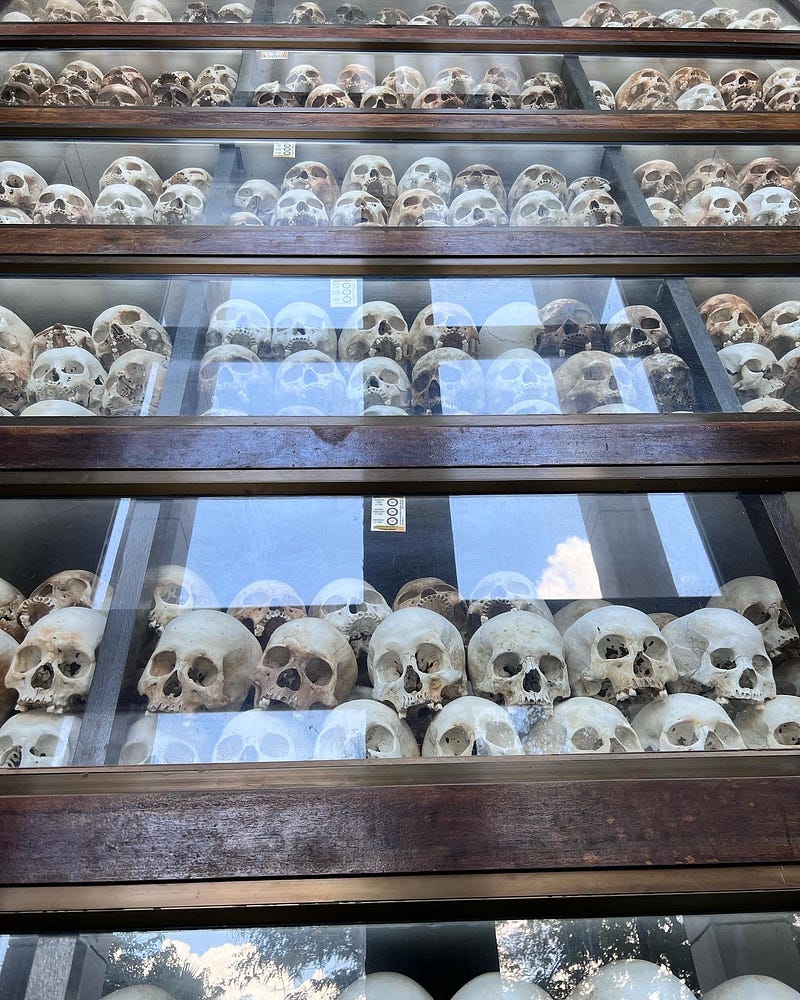
Cheung Ek was the largest of the hundreds of killing fields across Cambodia during the Khmer Rouge. It is estimated that over 17,000 Cambodians were murdered here in what used to be just an orchard. 8,000 skulls have been recovered, and they are stacked and made visible inside a stupa in the middle of the grounds.
The tour is incredibly powerful, but the museum has as much upkeep as a lower-class park might have in the United States. Weeds growing on the trials, wooden platforms rotting away, and the theater room plays a video that hasn’t been updated since the 1990s. I was looking around to see if I could find a VHS player feeding the projector. I truly felt like I went back in time.
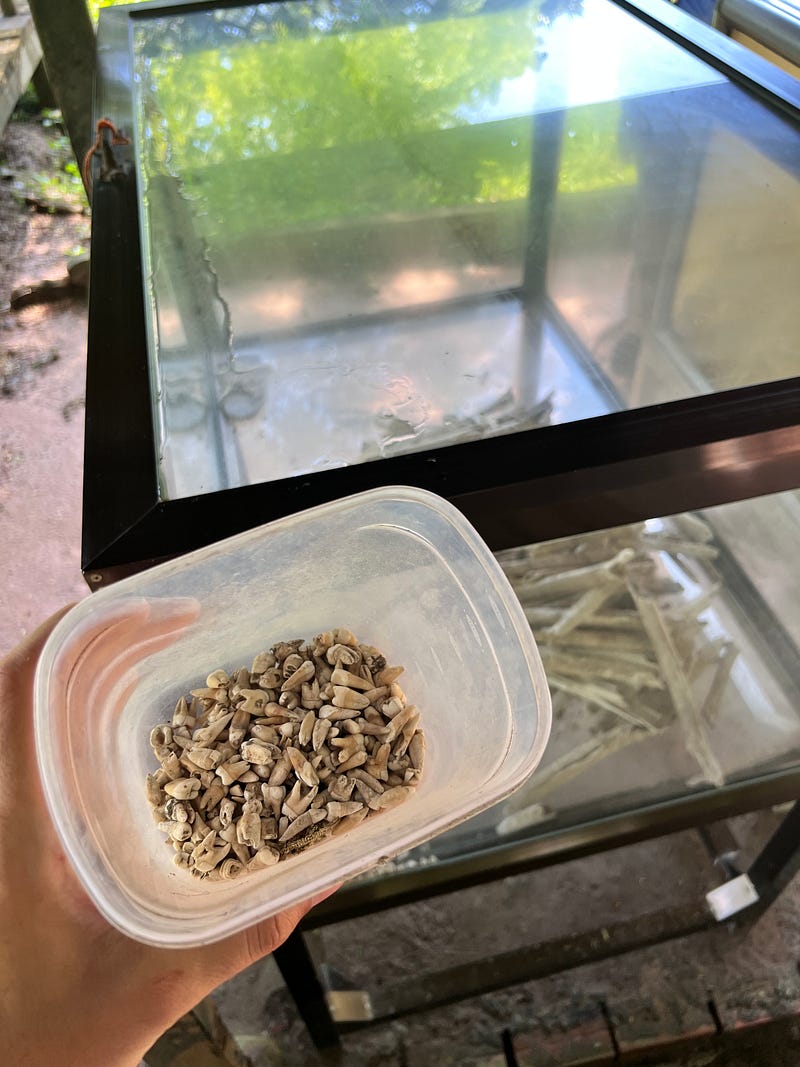
Toward the end of the tour, I approach a glass box that showcases a pile of bones, highlighting the remains that still get washed up when a storm runs through the orchard. On top of the glass box was a Tupperware which from a distance I assume had some nuts in it, perhaps for feeding ducks in the pond. When I got closer I quickly realized it was a tub full of human teeth, just sitting there, not even with a top. There was no deterrent to pick up the tub, any deviant could come by and take one as a souvenir.
I was struck.
After the tour Bri and I head back to Phnom Penh in a silent taxi ride. As we make our way back into the city you can’t help but infer that the rise of Phnom Penh feels inevitable, multiple cranes span across the horizon and the ground floor is sprawling with familiar signs of a ruthless free market society. We’re reminded that it’s not fair to associate such a horrid past with an entire country that is posed for a brighter future. These are the descendants of the Angkor after all, the creators of the largest temple structures in the world. A civilization that ostensibly reigned as one of the premier colonies in the 12th century. Yet it poses the question, how could the same bloodline that ascended to the preeminence of Angkor Wat, also comply with the horrors of Pol Pot?
This, I assume, is the hardest part to stomach. The atrocities that took place here, just fifty years ago, were carried out against each other. Cambodians enslaving and killing other Cambodians. Is that why these museums are so modest? Is the general sentiment here to forget rather than remember? Because I don’t think it would be fair to attribute it solely to a lack of capital. The infinity pool on the roof of our hotel contradicts that. Sure, foreign investment is most likely fueling the new skyline but local entrepreneurs and government officials must be getting their pockets filled as well. I saw their mansions off the highway on the way over. Where are their donations? Either way, it’s perplexing, much like the fact that Pol Pot lived freely to be an old man, dying peacefully in his sleep years after the genocide was recognized globally.
That night after dinner, Bri and I head to a distinct part of Phnom Penh known for its backpacker bars and the red light district. The sins of our Western male divorcees often take place in cities like these in Southeast Asia — most notably in southern Thailand. Whether you tolerate it or absolutely despise it, it can be an emblematic barometer of where a developing country is in its pursuit of the first world. Many countries with a determination to get there faster seem more willing to turn a blind eye. Either way, humanitarian progress seems more tied to GDP than morality.
When you turn onto the streets near the Phnom Penh night market, you’ll be overwhelmed with a surplus of young women sitting in rows of plastic chairs in front of their associated bars and clubs. It’s much grungier than what you may have seen in party districts in Bangkok and you can even feel it through the demeanor of the girls.
“I keep seeing the same faces I saw at the museum,” says Bri.
I hadn’t considered this, but as soon as Bri pointed it out, the rows of pictures of all the girls from S-21 overtook me, and it was all I could see as well. The Cambodian Genocide wasn’t predicated on any specific ethnicity after all. It was an extermination of a quarter of the country based on arbitrary accusations. In a way, the pictures in S-21 were a perfect sample demographic of the women back in the late 1970s. As Bri and I observed a similar parallel here in the red lights of Phnom Penh, we could only squeeze each other’s hands tighter in angst.
We grab a beer at a corner bar with a patio to people watch as we tend to do in every city we go. The clientele on the street is that of what you might expect. Out of shape, English-speaking older men in button-ups, backpackers in flip flops, and the occasional travel couple like us darting through to take a peek. Across the street, a child, no older than ten years old and wearing only pajama pants is carrying a naked infant and asking patrons for money. I can’t even describe it as begging, he was in relatively high spirits, simply another day on the job.
“Well, that was a rough scene,” I say to lighten the mood a bit. An almost impossible task.
“Yeah, we don’t need to stay here too long,” responded Bri.
“I know, we’ll just finish these beers,” I say. “Though I’m still glad we came. Just like the museums, I think it’s important to see these things, even if they’re unpleasant. We know they exist and have existed, but when you see it up close, it changes you I think.”
“I know, I know. Though I’m not exactly sure how,” she reluctantly agrees.
As we watch the street a couple emerges into our sight. At first glance, it appears to be a companionship that we’ve witnessed countless times across Southeast Asia—an older Western man with a younger, far more attractive Asian partner. Then as we look closer their relationship resembles more of what would appear as a father and daughter. Like a prospective stepdad taking his girlfriend’s daughter to the mall for the first time. If only that were the case. The man awkwardly tries to make conversation, while the girl shyly responds with just a smile. They hold hands and make their way to a taxi, likely heading for the man’s hotel.
The girl couldn’t have been older than 15.
Despite what I had just expressed to Bri, I now wasn’t sure exactly why I felt it necessary to succumb ourselves to bear witness to such a dark scene. I do know, that I’ll never forget the way the young Cambodian girl looked up at that old Western stranger. I’ll never forget the distraught look on Bri's face, and the hundreds of girls seated along the street who were undoubtedly envious of the young girl's good fortune to have been selected. Once again, the moment hurts. It hurts in ways I’ve never known before.
“Ok baby, let’s go now,” I say. “I think we’ve seen enough.”
As our tuk-tuk speeds along the Mekong River back to our hotel, I play out scenarios in my head for how I might have been able to redirect the course of that young girl's night or even the course of her life. For some reason, the poor girl from the photograph at the S-21 museum pops back into my head and I imagine her holding hands with the perverted man instead. When I note the dark and disgraceful irony, the thought in itself breaks my heart.
The Mekong reflects the city lights from the peninsula across the way. It’s a much more promising sight, and I’m confident that when I’m back here someday, there will be more luminations on the water and with it more hope. But for now, I’m ready to leave.
Previous Essays: