
How Will Musk’s Twitter Acquisition Affect His Status as World’s Richest Person?
It’s a questionable investment, as his stake in Tesla has already taken a big hit
It’s not every day that an investor files a Schedule 13D with the Securities and Exchange Commission (SEC), indicating they’ve crossed a threshold and now own more than 5 percent of a company, and within three weeks has its bid for the entire company approved by the board of directors. But of course, Elon Musk is no ordinary investor — he’s the richest man in the world. How was he able to pull off his super-fast acquisition of Twitter, Inc? Is it a good investment? And what impact will it have on his overall wealth?
How Much is Musk Worth?
According to Forbes, the day after Musk’s April 25, 2022 bid for Twitter was accepted, Musk’s net worth was $239.2 billion, comfortably number one as the richest person in the world (Jeff Bezos was number two, with a net worth of $165.2 billion). Net worth is the difference between what you own and what you owe.
Musk owns 21 percent of Tesla but has pledged half his stake as collateral for loans (which Forbes discounts in its calculation). Tesla’s market cap is around $906 billion, putting Musk’s share at around $190 billion.
Musk also owns about 50 percent SpaceX. The company was valued as of February 2021 at $74 billion (according to Forbes) and as of October 2021 around $100 billion (Barron’s). The puts Musk’s stake around $50 billion.
Before the full Twitter acquisition, Musk owned 9.1 percent of shares of Twitter. With the agreed value of $44 billion, Musk’s share of Twitter was around $4 billion. Musk is also a founder or co-founder of OpenAi, Neuralink, the Boring Company (a great name for a company involved in tunnel construction!), and Starlink.
How is the Twitter Acquisition Being Financed?
As every accountant will tell you, net worth is not the same as cash. Let’s say your major assets are a car worth $20,000, a house worth $300,000, and other assets (including furniture) worth $30,000. That gives you total assets of $350,000. On the liability side, you have a car loan of $10,000, and a mortgage of $190,000, giving you total liabilities of $200,000. That leaves you with a net worth of $150,000 ($350,000 in assets less $200,000 in liabilities). But the actual cash you have in a savings account may only be a fraction of that, say $5,000. So, if you decide to buy a cottage, you’re going to need to borrow.
Similarly, Musk has often referred to himself as being “cash poor” with so much of his wealth tied-up in shares. The only ways to generate cash are to sell shares, or borrow money. As such, in anticipation of acquiring Twitter, Musk lined up $46.5 billion in financing, as he outlined in a required SEC filing. It summarized what the different sources of financing were. First, Morgan Stanley Senior Funding, Inc. and others (according to The Wall Street Journal, Barclays, Bank of America, MUFG, BNP Paribas, Mizuho, and SocGen) agreed to lend $13 billion. Second, Morgan Stanley Senior Funding, Inc. and others (the same parties involved in the loan as well as others, including Canadian banks RBC and CIBC) agreed to a margin loan (or a loan against Tesla shares owned by Musk) worth $12.5 billion. Third, Musk himself committed to providing equity financing of $21 billion, which presumably would come from cash on hand or pending sales of shares.
Was (and Is) Twitter a Good Investment?
To put Twitter as an investment in perspective, we can trace how its stock performed since its initial public offering (IPO) on November 7, 2013. If you were lucky enough to have acquired shares in the IPO, your one-day return was 73 percent, as the stock closed at $44.90. As the chart below shows, the stock rose to a high of $77.63 on November 1, 2021.
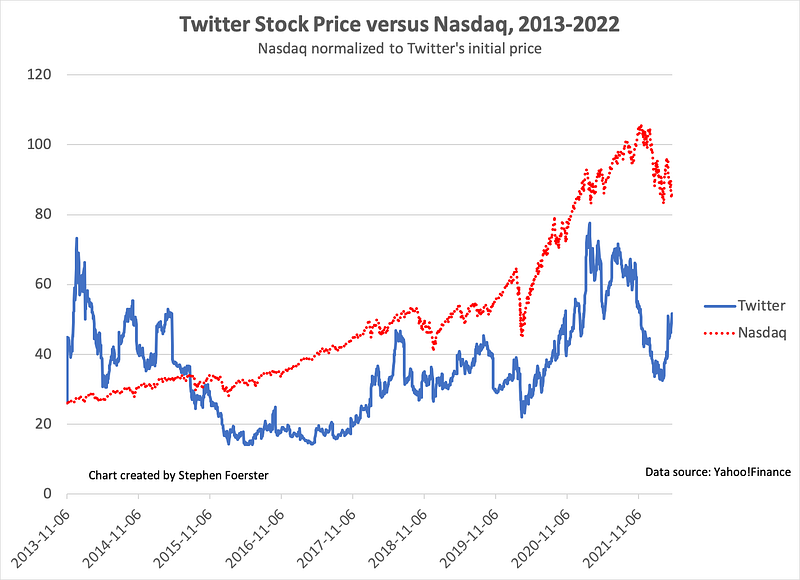
However, compared with the overall tech index, the Nasdaq, we can see that since 2015, Twitter has lagged the overall market. Up until April 1, 2022, just prior to when Musk announced his 9.1 percent stake in Twitter, the cumulative share price gain over the eight-and-a-half years was only 51.2 percent, compared with 262.0 percent for the Nasdaq index. And if you missed out on getting in at the IPO price (reserved for a select group of investors) and instead bought a day later at the close, you would have actually lost 12.4 percent.
Next, we can ask whether Musk is getting a good deal, buying Twitter at $54.20 a share. That’s not an easy question to answer without knowing what business plans Musk has in mind. In a typical situation of an acquisition to take a public company private — of course nothing is typical with Musk — we could estimate the present value of anticipated cash flows using a discounted cash flow model.
A simpler approach is to look at the acquisition premium. There are two reasons why an acquirer pays a premium to existing shareholders above the current share price, or the so-called “unaffected” price before the April 4th announcement that Musk had a large stake in Twitter. One is because the acquirer sees value in the stock that the market doesn’t see — in other words, the acquirer feels the intrinsic value is greater than the current stock price. Another reason is that in order to entice existing shareholders to sell, the acquirer needs to offer a premium. Typical acquisition premiums are in the 20–30 percent range.
According to The Wall Street Journal, advisors told Musk he should offer a generous premium of around 40 percent. Using the closing price on April 1st, 2022 of $39.31 (the day before Musk announced his stake in Twitter), the $54.20 price represents a premium of 38 percent. Why $54.20? Apparently, it’s another one of Musk’s cannabis jokes, incorporating the April 20th or 4/20 Cannabis Day into the offer price. The bottom-line is that Musk offered a very fair premium — I calculated that it is actually 62 percent above Twitter’s price on March 4th, 2022, just a month before the Musk investment disclosure.
Strangely, for an investment this size, Musk claims he doesn’t care whether Twitter makes money. It must be nice to be the richest person in the world!
What Impact Will it have on Musk’s Overall Wealth?
The day after Musk’s April 25, 2022 bid for Twitter was accepted, Musk’s net worth dropped by an incredible $29 billion, or almost 11 percent. According to the Forbes list, this one-day drop in net worth was greater than the entire net worth of the 46th richest person, hedge fund manager Jim Simons. Tesla’s shares experienced a one-day drop of over 12 percent, erasing $92 billion in value. Tesla investors may be concerned for a number of reasons. First, Musk may need to sell shares, putting downward pressure. Second, Musk may be spreading himself too thin, taking on yet another major project. So, the one-day drop in Musk’s wealth represents almost two-thirds of the Twitter investment. It’s clear that, at least in the short-term, Musk isn’t investing in Twitter in order to get even richer.
Musk’s position as the richest person in the world is probably still safe for a while. Barring any huge positive swing in Amazon’s stock price that would enhance Bezos’s net worth, Tesla’s stock price would have to drop by over 60 percent, to around $535 per share, for Musk to relinquish the title.
Keep in mind, however, it isn’t over until it’s over. The day after the deal was accepted by Twitter’s board, the stock closed at $49.68, or 8.3 percent below the offer price. This suggests that not all investors think the deal will go through. With Musk, one thing is certain: nothing is certain!
Stephen Foerster is a co-author, with Andrew Lo of MIT’s Sloan School of Management, of In Pursuit of the Perfect Portfolio: The Stories, Voices, and Key Insights of the Pioneers Who Shaped the Way We Invest, Princeton University Press.