The 2020 College Basketball All-Star Team
If you could build a college All-Star team to win this year’s March Madness tournament, who would make your starting five?
WHO WOULD MAKE YOUR 2020 COLLEGE BASKETBALL ALL-STAR TEAM? That was the question I asked myself this weekend. It’s March after all, and that means March Madness and endless college basketball the next few weeks.
It’s been a weird college basketball season, thanks to a weak draft class and a ton of teams that get to the top of the rankings and lose almost immediately to fall back to the pack. No one knows who’s good this year, and the race to cut down the nets seems especially open.
But what if you could build the perfect starting five? That’s the question I wondered, and I asked my Twitter followers for their thoughts this weekend:
I had a particular theory in mind as I asked the question (we’ll get back to that), but I ended up getting so many responses that I decided it was worth writing about the question.
So I tallied everything up, picked out 10 of the most interesting lineup combinations, and came up with the crowdsourced College All-Star lineup.
Here’s what I found…
The Most Interesting Crowdsourced Lineups
There were way too many lineups to show everyone’s, but I thought it’d be useful to run through 10 fascinating lineup combinations I found and note some patterns and roster-building archetypes I noticed along the way.
We’ll start with the most frequent two-player combination I noticed…
The Toppin-Okongwu Combo
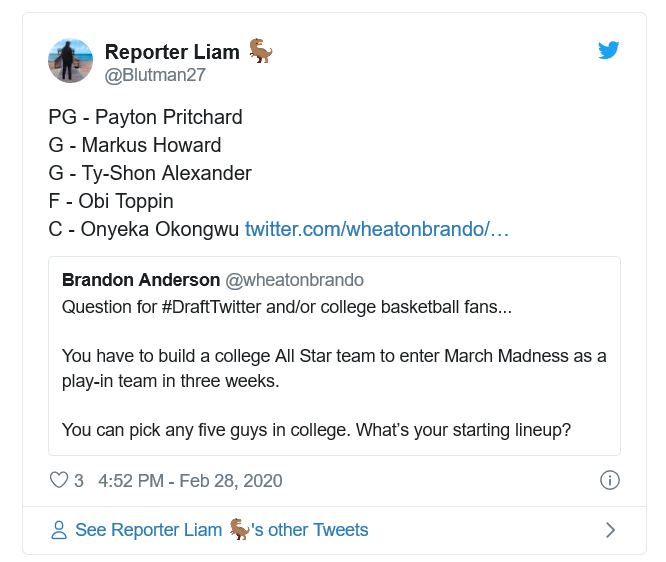
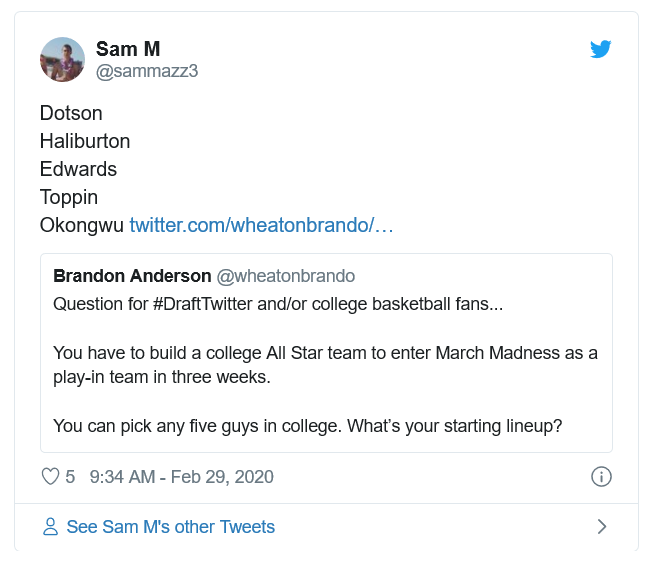
Almost 30% of the submitted lineups included both Dayton’s Obi Toppin and USC’s Onyeka Okongwu. I suspect that’s partly because #DraftTwitter got hold of this, but that alone isn’t enough of an explanation.
Obi Toppin has been the player of the college basketball season. That doesn’t necessarily mean he should win National Player of the Year, but he does seem to be the story of the season. His highlights are all over ESPN, Dayton has been in the top 10 all season, and everybody knows him. Not everyone thinks Toppin will score at the next level, but it’s clear he can do so now.
The one thing Toppin doesn’t do so is defend, and that’s where Okongwu comes in. Okongwu is a super efficient scorer too — at least in college — but he also has the versatility and switchability to make up for a lot of Toppin’s foibles on defense. Toppin was the single most common selection, but almost everyone that took Toppin paired him with a big man defender — if not Okongwu, then Udoka Azubuike, Jalen Smith, or another option.
Anthony Edwards at the 3
Sam Mazzullo’s lineup had another thing in common with a bunch of others: Anthony Edwards at the three, with at least two other guards or handlers alongside him.
Edwards has been another big name this season, though it’s been harder for ESPN to hype him since Georgia stinks and isn’t often on national television. Edwards’s talent is undeniable, but his winning potential is up for debate. He can take over a game in a flash, but he also disappears for long stretches, and that seemed to make people hesitant to rely too heavily on him, even though he’s pretty clearly the most talented option available (considering names like LaMelo Ball and James Wiseman weren’t even options).
Two things stood out about Edwards. First, he was chosen in under a quarter of the lineups, despite the obvious talent. Second, most people put at least two good guards next to Edwards, instinctively added a lot of handling and basketball intelligence next to him — presumably to balance Edwards out and take away the hero ball option.
Would that lineup win in March? Maybe. But it’s even more interesting what it tells us about Edwards as an NBA Draft prospect.
Three-Guard Lineups
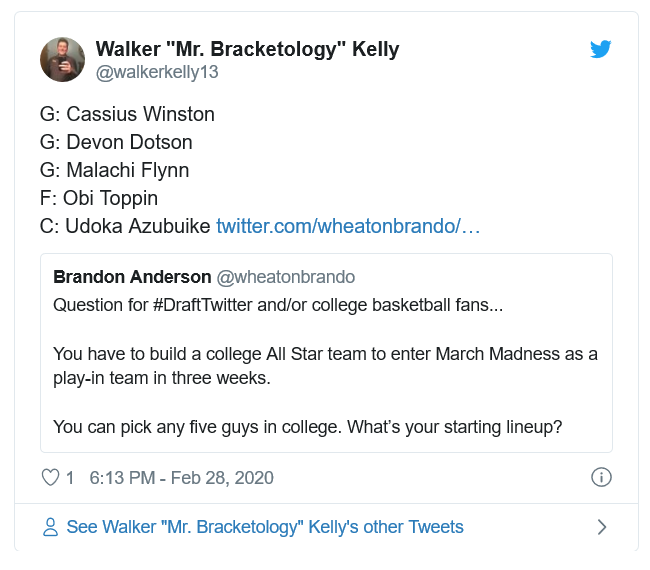
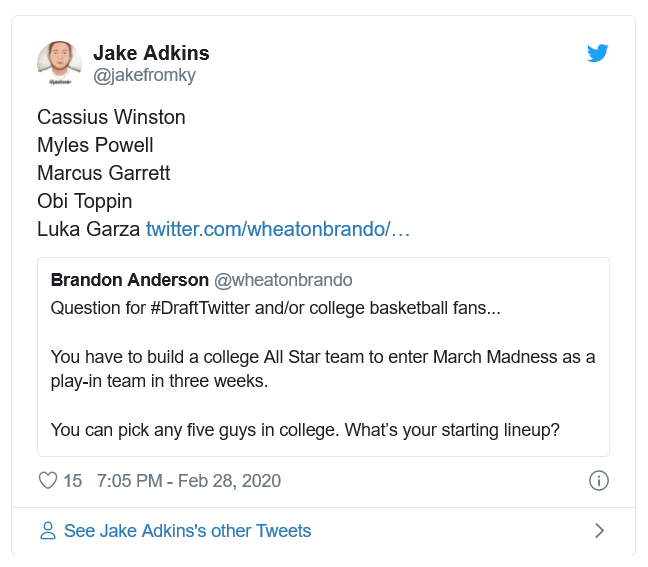
Of course, some of those Anthony Edwards aren’t playing him at the three at all. Maybe they’re just playing three-guard lineups, like many of the most successful college teams. Remember, we’re building a team to win March Madness, not one that has to succeed in the NBA. Our teams don’t have to stop Brow or Embiid, and they don’t have to out-shoot Steph and Klay.
These are two lineups that took the concept of a College All-Star team seriously. Every player taken by Walker Kelly and @jakefromky would be in the running for the National Player of the Year conversation, and that starts with loading up on elite guards like Cassius Winston, Devon Dotson, Myles Powell, and Malachi Flynn.
Three-guard lineups probably won’t work at the next level, but guard play typically wins the day in March. Why not take three?
The All-Defense Option
Not everyone needs moderation. Brian Schroeder was one of a handful of folks to go all-in on defense, which probably isn’t a terrible idea in a year without any presumed elite teams that can just outscore you with high-end offense. @Cosmis is hoping Grant Riller’s driving and Tyrese Haliburton’s passing are just enough offense and, as he says, that he’ll aim to win every game 55–40 with four mean defenders and one go-to scorer.
The All-Shooters Option
And then there’s the other end of the spectrum. @WandererSpartan is throwing his money behind lights-out shooting and just trying to outgun the opponent. Winston, Immanuel Quickley, and Saddiq Bey are proven shooters, and Toppin adds his usual element. But woof is this asking a lot from Xavier Tillman on defense. Too much, I think. Not every team can make every shot for six straight games like Villanova.
The Winston-Tillman Synergy
Like @WandererSpartan, @B1Gsad was one of a handful of folks to build their team around the already proven Michigan State synergy of Cassius Winston and Xavier Tillman. That was the most popular pairing outside of Toppin-Okongwu, and I only saw one lineup with Tillman that didn’t also have Winston.
The two have played well together for so long, and we already know they can perform at the highest level. Surround them with guys that can shoot and defend (*cough* where you at, Aaron Henry?) and you’ve got a shot.
The Draft Nerd’s Dream
As a fellow draft nerd, it’s hard to not get excited about @Will_Rucker3_AD’s fever dream. Isaac Okoro and Onyeka Okongwu defending together? Devin Vassell and Aaron Nesmith knocking down jumpers? Tyrese Haliburton as the glue holding it all together? *drool*
I’m not positive that team would have enough consistent scoring to win six straight in March, though they wouldn’t need a ton with all that defense. Like this year’s draft class, it’s missing that one star scorer that can do everything. But there sure are a lot of future NBA winners in that lineup.
My Favorite Lineup
This lineup from @dmurrayNBA was probably my favorite. It’s close to the one above, with one substitution: Obi Toppin for Isaac Okoro.
I adore Okoro, and I far prefer him to Toppin as an NBA prospect, but this isn’t the NBA yet. Okoro looks like an elite role player at the next level, but he can’t contribute much on offense yet and certainly can’t shoot much. Toppin is an infinitely worse defender than Okoro, but I’m willing to sacrifice that D for the upside Toppin brings to the team offensively.
There’s still enough defense here to hide Toppin on D, while there’s also enough offense to flat out outscore most teams. This team has a ton of spacing and a lot of high IQ basketball. It works. I think it’s my favorite.
The Most Popular Crowdsourced Lineup
Those were 10 of the lineups I found intriguing, but there were far more submitted. So who were the five most popular names?
Here’s the Twitter College All-Star starting five:
- Cassius Winston, Michigan State
- Tyrese Haliburton, Iowa State
- Anthony Edwards, Georgia
- Obi Toppin, Dayton
- Onyeka Okongwu, USC
Surprised? Probably not.
If you’ve followed college basketball, you probably know those five names pretty well by now.
Obi Toppin led all vote getters and was the only player to show up in over half the lineups at 58%. If we did this exercise for women’s hoops instead, I imagine Sabrina Ionescu would show up in at least 75% of the teams, but that’s another article. It was a big drop to the next choice, Okongwu at 40%. Haliburton ranked third at 34%, and Winston was fourth at 29%. Those were the only four players in at least a quarter of the lineups.
Anthony Edwards actually tied for fifth with Iowa’s Luka Garza, but I took the liberty of adding Edwards as a far more obvious fit in our crowdsourced lineup. Both came in just under the quarter mark, at 24%.
Four other names showed up on over almost 20% of the ballots:
- Udoka Azubuike, Kansas: 22%
- Myles Powell, Seton Hall: 21%
- Devon Dotson, Kansas: 19%
- Devin Vassell, Florida State: 19%
So those were our top 10 vote getters. Here are the other names that round out our top 25:
- Isaac Okoro, Auburn: 14%
- Saddiq Bey, Villanova: 14%
- Aaron Nesmith, Vanderbilt: 13%
- Xavier Tillman, Michigan State: 11%
- Markus Howard, Marquette: 11%
- Payton Pritchard, Oregon: 8%
- Grant Riller, Charleston: 8%
- Immanuel Quickley, Kentucky: 6%
- Killian Tillie, Gonzaga: 6%
- Tre Jones, Duke: 6%
- Vernon Carey, Duke: 5%
- Malachi Flynn, San Diego State: 5%
- Jalen Smith, Maryland: 5%
- Patrick Williams, Florida State: 5%
- Isaiah Livers, Michigan: 5%
So that’s it. That’s Twitter’s top 25 College All-Stars.
So what can we learn from the whole process?
20 Key Takeaways
In no particular order, here are some key things I took away from everyone’s College All-Star lineups…
- Obi Toppin is the player of the year. Despite playing for a mid-major, he led all vote getters by a wide margin. The National Player of the Year is supposed to represent that season. Obi Toppin represents this season.
- Toppin and Onyeka Okongwu would be a heck of a pairing. That’s a ton of efficient college scoring, and Okongwu looks like the perfect defender to cover up Toppin’s weaknesses.
- I was surprised no one tried Toppin as their lone big. Could a college small-ball lineup work? What if you took one of those three-guard lineups above and added a fourth scoring option and went for it? Maybe move Haliburton or Vassell to the “four” and just run and gun the heck out of teams. Seems worth a shot, this season.
- Haliburton and Vassell finishing top 10 was telling. Actually, they were what led me to ask the question. Everyone agrees these two are winning players. Everyone agrees they help teams, regardless of “star” potential. They play defense. They shoot. They handle. They play smart, all-around basketball. All of us know that. All of us want them on a winning team. So why wouldn’t they go super high in the draft too? Maybe they ought to.
- Then again, Isaac Okoro is the king of the star role players in this year’s draft, and he fell outside the top 10. I’ve had Okoro top-five on my draft big board all season and didn’t even really consider him much for my team. Maybe he’s just too young.
- Except, experience was not king. Our crowdsourced starting five had two sophomores and two freshmen. Experience is nice in March, but so is talent. Winners win.
- It was fascinating seeing so many teams with both Cassius Winston and Xavier Tillman, and it makes sense. Outside of Toppin-Okongwu, this was the only other pairing I noticed coming up again and again. Those two just have a ton of Michigan State synergy through the years.
- I was surprised to see Immanuel Quickley as the only Kentucky option considered. That means no Ashton Hagans, a presumed SEC Player of the Year contender, and no Tyrese Maxey, a potential top-five draft pick. I’m going to have to give Quickley a longer look in my draft evaluation. The shooting numbers are far better than I remembered.
- Not everyone believes in Anthony Edwards yet. The presumed #1 pick was only tied for fifth in votes, and most people that did take him felt compelled to defend their choice and/or surround him with high IQ handlers to take the ball out of his hands. Yikes.
- No one believes in Cole Anthony. Anthony showed up in a single, solitary lineup near the end of the exercise, and even worse, I didn’t even notice. It’s been a really rough campaign.
- This draft class is incredibly uninspiring. People aren’t sold on Anthony Edwards. No one wanted Cole Anthony or Tyrese Maxey. There was no love for any of the Arizona or Washington prospects. The highly-touted freshmen just haven’t really shown up.
- East Coast bias is real. A couple Josh Green votes were the only shouts to Arizona or Washington, despite both entering the season with a pair of presumed lottery picks. Gonzaga and San Diego State were largely ignored, despite both careening toward 1-seeds. Oregon’s Payton Pritchard is a National Player of the Year contender but showed up in only 8% of the lineups. Then again, a lot of people wanted Okongwu. Maybe the West Coast players just aren’t good enough.
- Everyone wanted lots of shooting and handling. Kind of obvious, but important nonetheless.
- Almost every team took a true defensive center. Even the teams that went offense-heavy and focused almost exclusively on shooting still took a giant to man the middle and swat shots.
- I was surprised how few people took Jalen Smith. He anchors a top 10 team and can stretch the floor on offense in a way almost no other college big man can — compare him to Azubuike’s lane clogging, for example.
- Two names I was surprised to see in so many lineups: Devon Dotson and Saddiq Bey. Both are good, sure, but I wouldn’t have considered either of them for my team. I’m relatively high on Saddiq as a draft prospect, but it looks like I need to give Dotson another look.
- It was interesting that so many people paired Cash and Tillman while few seemed to care about keeping Dotson and Azubuike together. Not sure if that means anything, but it might speak to some lack of synergy there.
- Then again, Kansas was the only team to get serious consideration for three players, though Marcus Garrett was a distant third. Is Kansas the best team in college basketball? It looks that way, especially considering the lack of selections for teams like Baylor, Gonzaga, and San Diego State.
- I love watching Myles Powell and Markus Howard but almost never liked the teams that chose them. I just don’t see a team built around a mega scorer staying hot enough playing hero ball to win six straight games in March. Then again, Carsen Edwards sure got close.
- The wisdom of crowds works. That crowdsourced starting five is pretty good! Honestly, the top 10 is pretty strong overall. Individual lineups may or may not have worked, but tallying this all up was actually pretty useful.
My Personal Starting Five
So who would I take?
Before this exercise, I think I too would’ve opted for the Cash-Tillman synergy, but I really like the Toppin-Okongwu pairing so many went with.
I’m convinced that players like Tyrese Haliburton and Devin Vassell should be on a team trying to win a championship. Those guys just check every box. They’re smart and almost always in the right place on both ends, they handle, they pass well, they defend, and they knock down shots. They’re winners, and they’re moving higher and higher on my 2020 draft board by the day.
I don’t think anyone took my starting five, and there were precious few lineups that were exactly the same, but many shared four of my five.
Here’s my winning lineup:
- Cassius Winston
- Tyrese Haliburton
- Devin Vassell
- Obi Toppin
- Onyeka Okongwu
That’s my starting five College All-Star lineup if I’m trying to cut down the nets in March!
So let’s hear from you — who are your 2020 College All-Stars? ■
Follow Brandon on Medium or @wheatonbrando for more sports, television, humor, and culture. Visit the rest of Brandon’s writing archives here.