
2004 Junior Nationals
Part of Four Days in London: A memoir about trying to find a way to the Olympics, and finding something else instead.
After the first year, my competition career had surprised me and my parents. I had started winning. Not a lot at first, but I started to accumulate medals and trophies. I beat an adult brown belt for the first time when I was only 14, and shortly after beat a black belt. Both were recreational adult players, one of which was frankly caught off guard and would have won a rematch. Still, though, around 15 I started to show some potential compared to my peers. I had my first major win against a junior national medalist in my age group in January 2004, and picked up some significant wins in the next month at the state championships. My parents decided after this, to send me to the National Junior Olympics Championships.
If you can permit an aside, American judo has a weird and fascinating history that is deeply bound to the history of not just judo itself, but racism. There exist three national judo organizations: the USJA, USJF, and USJI (USA Judo). The USJA was founded by military men, usually from the Air Force, who had learned judo while abroad in Japan. It was founded because due to conflicts with the USJF, which was founded by Americans of Japanese descent and Japanese immigrants. These two groups had come into conflict due to the legacy of the Japanese internment camps and racism. As I write this, it does dawns on me of how much the 1964 Olympic team, itself much more racially and ethnically diverse then the times might have otherwise allowed, must have seemed a triumph for the time. The USJI was eventually founded because the US Olympic Committee had had enough of the infighting and wanted an organization to handle Olympic team selection and development. Thankfully at these days, the three organizations all play different roles, with the USJA and USJF now hold combined events and work together to promote grassroots judo for everyone regardless of their background. When I was a teenager each of the three organizations had their own junior nationals, with the Junior Olympics, being the one for the USJI.
I had spent the previous spring and summer working for my dad at his hardware store to raise money for my trip. I didn’t compete very much outside of a major tournament in Albany, New York. I had surprised myself at the tournament, beating multiple brown belt competitors and making the final in both the junior and senior divisions. In the final, I fought Nate Torra, who would eventually be a 5x senior national finalist and two-time champion. Nate, who had just hospitalized his last opponent, said one of the more encouraging things to me before the match. “It’s just judo Chris. Let’s go out and have a fun match.”
I used the money to pay for a training camp at the Jason Morris Judo Club in upstate New York, which at the time had one of the top junior athlete programs in the country. Jason was an Olympic silver medalist in 1992 and at that time a very close friend to Jimmy.
My mother had, at the last second, bought my father a plane ticket to come to watch me compete at junior nationals. Up to that point, I had fought better at tournaments when he was around, which now that I think of it, was largely true for the rest of my career. Many of the best days I ever fought were when my dad was there. I tended to perform well in front of my family overall. I really can’t understate how important it is to have support from your famil when going for the Olympics. I won’t go to far off track, but I wouldn’t have been able to go as far as I did without the help of my parents, my brother, and later my uncle and aunt who financially supported me during my 2012 run. Without this experience overall, I wouldn’t be the person I am. To come back to the moment though, this was my first junior national tournament. This would be the first time I’d get to see how I stacked up.
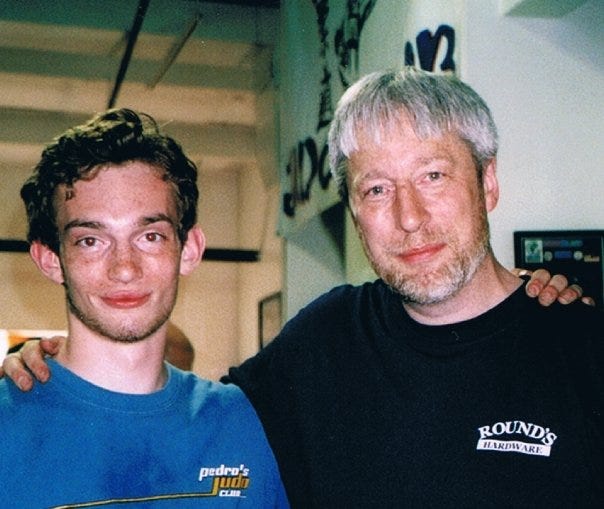
As I sat in the bleachers with my dad we watched some of the other divisions. I was nervous. My division, juvenile B 66kgs, had over 45 competitors from across the country. My first match was against a member of Cohen's judo club, which had a reputation for producing talented athletes. The more I watched, the less nervous I felt. I began to realize that many of these kids didn’t look much tougher than some of the people I had been competing against.
I stepped onto the mat. My hair was a mess and my gi was torn up. I wore a white gi that said Pedro’s Judo on the back, a gi I still own today. In my bag was my treasured blue Mizuno gi, which skirted the line of being remotely legal at this point. I was still nervous but I was functional. Jason’s wife Teri was in the coaching chair.
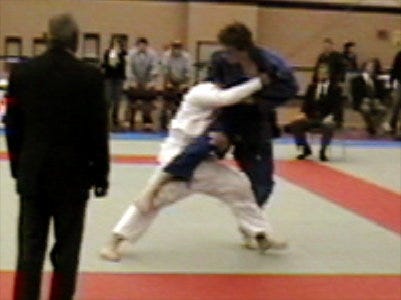
The match lasted a single exchange. I crossed my left hand to my opponent's left sleeve, grabbed his left tricep with my right hand, and hit a bizarre off the grip sumi gaeshi variation. He landed and I heard ippon called. In my brain, I thought that now at least, I can say I won a match.
The next match was a battle against the number one seed. He beat me three yukos to two in a tough match. Since the tournament was double elimination I dropped into the losers bracket.
In the next round, I had another barn burner match. In the first half of the match, I was getting crushed. My opponent threw me twice. Both throws I thought had ended the match but I had somehow turned out just enough to stay alive. In the dying seconds of the match, I threw him with the sameodd sumi gaeshi variation I had developed to nearly tie up the score. When we landed he scrambled to open guard. I entered into an over-under pass to pass his guard. I advanced to half guard and began to hit a knee slice pass. Both moves were signature moves of my dojo. I passed his guard and he tapped out in the remaining seconds. He later told me he had started to puke but the shoulder the pressure from me holding him down was stopping it. This story is in hindsight suspect, and if it was legitimate rather gross.
My next match was one-sided. While I couldn’t put him away, I won the match by a wazari, four yukos, and koka. This setup a match against Ryan, who had beaten me twice the year before in a tournament in upstate New York. I knew Ryan was good and had seen him on the list of people who had medaled in the past. I fought him well, and the match went better then it had the year before, but ultimately he beat me. My day ended at 3–2. I went off to the side and started crying. When I started the day I thought I would be lucky to win a match. By the end of the day I believed I might go home with a medal. After a quick conversation with my dad, I dried my tears and went back to watch the final matches of my division. The winner Patrick narrowly beat out Ryan in a hotly contested match.
What I didn’t notice through the day was that people were stopping by to watch me fight. My dad who was cheering from the bleachers would see people line up and noticed this. I was surprised when ten minutes after my division had ended, I heard my name. I had finished 5th at the Junior Olympic National Championships.
One of the coaches, a large Russian man who ran a club in New York City who I had seen around tournaments, stopped me and asked how I did. When I told him he said “good, I thought you were good enough to place here today”. He then walked off.
One of the things that had kept going through my head that day, was an assumption I would eventually lose. That I wasn’t good enough to be there despite knowing there were people there I could beat. That said, each match I fought, I thought at least, I wasn’t going to lose that match. That I had walked away ranked in the top 5 was really meaningful for me. It meant to me I wasn’t wasting my time. I had come close, and this kicked off what became a four-year quest to win a gold medal at the junior nationals. While we talked about it at home, I didn’t really understand how far I had really come from when I first started judo to this moment. I wouldn’t understand until years later as an instructor, I began to run into children with similar issues.
An important note: all of these pictures were taken after the tournament when I was sixteen and seventeen. I just don’t have any pictures from that period.


