20 things that Harvard Business School could teach you in an AI for Business and Finance MBA
AI is changing our world.
And everyone is trying to learn more about it.
In the 2000s, getting an MBA from a good Business School was a very popular thing to do.
And one of the best business schools is Harvard Business School (HBS).
The 2000s saw a significant increase in globalization, with businesses expanding their operations internationally.
This created a demand for managers and leaders who understood global markets, international trade, and cross-cultural management.
MBA programs, with their focus on global business practices, were seen as a pathway to acquire these skills.
Now in 2024, AI has taken over and increased its popularity.

Businesses across various sectors are leveraging these technologies for innovation, competitive advantage, and operational efficiency.
An MBA with a focus on AI could equip leaders and managers with the knowledge to harness these technologies effectively.
So how could this curriculum look like?
And how to learn those skills?
I’ll tell you.
Fundamentals of AI and Machine Learning for Business Leaders
The journey into the world of AI starts with understanding its core components, such as machine learning (ML), deep learning, and neural networks.
These technologies enable machines to learn from data, identify patterns, and make decisions with minimal human intervention.
- Machine Learning is a subset of AI that focuses on building systems that learn from data, improving their accuracy over time without being explicitly programmed for each task. ML applications in business include customer segmentation, fraud detection, and demand forecasting.
- Deep Learning, a more complex subset of ML, involves neural networks with many layers. These networks can learn from vast amounts of unstructured data (e.g., images, text, and voice) to perform tasks like image recognition, natural language processing, and sentiment analysis.
- Neural Networks are inspired by the human brain’s architecture and are fundamental to deep learning. They are composed of nodes (neurons) that process inputs and pass them through layers to produce an output. Neural networks are pivotal in complex problem-solving across various business applications, from chatbots to autonomous systems.
While the exact course content can evolve, here are 20 potential topics and skills that a program focused on AI for Business and Finance might teach:
- Fundamentals of AI and Machine Learning: Understanding the basics of AI technologies, including machine learning, deep learning, neural networks, and how they can be applied in business.
- Data Science for Business Decisions: Techniques for analyzing large datasets to make informed business decisions, including predictive analytics and statistical modeling.
- AI Strategy and Competitive Advantage: Developing strategies to leverage AI for creating and sustaining competitive advantages in various business domains.
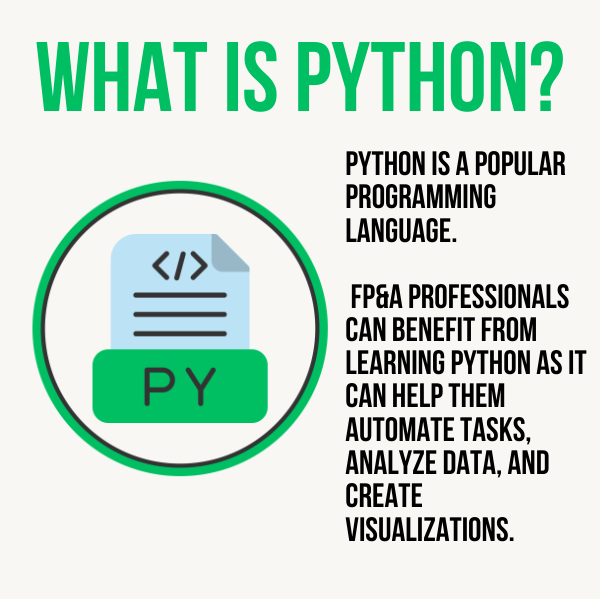
- Python Programming: Python is one of the most popular programming languages for AI, machine learning, and data science due to its simplicity, readability, and the extensive availability of libraries and frameworks such as TensorFlow, PyTorch, Scikit-learn, and Pandas. These tools make it easier to implement AI algorithms, process data, and develop machine learning models.
- Ethics and Responsible Use of AI: Navigating ethical considerations, bias, fairness, and the responsible use of AI in business practices.
- AI in Marketing and Consumer Analytics: Applying AI to understand consumer behavior, personalize marketing efforts, and optimize customer experiences.
- AI in Finance and FP&A: Exploring how AI and machine learning are revolutionizing areas such as banking, investment management, and insurance.
- AI in Operations and Supply Chain Management: Using AI to improve operational efficiencies, logistics, and supply chain management through predictive analytics and automation.
- Robotics and Process Automation: Implementing robotic process automation (RPA) to streamline business processes, reduce costs, and increase efficiency.
- AI Product Management and Development: Principles of designing, developing, and managing AI-based products and services.
- Natural Language Processing (NLP) in Business: Leveraging NLP for customer service automation, sentiment analysis, and extracting insights from text data.
- AI and Big Data Infrastructure: Understanding the technologies and architectures needed to support AI and big data analytics, including cloud computing and data storage solutions.
- Business Intelligence and Data Visualization: Techniques for visualizing data and insights in a compelling way to support decision-making.
- AI Governance and Risk Management: Establishing governance frameworks to manage risks associated with AI deployment, including data privacy and security.
- Innovation and Entrepreneurship in AI: Identifying opportunities for innovation and launching AI-driven startups within the business and finance sectors.
- Quantitative Methods and Algorithmic Trading: Using quantitative models and algorithms for trading and investment strategies.
- Blockchain and AI Integration: Exploring the convergence of blockchain technology and AI in creating secure, transparent, and efficient systems.
- Customer Relationship Management (CRM) with AI: Enhancing CRM systems with AI to better understand and engage with customers.
- AI for Social Media and Digital Marketing: Analyzing social media data to inform marketing strategies and engage with customers online.
- Leadership in the Age of AI: Developing leadership skills to manage AI-driven organizations, including change management and fostering a culture of innovation.
Now let’s break down some of the topics:
Data Science for Business Decisions
Data science merges statistical analysis, predictive modeling, and algorithmic strategies to extract insights and knowledge from data. In the business realm, it plays a crucial role in decision-making processes.
- Predictive Analytics involves using historical data to predict future outcomes. Businesses use predictive models to forecast sales, customer behavior, and market trends, enabling proactive strategies rather than reactive ones.
- Statistical Modeling helps in understanding relationships between variables and in making inferences about data. It supports decision-making by providing a probabilistic framework to evaluate risks and outcomes of different business strategies.

AI Strategy and Competitive Advantage
Developing an AI strategy involves understanding how to leverage AI technologies to create and sustain a competitive edge. It requires a blend of technical knowledge, strategic thinking, and a deep understanding of the business landscape.
- Strategic Integration of AI means identifying areas within the business where AI can add the most value, whether through enhancing customer experiences, optimizing operations, or creating new products and services.
- Sustaining Competitive Advantage with AI involves continuously innovating and adapting AI strategies to stay ahead of competitors. This includes investing in talent, technology, and data infrastructure, as well as fostering a culture of learning and agility within the organization.
For businesses, the integration of AI and data science is not just about adopting new technologies but about transforming operations, strategies, and value propositions. As AI continues to evolve, staying informed and agile will be key to leveraging its potential to drive growth, efficiency, and innovation.

AI Strategy and Competitive Advantage
Developing an effective AI strategy involves identifying how AI can create unique value for a business, differentiate it from competitors, and sustain its market position.
This requires a thorough understanding of AI capabilities, market dynamics, and the organization’s strengths and weaknesses. Key elements include:
- Assessment of AI Potential: Evaluating which areas of the business could benefit most from AI applications, such as customer service, operations, or product development.
- Strategic Alignment: Ensuring AI initiatives align with the overall business strategy and objectives, focusing on areas with the highest return on investment.
- Innovation and Agility: Cultivating a culture that encourages experimentation with AI technologies to drive innovation, while also being agile enough to adapt to rapid changes in the AI landscape.
- Building Capabilities: Investing in the necessary skills, technologies, and data infrastructure to support AI initiatives, including talent development and partnerships.

Python Programming
Python stands out as the programming language of choice for AI and machine learning projects due to several key factors:
- Simplicity and Readability: Python’s syntax is clear and intuitive, making it accessible for beginners and efficient for experienced developers.
- Rich Ecosystem: A vast array of libraries and frameworks — such as TensorFlow for deep learning, Scikit-learn for machine learning algorithms, Pandas for data analysis, and PyTorch for computer vision and natural language processing — facilitates the development and deployment of AI models.
- Community Support: A large and active community contributes to a wealth of resources, documentation, and forums for troubleshooting, ensuring continuous learning and improvement.
Ethics and Responsible Use of AI
As AI technologies become more pervasive, ethical considerations and responsible use are paramount.
This encompasses topics such as bias, fairness, privacy, security and social impact.
- Bias and Fairness: Addressing and mitigating biases in AI algorithms to ensure fairness across different groups, particularly in sensitive applications like hiring and lending.
- Transparency and Accountability: Developing AI systems in a manner that is understandable and explainable to users, fostering trust and facilitating regulatory compliance.
- Privacy and Security: Implementing robust data governance practices to protect personal information and ensure that AI applications do not compromise user privacy or security.
- Social Impact: Considering the broader societal implications of AI technologies, including potential job displacement and the digital divide, and working towards solutions that benefit society as a whole.
AI in Marketing and Consumer Analytics
AI transforms marketing and consumer analytics by enabling more personalized, efficient, and data-driven strategies.
Some of the topics to learn include:
- Consumer Behavior Insights: AI algorithms can analyze vast amounts of data from various sources to uncover patterns in consumer behavior, preferences, and trends.
- Personalization: Leveraging AI to tailor marketing messages, recommendations, and experiences to individual customers, enhancing engagement and loyalty.
- Optimization: Using AI to optimize marketing campaigns and channels in real-time, maximizing return on investment and efficiency.
- Predictive Analytics: Employing AI to predict future consumer behaviors, purchase likelihood, and market trends, guiding strategic decisions.
7 Reasons why someone would do an MBA with AI
Pursuing an MBA with a focus on Artificial Intelligence (AI) offers numerous advantages for professionals aiming to thrive in today’s rapidly evolving business landscape.
Here are 7 reasons why someone might choose this path:
1. Bridging the Gap Between AI Technology and Business Strategy
An MBA with a specialization in AI equips individuals with the unique skill set required to understand complex AI technologies and apply them strategically to solve business problems, drive growth, and innovate.
This blend of technical knowledge and business acumen is highly sought after in various industries.

2. Leadership in the Digital Transformation Era
As businesses undergo digital transformation, leaders with expertise in AI and its applications in business are crucial.
Such a program prepares professionals to lead teams and projects that involve AI, ensuring that their organizations stay competitive and innovative.

3. Enhanced Career Opportunities and Earning Potential
Specializing in AI opens doors to high-demand roles across industries, including tech, finance, healthcare, retail, and more. Positions like AI strategist, product manager for AI solutions, and head of innovation are examples where this specialized knowledge can significantly increase one’s marketability and earning potential.

4. Innovation and Entrepreneurship
For those inclined towards entrepreneurship, an MBA focusing on AI provides the tools and insights to identify opportunities for disruptive startups or new product lines within existing businesses.
Understanding AI can be a key differentiator in developing solutions that address unmet needs or enhance efficiency.

5. Developing a Strategic Mindset
Learning about AI within the context of an MBA program emphasizes not just the technical aspects but also strategic thinking, problem-solving, and decision-making skills.
It prepares individuals to think critically about how AI can be leveraged to create value and sustainable competitive advantages.
6. Global Perspective and Networking
Such programs often attract a diverse cohort of students, offering a global perspective on how AI is being implemented across different sectors and regions.
This environment fosters a valuable network of professionals with shared interests in technology and business, offering lifelong connections and opportunities.

7. Staying Ahead of the Curve
AI and machine learning are rapidly advancing fields. Engaging in an MBA program with a focus on AI allows professionals to stay current with the latest technologies and methodologies, ensuring they remain relevant and proactive in their careers.