
20 Lessons From Making $20,050 as a Writer in 30 Days
How to write faster, raise your rates, and love your work

In my first month as a freelance writer, I made $650.
Nineteen months later, I made $20,050 in 30 days.
When I started freelance writing in January 2018, I never in my wildest dreams thought that making $20,000 in one month was possible.
I couldn’t even make that much in my sales gig in the real world. I assumed there was no way that you could earn that much writing.
The craziest part about this insane income month is that I still had a life. I wasn’t stuck in my office writing for 12 hours a day, thanks to a lot of the habits and routines I’m going to share with you.
Before I dive into the most significant takeaways, I want to say this income is not regular (yet). I only write part-time typically, but September had a few big projects and an ebook added to my usual roster of clients.
Without those two projects, I would have earned about $7,000 while working about 15 hours per week.
Here are the 20 biggest lessons from my best month of freelance writing ever.
1. Calculate Your Hourly Rate
If you only remember one tip from this entire post, remember this one. As you start to get clients and earn money writing, make sure to calculate your hourly rate.
For the first 15 months of my writing career, I never did this, and it cost me big time. Not only was I writing, but I was trying to grow my blog, podcast, and YouTube while also pursuing professional golf. My time was spread thin and I wasn’t doing great at any one thing.
What made matters worse is that I was trying to do everything myself. I had this old limited belief from my dad (who is an entrepreneur) that you have to do it all yourself.
If I look back, I was probably only writing a few hours per day. Instead, I was spending the rest of my time on small tasks that I’ve since outsourced or quit doing.
One day when I was on a call with a client who is a multi-millionaire entrepreneur, I talked about my struggles scaling the business. When I told him how I spent my days, it became clear what I was doing wrong. He told me, calculate your hourly rate and then outsource the rest.
When I did this, I realized I made between $100 to $150/hour when writing (depending on the niche, SEO, research, etc.). For every four hours of writing, I maybe had one hour of editing.
2. Outline Before You Write
I’ve made every mistake a blogger or writer could make over the past few years
One of the biggest mistakes was not outlining my work ahead of time. Instead, I would try to research, write, and edit at the same time, which led to a lot of wasted time.
Instead, batch your work so part of your time is spent outlining and the other writing. It’s so much easier to write when you have an outline vs. looking at a blank screen.
3. Buy Grammarly Pro
If I had to guess, I think I wrote close to 100,000 words in September.
While it’s not something I want to do regularly, the $20k was well worth it. But one thing I continue to struggle with as a writer is proofreading my work. (If you’re an editor, hit me up — seriously!)
But in September, I decided to buy Grammarly Pro. The free extension was useful, but I got a discount code and bought the paid version for half price. It was 100% worth it!
I would recommend Grammarly Pro to every freelance writer because a year ago, editing cost me a top client. In May 2017, I lost my biggest retainer client ($3,000/month) because I was lazy and sucked at editing.
Don’t be like me. Buy Grammarly; I promise it’s worth the small investment.
4. Eliminate Distractions
If you’re like most people, you live and die by your phone. We are addicts to these devices, and if you’re a writer, they will kill your productivity.
Don’t get tempted to look at your phone. Instead, turn it off entirely or put it in airplane mode. Sometimes, I would intentionally leave it in the other room so that I wasn’t tempted either.
Also, get rid of clutter on your desk.
Minimize the other 12 tabs on your computer and focus on the task at hand. By removing a few distractions, you’ll write more effectively than ever before.
“An addiction to distraction is the end of your creative production.” — Robin Sharma
5. Write and Edit Separately
While outlining before writing helps, the same goes for editing and writing separately. If possible, I recommend writing one day and editing the next day or at least a few hour-long breaks in between the two sessions.
For me, I get so involved with what I’m writing that I find it nearly impossible to disconnect from the material, and thus, make a ton of errors. While Grammarly Pro does help, no editing software is perfect.
When scheduling your days and weeks, try to separate writing and editing as much as possible. Even if it’s just a few hours, it can make a massive difference in the finished product.
6. Listen to Binaural Beats
Writing 100,000 words required more focus than I care to remember. To improve my attention, I do a lot of meditation, hypnotherapy, and other mindfulness habits regularly.
But another writer hack I’ve recently added was binaural beats. According to Medical News Today, they help:
- reduce stress and anxiety
- increase focus, concentration, and motivation
- improve confidence
- better long term memory after exposure to beta pattern frequencies, according to a 2019 study
- enhanced psychomotor performance and mood
If you haven’t tried them yet, go on YouTube, and you’ll find tons of free tracks.
7. Get Out of the House
If you’re writing even a few hours per day, it’s easy to feel a little crazy. While some people can write in public spots like coffee shops, I prefer my standing desk double-monitor office setup at home.
And who are we kidding, I like not showering, wearing gym clothes, and hanging out with my Corgi, Munchie.
But I realized that with so much writing, I needed to get out of the house more often to recharge. I found after the first week that several days went by where I didn’t speak to anyone else.
Make sure to get out of the house and interact with society every once in a while. I joined a group workout class, go to yoga, and schedule golf with friends to keep engaged in the real world.
I promise getting out will help motivate your inner writing genius.
8. Find the Best Time of Day to Write
Finding your ideal writing time is key to getting more done in less time.
For me, it’s early in the morning. I can write midday as well, but anything in the evening is usually not my best work.
Every writer is different, so make sure to experiment and find the best time for you! That’s one of the many amazing perks of being a freelance writer; you get to work whenever you want.
9. Use the Pomodoro Technique
The Pomodoro Technique is a time management system that encourages people to work with the time they have — rather than against it.
Using this method, break your workday into 25-minute chunks separated by five-minute breaks. These intervals are referred to as Pomodoro.
Or, if you’re someone who can stay focused for more extended periods, work for 50 minutes and take 10 minutes off. I found this to be incredibly helpful, especially when paired with a phone in airplane mode + binaural beats.
10. Wear UV Blocking Glasses
Geek tip — wear UV blocking glasses. One thing I don’t share very much is that only one of my eyes works. Yes, I’m a cyclops.
As you can imagine, keeping my vision strong is vital to my long-term success.
Spend the $20 on Amazon and get some glasses that reduce harmful UV light.
11. Plan Your Days & Weeks
In some of the earlier points, I talk about the importance of planning. Planning is a strategy that I’ve done since college, and it helped me stay organized even when I was partying five days a week.
If college Michael can do it, you can too. As a writer, hitting deadlines is essential to your success. One missed deadline could cost you a client and a lot of money in the long run.
To avoid this, plan as much as possible. Planning doesn’t need to be a tedious process either. Spend 20 minutes on Sunday planning the week based on:
- Upcoming client deadlines
- Scheduling time with friends and family
- Creating time for self-care rituals and exercise
- Allocating time for writing, editing, and research
By spending 20 minutes every Sunday, you’ll set yourself up for success.
12. Review Your Writing Outline Before Bed
Have you ever woken up and had the answer to a question that has plagued for days, weeks, or months? If you’re like most people, the answer is a resounding yes!
But this isn’t a coincidence. A lot of great ideas happen when you first wake up, when you’re driving, or when you’re in the shower. The reason? Your subconscious is more active than your conscious mind.
If you have a blog post or writing assignment that you can’t seem to get moving on, review your outline before bed. Ask out loud, how can I (insert your intended result)?
This works because as you sleep, your subconscious is wide awake 24/7. While you sleep, your conscious mind is turned off, and your subconscious is in full control. Your subconscious is your creative part of the brain, and it loves to help you solve problems.
So instead of going to bed without any goals, always give your subconscious something to solve.
“Never go to sleep without a request from your subconscious mind. “ — Thomas Edison
13. Understand the Power of Context Switching
If you’re a writer and a blogger, chances are you’re “busy” all the time. Whether you’re writing for clients, writing for your blog, editing, doing stuff on Wordpress, etc.
While most of us wear busy as a badge of honor, jumping around from project to project is a massive waste of time. Studies have found that context switching can kill up to 80% of your productive time!
Here’s how this looks in practice:
- Focusing on one task at a time = 100% of your productive time available
- Juggling two tasks at a time = 40% of your productive time for each and 20% lost to context switching
- Juggling three tasks at a time = 20% of your productive time for each and 40% lost to context switching
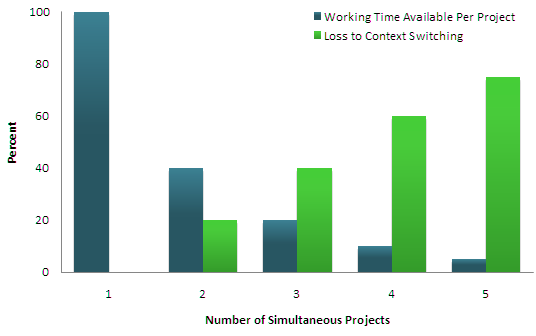
According to Forbes, most people try and to do five projects in a single day. If you do this, you’re losing up to 80% of your productive time each day to context switching!
So when planning your days and weeks, focus on working on one project at a time. This will skyrocket your productivity.
14. Get a Stand-Up Desk & Use Two Monitors
As you can tell, I’m all about getting more done in less time. That’s why I don’t usually work in coffee shops; it’s hard for me to focus and write efficiently. I typically only go there when working on other projects for my brand, Inspire Your Success.
The main reason I like writing from my home office is my setup. I bought a standing desk a while back, and it’s been a game-changer. If I’m feeling lazy or unmotivated, I’ll move it up and seem to have more energy.
Plus, I also use a second monitor as well. This way, I can write on one screen and have research or guidelines up on the other one.
15. Raise Your Rates
Over a year before my epic month, I doubled my rates. Depending on the project, I charge between .20 to .25 cents (now more) per word and do some retainer gigs as well.
If you want to make more money and work fewer hours, charge higher rates. I see so many writers undervalue themselves and their work because they don’t think anyone will hire them.
But if you can deliver and believe in yourself, I promise you can charge much more than now. There’s nothing to be scared of either.
When you raise your rates and pitch new clients, only a few things can happen:
- Clients agree (this will happen more than you realize)
- Client says no but negotiates to a middle rate (still an increase)
- Client says no (you move on and find someone else)
Plus, once you take on new clients with these rates, I can almost guarantee your writing will be step up as well.
16. Write Content You Enjoy
Taking a writing job just for the money is no different than taking a typical 9–5 for the money. If you’re in a money crunch, I get it.
But in the long-term, I’ve found that writing about topics you care about is much more enjoyable and rewarding. As lame as it sounds, it doesn’t feel like work.
While some projects and some clients suck, I encourage all of my students to find work you enjoy doing (at least for the most part). Because in the beginning, I took gigs because I needed the money. Taking some of these gigs led me to resent them and the personal finance niche, and it also made me hate writing for a few months.
Ever since I pivoted niches to entrepreneurship and added a second niche, golf writing, my love for writing has never been stronger.
“Doing what you love is freedom. Loving what you do is happiness.” — Lana Del Ray
17. Network with Other Writers
Writing is a lonely job; don’t let anyone tell you otherwise. Part of my personality loves it, but other times, it’s incredibly isolating.
One way to help the isolation is to network and connect with other writers, both online and offline. Don’t discount the power of Facebook groups or LinkedIn to find other writers.
Just reach out to other writers and give them a compliment about their work. Sign up for Calendly so you can make it easy for others to book time with you. Don’t forget, one idea or a new perspective from another writer can change your online business!
18. Don’t Forget to Exercise
The standing desk doesn’t count as exercise. While I’m sure you burn more calories standing than sitting, don’t neglect your health.
Exercise is a top priority in my life, and I have found it makes me a much better writer as well. When I’m at the gym or on a run I almost always get the best ideas and have to add them as a note on my phone.
Find an exercise you love (schedule it on Sundays) and stick to it. Your wallet and body will thank you!
19. Have Fun
Keep everything in perspective. You’re getting paid to type words on a computer while other people in the world barely survive.
Sure, some clients suck, you might get fired from a job, or cold pitches can ghost you. But at the end of the day, these are small problems compared to most people’s.
Remember that with a strong work ethic, freelance writing is the easiest way to make money online. In 12 months, I scaled my writing business 10x while only working 20 hours and with hardly any capital upfront.
Have fun, enjoy the process, and know that if I can do it, you can too!
20. Celebrate Your Wins
My final tip?
Celebrate your wins!
Seriously, it’s so simple but so effective. This quote from Inc says it best:
“When you celebrate, endorphins are released inside your body and you feel incredible. When you accomplish something and don’t take the time to celebrate, you are robbing yourself of an important feeling that reinforces your success. So much of what we do in our business is driven (or limited) by our psychology. Celebrating your wins not only feels great physically, but it reinforces the behavior you want to show up when you face a new challenge or opportunity.”
If you’re like me, I struggle to give myself enough credit in my entrepreneurial journey. Even when I sent out $20,000+ of invoices, I found myself not celebrating enough and already thinking about the following month.
Don’t forget: Your brain loves celebrating wins! Small or big, it doesn’t matter. Get in the habit of giving yourself praise and celebrate everything you do in your writing journey.
Winning breeds winning!
Final Thoughts
I’m no different than you.
I started a blog in January of 2016 and, quite frankly, was an awful writer.
Two years later, I started freelance writing because my blog was failing, and I had already quit my job. Two years later, I’m publishing a post about making $20,000 in 30 days.
No, success isn’t overnight. But if you keep going, amazing things can happen.
Remember, If you are struggling right now, your situation can improve. Just keep believing in yourself, upgrading your skills, and trust the process.
As my mentor, James Wedmore, always says, “100% possible, 100% of the time.”
If you use these tips and strategies, I’m confident that you can speed up success and make a full-time income writing.


