
2 Strategies To Take Advantage Of The Instability Of Financial Markets
In the short term, the market is a voting machine, but in the long term, it is a weighing machine”.
-Benjamin Graham
September 15, 2022, definitely proved that the markets were crazy.
In a resounding statement, Adobe, the giant of digital creation software (including Photoshop, Illustrator, and Acrobat, which taxes you as soon as you want to make a pdf)
Announces the purchase of Figma, a company specializing in the collaborative creation of user interfaces, for $20 billion.
And this is a titanic opportunity for Adobe.
Why?
Because Figma would allow it to excel in a field where Adobe is still unable to break through.
And would offer him a virtual monopoly, giving him the status of undisputed world leader in the sector.
As for Figma,
It would benefit from Adobe’s sprawling ecosystem and monstrous customer base.
Win-win, isn’t it?
Well, not for investors
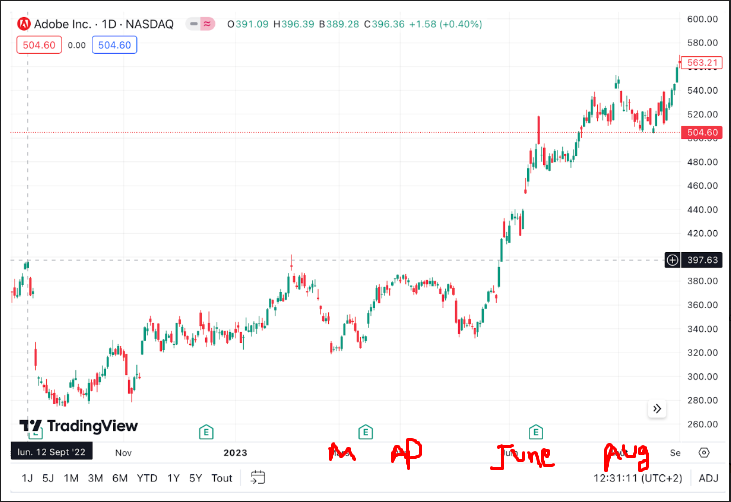
Following the announcement, the price of Adobe collapsed by -31% in 3 weeks.
(Translation: According to investors, Adobe is worth even less now after making a giant leap in the sector than before).
Why?
Because investors are like most humans, they hate change.
At the slightest announcement that risks confirming their bias (often negative), they panic or go crazy with joy and act irrationally.
And announcements, there are a bunch that arrive every year :
- The publication of economic indicators such as the consumer confidence index, the unemployment rate, the industrial report, etc ;
- Wars or other economic conflicts ;
- Concerns related to inflation or deflation ;
- The government’s fiscal and monetary policy (with the FED’s announcements that are freaking out investors…) ;
- Technological changes, innovations, or acquisitions ;
- Natural disasters or epidemics (Hello Covid-19 …) ;
- Data on the performance of companies or governments (in particular quarterly revenue reports) ;
- The evolution of regulations ;
- Changes in investors’ feelings about certain industries or the legal system.
And this affects the markets at all levels :
- At the level of companies, as I showed you with the example of Adobe.
- At the index level, as of March 16, 2020, where the Nasdaq (an index mainly composed of technology companies) fell by 12% after the announcement of COVID-19.
- At the global market level, as during the real estate bubble of 2007/2008 or the “.com” bubble of the 2000s, investors' euphoria caused a monstrous fall.
This proves one thing :
No matter what happens, you can’t rely solely on the markets to make reliable decisions.
(Although I know it’s tempting to do it like everyone else.).
Because if you follow the movement, even the best investments, managed by the best managers like Peter Lynch, will make you lose money :
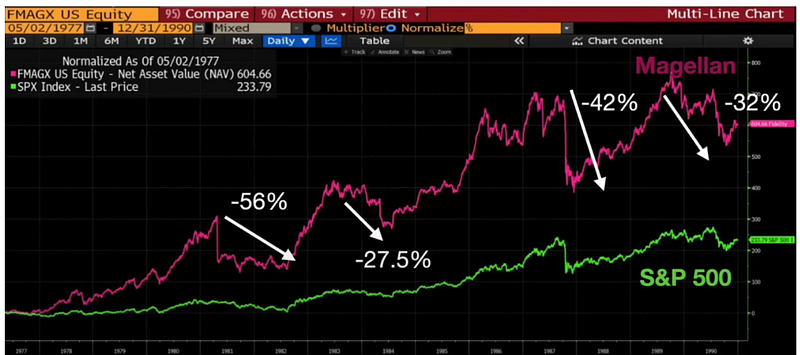
Despite a performance of +604% in 13 years, 50% of the fund’s investors have lost money.
And for the rest,
A very small average gain of +7%.
That’s what it costs to react to the blow of emotion.
(The phenomenon is so violent that CNN Finance has created an index to measure it: the fear and greed indicator. He is supposed to estimate at all times whether the market is crazy or reasonable).
Fortunately, in the long term, the markets know how to regulate themselves and correctly assess the price of assets.
This is what Benjamin Graham, Warren Buffett’s mentor and pioneer of market analysis, means when he says :
“In the short term, the market is a voting machine, but in the long term, it is a weighing machine.”.
Because, in the end, good investments always increase, and bad ones collapse.
For Adobe? A year after its fall of -31%, the share price exploded by 104.7%
For the Nasdaq? One year after its fall of -12%, its price has risen by +95.64% :
As for the bad investments in the economic bubbles of 2000 and 2007/2008… Countless overvalued companies went bankrupt, destroying the capital of investors who acted out of pure greed without evaluating the market in depth.
So what are your options for taking advantage of the madness of the markets?
You have 2 possibilities :
1. You can use a momentum approach (quite risky), to surf on the sentiment of the markets. You identify an uptrend (even unjustified) and invest in the short/medium term to withdraw before it fizzles.
2. You adopt a more reliable and methodical approach by taking advantage of the various market events to optimize your DCA. Instead of investing every month, you can keep part of your DCA (the amount you decided to invest each month) to spend strategically :
Is the FED having a meeting soon? Most of the time, the markets react badly to his statements.
Will a PCE inflation report be published soon? Even if they are correct, they are never good enough for investors…
You can even keep some cash in your wallet in case a major event occurs (war, pandemic, …) to take advantage of a significant market decline.
The possibilities are unlimited. As long as you are trained and know what to invest in, the markets will always end up bringing you gains.
If you master fundamental analysis, you will know the real price of assets and their real potential.
Be methodical and patient, and you are guaranteed to achieve your goals.
So ignore the crowd, focus on your strategy, and the markets will always be on your side.
Good luck with your investments!
Thanks for reading
I’m grateful for your support. You are welcome to subscribe to my free email lists.. If you like it, please give it claps and follow to stay on for the next article.