
To Transform the Plastic Crisis: Reduce the Amount of Virgin Plastics Produced
(This is part of the series for 7 Main Areas of Focus to Transform the Plastic Crisis)
Some might say reducing the amount of plastic produced should be #1 and innovation should be #2. The reason this is second here is that without the required innovations, alternatives and behavioral transformations reducing the amount of plastics is highly unlikely.
Between 1950 and 2015 our civilization went from producing 8Million Metric Tons (mmt) to 380mmts, and topped off 2018 at 415mmts.
The total production rate in 1950 is now equal to just the annual leakage into the ocean.
The total production rate in 1950 is now equal to just the annual leakage into the ocean — that’s equal to the weight of two Empire State Buildings per month, 24 per year. The number is so large and the million metric ton unit is so foreign to 99.9% of the population that none of us can truly comprehend what this means. Everybody has the idea that “somebody has an eye on it.” Truthfully, do they?
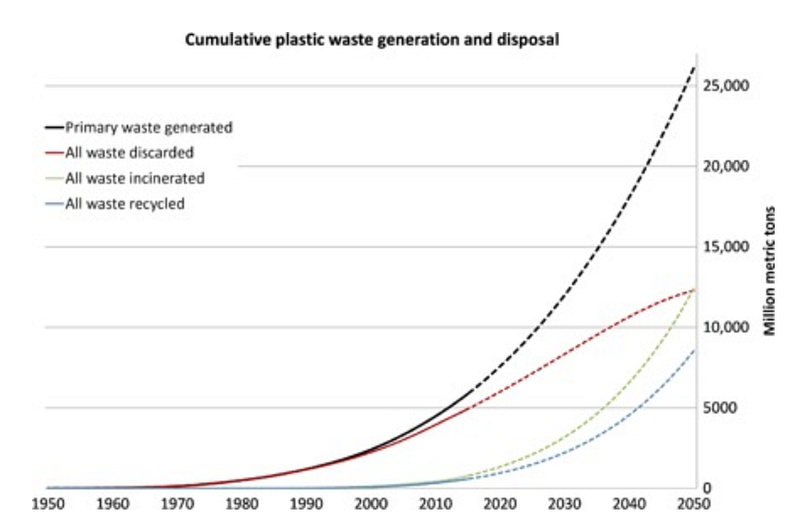
With increased populations the amount of plastic produced is projected to increase 4 times by 2050! Even with all the recycling and collections activated communities around the world wouldn’t be able to handle this much material being pumped into the planet and dumped into the environment.
The industries are doing their jobs and growing the industry and production on an annual basis per stakeholder demands. What is required is a cap on the amount of raw plastics produced in a year. Another potential approach is to incentivize the use of recycled content for manufacturers and for customers to demand recycled and reusable products. Whether your vacuum cleaner, dashboard, outdoor furniture etc are made of recycled plastic doesn’t have an impact on the quality of the product or the quality of your lifestyle.
There is data to show that China is the largest producer of plastics. Undoubtedly, inarguably and absolutely true. We wouldn’t need a study to see this. But not just because of the size of their own population and consumption — but also that when you go to any shop in North America, Europe, Middle-East and even in many places in South America what you see is mainly “made in China.” The root cause of this is an entire conversation of its own. However, we in the West are the ones who deem China our manufacturing market, take them all of our demand and then we blame them for producing and then also discarding most plastics. The change here is all around -circular- again. The west needs to stop prioritizing profit margins and stop buying things that are made in China. There is a true cost for everything and trying to pretend that there isn’t is a big reason of the woes our economic structure is now producing.
What are some ways to reduce amount of virgin plastics produced/required every year?
- Increase investments in alternative products — we discussed this in the previous “Invest in Innovative Product Design” article.
- Incentivize products with higher recycled content — municipalities, businesses, consumers, can all be incentivized when using and purchasing products that have higher recycled content. To provide incentives more investments and subsidies will be required in some markets, like North America, to fund the incentives until the volumes create economies of scale. Feeding the circular economy, once incentives start paying off back in the “purchase” or “manufacture” stage the required subsidies would also go down naturally.
- Participate in product sharing programs and methods — again this topic is also covered in the previous part of the series — using shared technologies naturally translates to less number of products required, and hence less amount of plastics used and discarded.
- Tax the use of single-use plastic packaging — governments can step in and play a major role through policy changes. Short of banning all single-use plastics, governments, municipalities, and communities can create programs where single-use packaging is taxed from the manufacturer and retailer for wanting to purchase a cheaper option rather than options without single-use plastic.
- Incentivize customers and businesses to provide reusable products — is there really any reason that Starbucks is able to serve coffee in only a To Go cup while you sit down to have your coffee? It’s not like they’re providing cheap coffee. Businesses think that not providing reusables and removing the “overhead” for dishwashing is cheaper than just buying and throwing “away” a plastic cup. This again comes from the ignorance of the true cost of something. Even if the $ costing you today is cheaper — you’re paying in higher taxes for removing waste, finding a solution to the plastic problem in water streams, and health implications. There is a true cost — a full life cycle — of these “cheap” materials that need to be considered.
- Ban the use of single-use plastics — many countries are moving towards this option. Europe has recently just announced banning all single-use plastics in the region. As challenging and difficult as it might seem it is doable. The cultural, behavioral and political factors are major contributors to realizing these bans. Recently, Suffolk County reported that their plastic bag use has gone down by 1.1Billion in one year, since their plastic bag ban in January 2018. 1 Billion bags, in one county, one year. #wereallinthistogether
Next we take a brief look at Taxing on Landfills and Single Use Plastic Packaging