avatarLucy Dan 蛋小姐 (she/her/她)

Free AI web copilot to create summaries, insights and extended knowledge, download it at here

1792

Abstract

erhood or relationships, or survival.</p><p id="d2fc">I wonder now, what stories and text-to-self connections this new addition will add to the world.</p><blockquote id="4cbd"><p><b>Author’s note</b>: I read book 1, The Handmaid’s Tale for leisure, and then it was assigned to us for deeper analysis as part of the high school curriculum. Atwood, after all, was a titan in the Canadian literature realm, and we wouldn’t graduate without an English teacher requiring us read one of her books. I reread the book again when the tv series came out, wanting to refresh my mind of the story before diving into the tv show. I was shocked. There was so much I missed as a 16-year-old that adult me noticed. It made me wonder what it would be like to experience the book side by side, especially reading the sequel as a teen and seeing teen characters centered in the story. I wonder.</p></blockquote><blockquote id="1d66"><p>Once a story you’ve regarded as true has turned false, you begin suspecting all stories.</p></blockquote><p id="4b7e">There are the things painted as protection proudly purported in the name of safety — ㅤdoes it truly bring safety ㅤor does it simply ㅤuse violence ㅤto maintain ㅤthe status quo of power?</p><p id="0116">There are the things regarded as ridiculous, extreme and egregious — ㅤwar is not peace ㅤfreedom is not slavery ㅤㅤand ㅤignorance is not strength. In that world, words were manipulated ㅤso that nothing was ever true, ㅤeach meaning diluted in nuance. Yet in our world, algorithms manipulate ㅤsuch that everything is always loud, ㅤextreme, but the only “truth” or “perspective” ㅤthere is to be held, ㅤdissolving nuance ㅤㅤand ㅤconcentrating extreme views.</p><p id="d065">Perhaps ㅤnot all stories were false, ㅤand there will be ㅤsome merit ㅤwithin each

Options

perspective, But ㅤit is down to us ㅤto ask those questions, ㅤhave that suspicion ㅤin the first place.</p><blockquote id="91f5"><p><b>Author’s note</b>: The use of different (flawed, biased, but human) perspectives to illustrate a dystopian is one of my favourite. It’s by no means unique to Atwood’s writing, but I think with this book in particular, I was grateful to have gotten the perspective outside of Offred’s point of view.</p></blockquote><p id="a0da">Hi, I’m <a href="undefined">Lucy Dan 蛋小姐 (she/her/她)</a> and this was really fun to write! I thought I’d start out with an unstructured rant in response to the book but it turned out there were a few poems that came out instead. That’s what’s fun about writing, right?</p><div id="beee" class="link-block"> <a href="https://link.medium.com/8mAxuWktpeb"> <div> <div> <h2>Fertilizer</h2> <div><h3>When everything you write is cr*p</h3></div> <div><p>link.medium.com</p></div> </div> <div> <div style="background-image: url(https://miro.readmedium.com/v2/resize:fit:320/0*HdicHAzG-jxGmgFb)"></div> </div> </div> </a> </div><div id="9164" class="link-block"> <a href="https://link.medium.com/pWK9JfEP7fb"> <div> <div> <h2>Smoking</h2> <div><h3>Why is killing myself a comfort zone?</h3></div> <div><p>link.medium.com</p></div> </div> <div> <div style="background-image: url(https://miro.readmedium.com/v2/resize:fit:320/0*kAe8U-tB7DY63qM2)"></div> </div> </div> </a> </div></article></body>

2 Poems Inspired By Reading The Testaments by Margaret Atwood

Thank you, Margaret Atwood
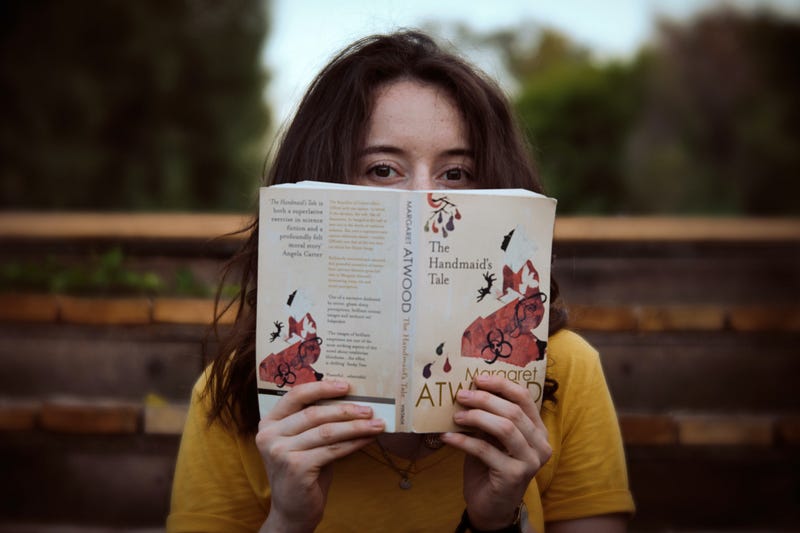
Photo by Umid Akbarov on Unsplash

Book: The Testaments Author: Margaret Atwood

Book and Sequel

The dive into a dystopian world as a teen was not new;

both prescribed reading, and for leisure, dystopia placed first in my genre of favourites.

But then, I’d read this book as if it were some kind of dystopian world, too distanced to be true.

Reliving your pages as an adult, blood drained from my face as scenes I didn’t understand became all too true, all too close to my experiences as an adult.

A lifetime later, we receive a sequel, and I mean a true lifetime — a distance in time that spans larger than my own life.

In the sequel, my adult brain saw this dystopia through teen eyes,

juxtaposed with one of the villains I came to hate in a previous decade,

viewed through a new lens of survival.

I wonder what it would be like for an adolescent to see themselves more directly in the sequel,

than for then 16-year-old me, to wonder what it would be like to be the adult main character, not truly understanding the intricacies of motherhood or relationships, or survival.

I wonder now, what stories and text-to-self connections this new addition will add to the world.

Author’s note: I read book 1, The Handmaid’s Tale for leisure, and then it was assigned to us for deeper analysis as part of the high school curriculum. Atwood, after all, was a titan in the Canadian literature realm, and we wouldn’t graduate without an English teacher requiring us read one of her books. I reread the book again when the tv series came out, wanting to refresh my mind of the story before diving into the tv show. I was shocked. There was so much I missed as a 16-year-old that adult me noticed. It made me wonder what it would be like to experience the book side by side, especially reading the sequel as a teen and seeing teen characters centered in the story. I wonder.

Once a story you’ve regarded as true has turned false, you begin suspecting all stories.

There are the things painted as protection proudly purported in the name of safety — ㅤdoes it truly bring safety ㅤor does it simply ㅤuse violence ㅤto maintain ㅤthe status quo of power?

There are the things regarded as ridiculous, extreme and egregious — ㅤwar is not peace ㅤfreedom is not slavery ㅤㅤand ㅤignorance is not strength. In that world, words were manipulated ㅤso that nothing was ever true, ㅤeach meaning diluted in nuance. Yet in our world, algorithms manipulate ㅤsuch that everything is always loud, ㅤextreme, but the only “truth” or “perspective” ㅤthere is to be held, ㅤdissolving nuance ㅤㅤand ㅤconcentrating extreme views.

Perhaps ㅤnot all stories were false, ㅤand there will be ㅤsome merit ㅤwithin each perspective, But ㅤit is down to us ㅤto ask those questions, ㅤhave that suspicion ㅤin the first place.

Author’s note: The use of different (flawed, biased, but human) perspectives to illustrate a dystopian is one of my favourite. It’s by no means unique to Atwood’s writing, but I think with this book in particular, I was grateful to have gotten the perspective outside of Offred’s point of view.

Hi, I’m Lucy Dan 蛋小姐 (she/her/她) and this was really fun to write! I thought I’d start out with an unstructured rant in response to the book but it turned out there were a few poems that came out instead. That’s what’s fun about writing, right?

Books
Poetry
Margaret Atwood
Recommended from ReadMedium