
2 Bad Habits That Stole Decades of My Happiness — Zen Approach to Overcoming Bad Habits
Zen can show you what to do. Also, what not to do.
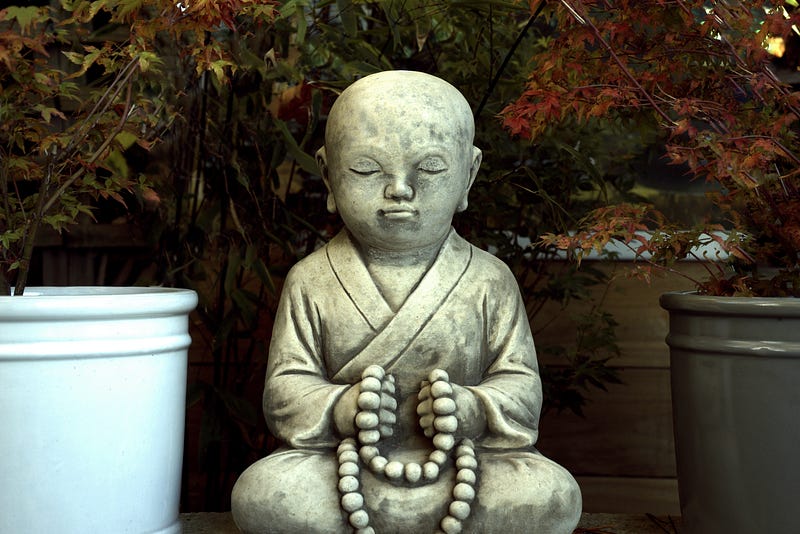
The positive side of the ancient Zen stories is valuable, but the negative side of the parables is equally, if not more, important.
The gatekeepers of the billion-dollar personal and business management industry would have you believe that you need spend big to get massive results. But is that true?
Is your focus captured by that which is shiny and you follow it? And sometimes to your determinant.
Zen teachings are cloaked in cryptic messages. I may not know the sound of one hand clapping, but I do know the hard lessons learned from an ascetic life in India and paying thousands of dollars on personal development courses.
These Zen stories are from the book Shaseki-shu (Collection of Stone and Sand), a collection of Zen stories by Mujū Dōkyō.
1. Stingy in Teaching
A young physician in Tokyo named Kusuda met a college friend who had been studying Zen. The young doctor asked him what Zen was.
“I cannot tell you what it is,” the friend replied, “but one thing is certain. If you understand Zen, you will not be afraid to die.”
“That’s fine,” said Kusuda. “I will try it. Where can I find a teacher?”
“Go to the master Nan-in,” the friend told him.
So Kusuda went to call on Nan-in. He carried a dagger nine and a half inches long to determine whether or not the teacher was afraid to die.
When Nan-in saw Kusuda he exclaimed: “Hello, friend. How are you? We haven’t seen each other for a long time!”
This perplexed Kusuda, who replied: “We have never met before.”
“That’s right,” answered Nan-in. “I mistook you for another physician who is receiving instruction here.”
With such a beginning, Kusuda lost his chance to test the master, so reluctantly he asked if he might receive instruction.
Nan-in said: “Zen is not a difficult task. If you are a physician, treat your patients with kindness. That is Zen.”
Kusuda visited Nan-in three times. Each time Nan-in told him the same thing. “A physician should not waste time around here. Go home and take care of your patients.”
It was not clear to Kusuda how such teaching could remove the fear of death. So on the forth visit, he complained: “My friend told me that when one learns Zen one loses his fear of death. Each time I come here you tell me to take care of my patients. I know that much. If that is your so-called Zen, I am not going to visit you anymore.”
Nan-in smiled and patted the doctor. “I have been too strict with you. Let me give you a koan.” He presented Kusuda with Joshu’s Mu to work over, which is the first mind-enlightening problem in the book called The Gateless Gate.
Kusuda pondered this problem of Mu (No-Thing) for two years. At length he thought he had reached certainty of mind. But his teacher commented: “You are not in yet.”
Kusuda continued in concentration for another yet and a half. His mind became placid. Problems dissolved. No-Thing became the truth. He served his patients well and, without even knowing it, he was free from concern of life and death.
Then he visited Nan-in, his old teacher just smiled.
The bad habit is thinking simple lessons are not powerful.
I paid over $6,000 on a course. What I got from it was the same thing I got from a $75 Primal Therapy session. How to direct and harness my unresolved anger.
Preconceived biases distort your thinking toward what is required to get your desired outcome.
The more I pay for a management course, the better results it will provide.
If I do a personal development course for someone famous, it will relieve my 47-year-old inner sadness
I have seen that the more you pay isn’t necessarily linked to quality. Or the theme of the teaching is the same, but:
- The facilitator wears a $2,000 Italian suit, compared to a teacher in jeans and a T-shirt.
- The teaching is given in a 6-star hotel, compared to an old run-down temple.
Factors that play in the power of teaching are:
- Your receptivity.
- The ability of the teacher to deliver the teaching at your level.
- Putting the teaching into practice and learning the nuances to perfect the lessons.
2. A Parable
Buddha told a parable in the sutra:
A man traveling across a field encountered a tiger. He fled, the tiger after him. Coming to a precipice, he caught hold of the root of a wild vine and swung himself down over the edge. The tiger sniffed at him from above. Trembling, the man looked down to where, far below, another tiger was waiting to eat him. Only the vine sustained him.
Two mice, one white and one black, little by little started to gnaw away the vine. The man saw a luscious strawberry near him. Grasping the vine with one hand, he plucked the strawberry with the other. How sweet it tasted!
The bad habit is being mesmerized by the shiny object.
In the last 27 years, I spent 7 years living in India.
I read 100s of autobiographies of swamis and Indian saints in my earlier 20s.
The allure of studying in the far reaches of the snow-capped Indian Himalayan mountains was strong.
I was captivated by the romantic idea of being enlightened by the touch of a Realized Master deep in an ashram hidden in the deep recesses of the Himalayan Cedar woods.
I would then later go on to pen my spiritual journey memoir that would sit atop the New Times Best Sellers list — for several months.
Reality check:
- I spent 2 years and 9 months at an ashram a couple of hours out of Mumbai with an Indian guy dressed in white (he wasn’t a monk) who said he was more powerful than Jesus.
- A painful week in a Pune hospital, on a drip. That included a painful colonoscopy.
- Exposed the real side of swami’s that included seducing women, eating food they shouldn’t be, manipulating their followers to give them money, leering through windows to look at a female having a shower, a crafted document that had the headshots of pictures of some of the women in the ashram cut and pasted onto the naked bodies from pictures lifted off the internet, continual ugly power plays of devotees (followers of gurus) trying to get close to the gurus.
- Made my mom cry after she had visited me, from Australia, at one of the ashrams I stayed at after I was babbling on about how she ruined my life. And that spiritual people aren’t close to their families.
Work with what you have at your disposal in the present moment. Chasing things you harvest in books and expensive courses is an endless cycle, that makes you poorer and the other person richer.
The perception that there is any wrong with you is a lie.
Do you need healing? If you have been hurt, then maybe yes. But that doesn’t mean there is anything wrong with you at a fundamental level as a human being.
Avoid these 2 bad habits at all costs.
These are bad habits that can be changed immediately through a shift in perception.
In the comfort of your own home, reflect on what is true for you and makes sense.
Look beyond what you see and what you are told by the experts.
The old Zen masters didn’t charge for their teachings but gave them away freely. Don’t be fooled by the overlooking of the power in simplicity.
Success comes through intelligent and insightful action.
Join my email list of +1,000 people to receive your FREE Zen Checklist