
2 Amazing Books For the Challenges of Life
People and change, like death and taxes, are the constants in your life.
Two extraordinary books help me through life’s ordinary events as well as life’s tough times. That’s saying something since I come from a literature background. But these two slim volumes provide the nurturing for my soul when I need it most.
I had been living the philosophy of Don Miguel Ruiz before I read his phenomenal book The Four Agreements. It wasn’t so much that Ruiz taught me how to shape my life experience as it reflected how I was already living. It provided voice to the unspoken philosophy of my soul.
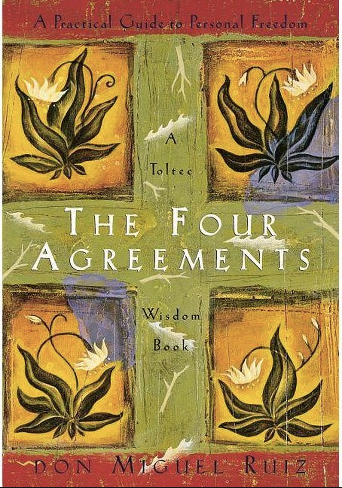
The Four Agreements will change your life. As Ruiz says, we all live in our own dream world and those dream worlds bump into each other’s. That friction can create havoc in our lives. Thus, these four agreements allow us to retain some semblance of control over our dream worlds.
- Be Impeccable With Your Word
- Don’t Take Anything Personally
- Don’t Make Assumptions
- Always Do Your Best
When used together, these four small philosophies for life pack a big whallup that can cover almost any situation and can truly lead to a world with less strife, more creativity, and more love and joy.
1. Be Impeccable With Your Word
“Impeccable” is the only $10 word in the bunch. All the rest are normal everyday words.
The word “impeccable” comes from the Latin “impeccabilis” from in- (‘not’) + peccare (‘to sin’). It means “faultless, or in accordance with the highest standards of propriety.”
In other words, don’t sin with your words. It’s a moral imperative. It means so much more than just “don’t lie.” It means doing as you say you will.
If you say you will drop off food for your mother-in-law on your way home, then you must be good to your word and do it, even if traffic is horrible and you’ve had a bad day or just aren’t feeling up for a visit.
Your word is your oath. It is your character. It is the stand-in for your entire self-worth. If your word is not good, who should believe you in anything you do? Lying is the easiest way to break your word, but there are more insidious and subtle ways to break it, such as not following through.
It’s basically a habit to be good to your word, a habit worth cultivating so that others see your word for the good it is.
2. Don’t Take Anything Personally
This is an amazing agreement. Just as we shouldn’t worry too much when people belittle us, we should also not let our ego get inflated when they overly praise us. That’s right! Use this agreement to deflect praise as well as criticism. It provides a much more stoic and balanced view of life than the external chaos around us.
People’s words toward you are more of a reflection of their own internal concerns than having anything to do with you. This one is tough in today’s society, especially if you are a social media user. People are angry. They have short tempers. They are stressed. People lash out at others. Bashing others is easier than looking at yourself and your own actions.
But that’s the point. Things that people say say more about them than the words they say about you. Projection is a real thing. If someone calls you “lazy,” then maybe it’s because they’re beating themselves up for being lazy or know the downsides of their own laziness.
I’ve been through two divorces. I’ve made mistakes. I’ve deserved some of the acrimonious remarks issued by my exes. But I also learned through those divorces that when they yelled at me, they were mostly berating themselves. Don’t let someone else’s words get to you, either positive or negative.
3. Don’t Make Assumptions
For me, this is the most important rule. I think making assumptions is worse than lying. Sometimes we lie to those we love to soften the truth. The white lie about whether dinner was good or whether some article of clothing looks good or not. We lie to spare feelings.
If you’re taking care of agreement #1 — Be Impeccable With Your Word, then lying won’t be a problem, even if it’s difficult sometimes.
But assuming will lead you down dark paths. We know the old saying: “if you assume, you make an “ass” out of “u” and “me.” That’s a humorous but flippant warning about assuming.
When you assume, you make erroneous leaps in logic that may result in judging or labeling others in ways that don’t stand up to the truth. Assumptions go hand in hand with many stereotypes. When you start dealing with people as types and not as individuals, you stop taking people on their individual merits.
Assuming will lead to havoc in your personal and professional life. If you assume an employee isn’t working well, and treat him as such, you will create an employee who doesn’t feel valued and thus will not work well. Assuming starts a vicious cycle.
Making assumptions is a natural part of life. We must make generalizations to filter through millions of details simultaneously. Assuming allows us to generalize when needed. But taking assumptions as truth is a dangerous proposition. It’s a guess. And that’s not good enough for many of the things we must deal with daily.
You can learn to get through life without assuming much. Always be on guard for that unstated assumption, and you will have less strife in your life, guaranteed. We all get caught assuming now and then. But you can decrease assumptions in your life through conscious attention of dealing with the facts at hand.
4. Always Do Your Best
Finally, this is the perspective-making agreement. Remember that your best is always relative, not your objective best. If you have a cold, then you may be at 50%. But if that’s your best for that day, then you are doing the best you can at 50%. Some days you will be at 100%. Other days, you may be at 10%. The human body and mind doesn’t always work at top efficiency.
In short, strive to do well, but cut yourself some slack as well.
I’m a big fan of Yoda — Do or do not. There is no try. If you are doing something, you should always do your best. No half-assing it. You want to have pride in your actions. Doing your best will allow you to look at your accomplishments and see your hard work for what it is. If you keep trying and don’t give up, you will always have something to be proud of, even if the outcome is less than what you had hoped.
Taken altogether, these four agreements form a powerful life philosophy that can shape your daily life into a calm, centered, stable look at an often chaotic world.
But life isn’t always manageable. Right now, during the pandemic, we also see a world struggling against autocratic impulses of world leaders, friction between nations, and basic civil rights struggles, important struggles of life and death that have enormous consequences for people’s lives. What people are dealing with the most is loss.
Navigating Loss
The book I turn to when life gets rough is How to Survive the Loss of a Love by Peter McWilliams, Harold H. Bloomfield, and Melba Colgrove. This pithy book is both cheesy and memorable. It’s such a remarkable book that I have given it as a gift to a dozen people as they’ve faced life’s challenges.
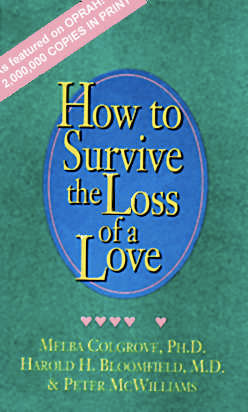
It explains what loss is (loss of a person through divorce or death, loss of a relationship, loss of a job). It also describes hidden losses (completion of school is loss of a goal). Sheltering in place during the pandemic is a loss (loss of freedom, loss of employment, loss of daily life routine). Our current civil strife against police brutality is also a fight against loss (senseless loss of life and loss of control).
Life is loss. Loss of love, partners, family, jobs, pets. Those losses can accrue over time or can come in waves like avalanches. Loss doesn’t get easier. Time doesn’t heal all wounds. But loss need not break us.
This extraordinary little book describes the 3-stage journey through loss, whatever the cause— Surviving, Healing, Growing.
Each single-page chapter is paired with a single page poem, each of which provides a visceral picture of that stage of the process. These poems are short enough and witty enough to be memorable, to sink deep into your brain.
The first chapter deals with base human survival, offering the refrain “I am alive. I will survive” as an utterance to get you through the (literally) breath-taking moments of day-to-day anxiety following a loss, a phrase I have uttered many times during my darkest days of struggle. It really works.
Surviving loss is an art in its own right. At the beginning stages of loss, we do anything to escape the pain. And we wallow and do the same things repeatedly, like cry and mope around endlessly. We also suffer fatigue and brain fog. One of the poems abdicates all responsibility to be a poem at all:
(there is no poem on this page as the poet decided to take a nap)
The chapters on healing fully embrace all that we do when we heal from loss — denial, anger, bargaining, depression, acceptance. Trust in the healing process to make the whole process if not easier, at least understandable.
The most memorable chapter for me is about finding new love. Often, when we have our hearts broken, we swear we will never love again, that the pain is too great. And yet, humans have an affinity, maybe even a base survival instinct, for seeking out and experiencing love. It’s one of life’s greatest joys. This small poem has remained with me since the first time I read the book.
It is a risk to love. What if it doesn’t work out? Ah, but what if it does?
That miracle of what the next day brings keeps me going.
When life is uncertain, when the losses pile up, when it seems easier to hide under a pillow, I grab for this book.
Books can be a source of adventure or a realistic look at the world around us. But they can also provide a philosophical structure or guidance through the stormy seas of life.
The Four Agreements and How to Survive the Loss of a Love are both extraordinary books that can heal you from life’s wounds and provide comfort through this remarkable journey on this earth.
Lee G. Hornbrook taught college English for 25 years in every time zone in the continental United States. He writes about sailing, movies, literature, baseball, growing up in the San Fernando Valley and is at work on a memoir. Find him on Twitter @awordpleaseblog and at his personal blog A Word, Please, or his Medium publication Valley Dude.