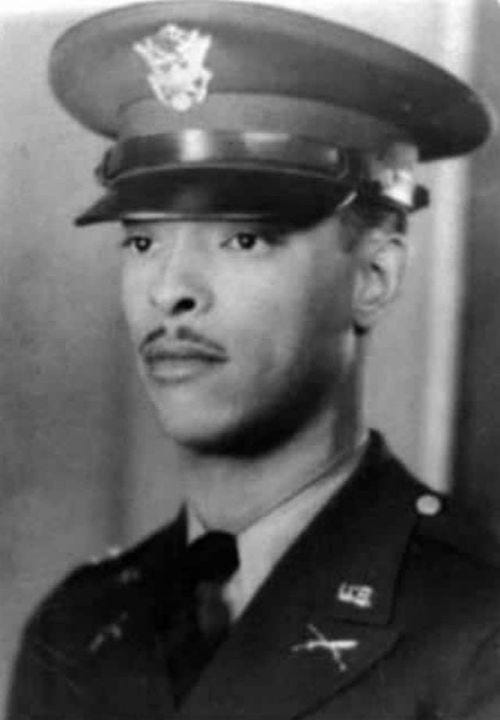
1st. Lt. John Fox: A Medal of Honor recipient who proved racists wrong about Black soldiers in combat
On this Martin Luther King Day, in an Army town such as ours outside Fort Leonard Wood, it’s appropriate to remember 1st Lt. John Fox, who nearly 80 years ago died when he called in an artillery barrage on his own position after being surrounded by German and pro-Fascist Italian soldiers during the American invasion of Italy. When his body was recovered a week later, he was found in a building surrounded by a hundred dead enemy soldiers.
Decades later Fox was awarded the Medal of Honor, but initially received no commendation at all, almost certainly due to being Black.
For Fox to become an officer in the segregated Army of the era immediately before America entered World War II was very difficult. Few colleges would admit Black students, and few of those that would allowed them to join ROTC programs. An exception was Wilberforce University in Ohio, to which Fox transferred and from which he received his commission in 1941. Even after joining the Army as an officer, his segregated units were largely prevented from front-line service.
That changed in late 1944 when, during the American invasion of Italy, mounting pressure from early civil rights advocates caused Fox’s unit, the 366th infantry regiment of the segregated 92nd “Buffalo” Division, to be assigned combat duty. Quoting an article from the National Medal of Honor Museum: “The division took for their symbol a buffalo, hearkening back to the black Buffalo Soldiers who fought for the United States after the Civil War. On that cold morning in 1944, the division received its new commander, Major General Edward Almond, who gave his troops a speech in which he is reported to have said, ‘I did not send for you. Your Negro newspapers, Negro politicians, and white friends have insisted on your seeing combat, and I shall see that you get combat and your share of the casualties.’”
Such sentiments today would be career-ending for an American military leader, but they were common in the 1940s. General Almond was unhappy with the performance of his troops during the Italian invasion and blamed it on their race. Years later when confronting North Korean and Chinese forces in the Korean War, his lack of respect for the fighting capacity of enemies he derided as “Chinese laundrymen” was responsible for some of the worst American defeats in Korea following foolhardy attacks. Almond learned the hard way that underestimating what people can do based on their skin color can have terrible consequences.
While there were problems in the 92nd, Fox proved the fears of his general unfounded that Black soldiers were unable or unwilling to do more than be rear-echelon support troops.
Again quoting the article: “A few weeks later, on December 23, 1944, John Fox moved to the front and took his place in an observation post (OP) in the town of Sommocolonia. Fox had volunteered for duty over Christmas, a four-day stint…. This action was Fox’s first while serving as forward observer, and his first on the front line ever. As the Italian partisans guarding the village called for support, Fox quickly realized that the attacking force, the size of which was difficult to estimate due to the dark, was too close for artillery interdiction because of the danger of hitting friendly forces… The Americans had been ordered to ‘hold at all costs,’ but their positions were rapidly unraveling under the relentless enemy assault. Fox ordered his men to retreat, and then issued the last fire request he would ever give: an artillery strike directly on his position. He was warned the coordinates he called in were right on top of him. Nevertheless, Fox repeatedly affirmed the coordinates, ending by saying ‘Fire It! There’s more of them than there are of us. Give them hell!’ Fox died in the ensuing barrage, possibly due to enemy fire. His body was recovered a week after the Axis attack, when an Allied offensive retook Sommocolonia. His sacrifice allowed some Allied troops and Italian civilians to escape, delayed the German offensive by at least a day, and resulted in the death of a great number of the attackers.”
How was Lt. Fox recognized at the time?
Not at all. A different set of commanders might have recognized Fox’s valor and used it as a motivator for troops in an underperforming division. Fox’s commanders did nothing.
It was not until 1982, three years after Almond’s death, that Fox received the Distinguished Service Cross, and not until 1997 that his award was upgraded to the Medal of Honor.
The only colors that are supposed to count in America are red, white and blue, but on that long-ago Christmas in 1944, race still meant a great deal, and sadly, that wasn’t true only for the fascists.
Lt. Fox died fighting an evil race-based ideology that considered men like him to be “untermensch,” inferior men of an inferior race who were not capable of much. While today associated with the Nazis, the term didn’t originate in Germany. The word “Untermenschen” was the German translation in 1925 of the title of an American book written by an American Klansman, Lothrop Stoddard, in 1922. His horrible title, “The Revolt Against Civilization: The Menace of the Under-man,” says all that needs to be said about his views, and shows the problem was not limited to Germans. Far from being a “country bumpkin bigot,” Stoddard held a Harvard Ph.D. and many of his books on so-called scientific racism were issued by the major mainline Scribner’s publishing house. (Ironically, Stoddard also viewed “Mediterraneans” — in that era, a code word for Italian immigrants — as ‘under-men’ who were damaging the United States by being allowed to immigrate. The Nazis in Germany liked some of what Stoddard wrote, but Mussolini’s Italian fascists obviously did not!)
There’s no way to know for sure whether the Germans and fascist Italians who Lt. Fox killed knew they were fighting a Black man inside that building calling in artillery strikes on their positions. The usual practice in that era was for Black enlisted men in segregated all-Black units to be commanded by white officers; Fox and his unit were exceptions. It is known the attackers believed the Americans they were fighting were inexperienced and unused to combat, which was true. The Germans and Italian fascists selected that sector of the Italian Front for counterattack based on their belief the forces they were fighting were weak.
Lt. Fox never got a second chance to prove his bravery and lack of weakness.
Once turned out to be enough.