
It’s Time to Retire the Dow
Where is Amazon, Facebook, or Alphabet? The most overrated metric in all of moneydom finally proves its irrelevance.
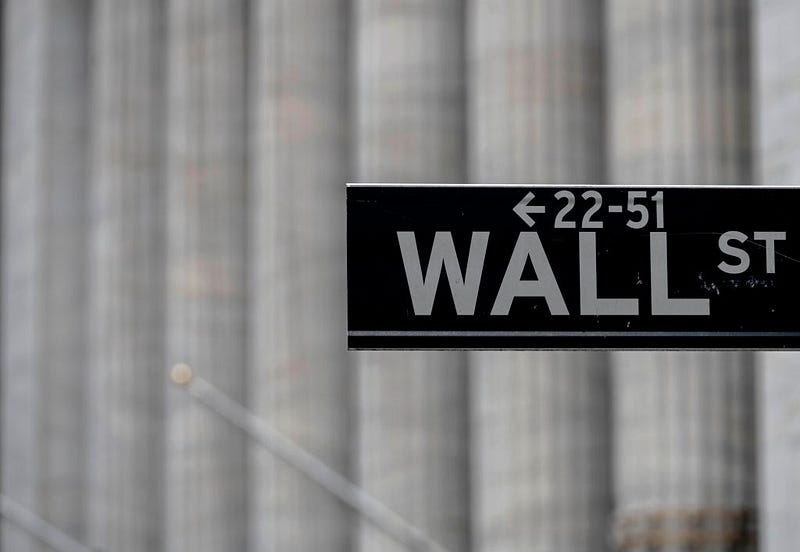
The Dow Jones Industrial Average is getting its latest makeover, a process of adding and subtracting companies that happens every few years. One thing about this ritual stays constant: It can never quite disguise that the Dow is the most overrated metric in all of moneydom. This most recent spruce-up, taking effect today, is a stark example of why that is so — and why there has never been a better time to ignore the Dow.
The state of the Dow is routinely cited by evening news anchors and in digital and print headlines as some kind of gospel-level measure of the American financial markets and by implication the economy in general. But in reality, the Dow is an index tracking the performance of a mere 30 stocks that supposedly give us all an idea of the broader business picture.
Which 30 stocks? The answer changes over time; that’s what these regular makeovers are about. (The Dow dates back to 1896, when it consisted of a dozen industrial companies; it later expanded to 20 companies, then 30, including nonindustrial firms.) Most recently, three members are being given the boot: oil giant ExxonMobil, drug maker Pfizer, and aerospace and defense firm Raytheon. The new inductees are software behemoth Salesforce, biopharma company Amgen, and the venerable conglomerate Honeywell (which, as it happens, is making a return, having been kicked out of the Dow a little over a decade ago).
The event that sparked this adjustment was not an overnight change in the makeup of the American economy. It was Apple announcing a four-for-one stock split, scheduled for today. This basically means (I’ll use round numbers) that each $500 share of Apple stock will be divided into four shares worth $125 each. Obviously this does not change the overall value of Apple, which recently made history by surpassing a $2 trillion market cap. But because the Dow is tied to measuring share price rather than overall valuation, it looks (to the Dow) like Apple shares are plunging from $500 to $125. So while in the real world Apple will remain as valuable as ever, in the Dow world, it will be worth one-fourth of what it was. This meant, to the Dow’s overseers, that the index would now suddenly underestimate the role of tech companies in the economy. Thus the need, officially speaking, for some component fiddling.
Why would anyone try to deduce some snapshot of the economy through the performance of 30 handpicked public companies?
A less official reading is that the Dow dumps underperformers for companies with sunnier share-price futures — a perspective perhaps influenced by the fact that the Dow lately hasn’t matched the performance of the broader S&P 500. Under this theory, Salesforce not only helps give the Dow a little more tech heft but will boost the index overall. (Salesforce just announced a strong quarter, resulting in a record single-day stock surge.)
It’s certainly understandable why a stock-picker might choose a Salesforce over an Exxon. But to consider the Dow on its own professed terms: Has the role of oil in the economy really taken a definitive dive? (Chevron will be the only energy stock left in the index.) And is a pharma giant like Pfizer actually less relevant to gauging the broader business picture than it was a month ago? More broadly, as Dow critics point out, there’s nothing in the Dow representing real estate or utilities. (And if you’re curious: Amazon is not in the Dow. Nor is Facebook or Google parent Alphabet.)
Lately, the entire stock market has seemed increasingly disconnected from the economy most of us actually inhabit — climbing ever skyward even as retailers and restaurants go bankrupt and millions lose their jobs. Generally speaking, that’s because stock markets do not gauge the overall health of the economy; they measure investors’ expectations around the future profits of public companies. (And public companies are emphatically not the entire economy: In fact, the number of public companies has shrunk from about 8,000 in the mid-1990s to roughly 3,500 in 2016.)
Still, if you must have one number to stand in for the performance of “the markets,” it makes far more sense to look to the S&P 500, which tracks the value of the largest public companies by their overall market value. This is still not a great way to track the economy. (It has its own distortions because a small handful of companies including Apple, Amazon, and a few other tech giants, represent an outsized percentage of the S&P 500’s total value.)
But by comparison, the whole concept of the Dow—and the way its performance is dutifully reported—is just weird at this point: Why would anyone try to deduce some snapshot of the economy through the performance of 30 handpicked public companies? We all have enough information to sort through these days. This latest reshuffling is a great reminder that the performance of the Dow is a data point we can safely ignore.