
Pattern Matching
What Big Tobacco’s Fall Tells Us About Big Tech’s Future
Taking on a powerful industry takes time — and a truly outraged public
Welcome back to Pattern Matching, OneZero’s weekly newsletter that puts the week’s most compelling tech stories in context.
On April 14, 1994, the CEOs of the seven big American tobacco firms sat side by side, facing a Congressional subcommittee hearing on their products’ health impacts. Rep. Ron Wyden, D-Oregon, asked them one by one to answer a simple question: Do you believe nicotine is not addictive? All seven, under oath, confirmed that they did not believe nicotine was addictive (video). The executives acknowledged that they manipulated nicotine levels in their products, but said it was to improve their flavor, not keep users hooked.
The hearing marked a turning point in the industry’s history. Up to that point, Big Tobacco had seemed untouchable politically at the federal level thanks to its cozy relationship with the GOP. But public opinion gradually turned against it as the industry continued to deny what had become plain to see: that its products were deadly, that it knew they were deadly, and that it marketed them to young people anyway.
After the 1994 hearing, the executives’ claims became infamous, and they were dubbed the “seven dwarfs.” A cascade of litigation followed, and by 1998 Republicans had abandoned the industry as a political liability, setting the stage for the industry-changing Tobacco Master Settlement later that year.
What does all of this have to do with the tech industry in 2020? Well…
The Pattern
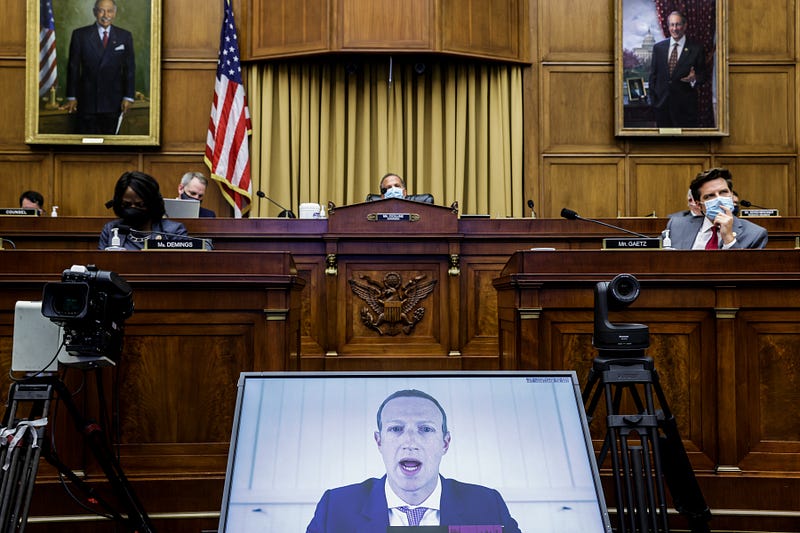
Mr. Bezos, Mr. Cook, Mr. Pichai, and Mr. Zuckerberg go to Washington.
- On Wednesday, the CEOs of the four most dominant internet platforms testified before the U.S. House Judiciary Committee’s subcommittee on antitrust. Each called in via Cisco’s WebEx videoconferencing service, though each runs a company that offers its own such service. (Fun fact: the venerable WebEx is The Wirecutter’s top pick for videoconferencing.)
- While it may not have been clear to the casual viewer, this wasn’t a one-off event; it was the sixth in a series of hearings by the subcommittee on digital platforms and market power, part of an investigation that’s expected to culminate in a bipartisan report to Congress later this year. So you can automatically discount any take that treated the hearing as if it were supposed to be the be-all and end-all of Congress’s antitrust inquiry. As the Amazon critic Stacy Mitchell pointed out in my Q&A with her ahead of the hearing, there’s a long game here that’s bigger than the hearing itself.
- That became more apparent when the subcommittee released a huge trove of documents obtained in the course of the investigation, which included internal emails and chats from each of the companies. “These documents build a far better antitrust case against the four tech giants than anything the CEOs said during the hearing,” CNBC’s Steve Kovach wrote.
- Still, Wednesday’s six-hour marathon understandably stole the spotlight, because it featured the top executives of four of the most powerful companies in world history. The hearing was Thursday’s top story in the major U.S. papers, and drew inevitable comparisons to the Big Tobacco hearings a quarter-century ago.
- We can learn from the similarities between the two. The label “Big Tech” to describe the largest internet companies overtly echoes “Big Tobacco,” and is meant to evoke the same sense of shadowy power, a force in society whose influence sprawls far beyond its direct relationship with customers. Inviting the executives of all four of the major companies involved in the probe was certain to evoke callbacks to the seven dwarfs. As with Big Tobacco, there’s a sense that Big Tech is up to devious tricks behind the scenes that belie its marketing claims.
- But the differences are at least as instructive as the similarities, when it comes to mapping out where this will lead us. While smartphones and social media have been compared to tobacco for their addictive qualities and health effects — mostly mental health, in tech’s case — that is not the core of the antitrust argument against them. Whereas Big Tobacco was under fire for making products that were literally lethal to its customers, the alleged harms at issue in the current Big Tech inquiry are mostly to rival businesses, and to more nebulous concepts such as fair competition and open markets. (I wrote briefly on Wednesday about what’s really at stake.) That doesn’t necessarily make them less urgent. But it makes them harder for the mainstream press and general public to wrap their minds around, let alone get riled up about.
- And unlike the tobacco executives, whose companies were more or less interchangeable, the tech executives who testified Wednesday represent firms whose core platforms focus on four different arenas: online retail, mobile apps, internet search, and social media. There is a common thread — their control of lucrative sub-economies that myriad smaller companies depend on — but each raises distinct competition problems that must be understood individually. That’s why there could be no single “gotcha” moment in Wednesday’s hearing, as there was in the 1994 tobacco hearing; no iconic clip that indicts all of them in one swoop.
- It did offer moments of drama. They were one-on-ones between a prosecutorial representative and a stammering CEO, as when Rep. Pamila Jayapal, R-WA grilled Zuckerberg (video) on whether he bullied Instagram into selling in 2012, or when Rep. Mary Gay Scanlon, D-PA, pressed Bezos (video) on Amazon’s alleged 2010 use of predatory pricing against Diapers.com. On multiple occasions the CEOs were struck by sudden cases of selective amnesia when it came to some of the largest business moves in their history. But watching them dissemble separately, via videoconference, in response to disparate lines of attack was not the same as seeing the tobacco executives squirming side-by-side as Wyden pinned them down with one simple question.
- The antitrust questions around tech platforms won’t be decided solely by the media and the public, of course. The subcommittee’s inquiry is helmed by Chair David Cicilline, D-RI, who in turn is being advised by staffers with deep knowledge of antitrust law and a strong reform agenda, as this New York Times profile of Cicilline from December 2019 explains. (See also this profile of law professor Lina Khan, who is helping to lead the investigation behind the scenes.) Several other Democratic committee members, including Jayapal — who got her own Times profile as an increasingly vocal Amazon critic in May — seem fully on board.
- But the Big Tobacco saga reminds us that it may take more than a cadre of crusaders from one party to effectively take on a powerful industry. In tobacco’s case, it ultimately took both parties, plus an outraged public. It also took a very long time. Though the 1994 hearing is rightly remembered as a turning point, it was only in 1996 that then-President Bill Clinton made the crucial decision to regulate nicotine as a drug. And it wasn’t until Newt Gingrich’s Republican majority in Congress finally turned on its longtime allies in the tobacco industry in 1998 that industry leaders realized they had no choice left but to settle, as detailed by an in-depth Washington Post series from that year. Gingrich did so not out of conviction, but out of fear that Republicans would be punished politically by Democrats for continuing to support an industry that had by then become deeply unpopular.
- While there’s no guarantee that the same political dynamics will apply to Big Tech in the 2020s as Big Tobacco in the 1990s, there are a couple of lessons we might safely draw. One is that the Democrats and Republicans will have to find some common ground, if not in ideology than at least in political expediency. Right now, members of both parties are going after Big Tech, but for very different reasons. The Democrats on the subcommittee are concerned chiefly with how they wield market power, but the Republicans, with one or two exceptions, are preoccupied with what they see as anti-conservative bias in the companies’ enforcement of content rules. One is a classic antitrust question, the other only tangentially related. And neither party seems yet to fear that failing to stand up to Big Tech will cost them at the ballot box, in part because the public is not yet nearly as disenchanted with the industry as it became with Big Tobacco.
- Another is that we shouldn’t necessarily expect a big breakup to ensue anytime soon. There are likely to be any number of intermediate steps as the political battle plays out, evidence accrues, and the public learns more about the core issues. And by the same token, if it doesn’t happen soon, that doesn’t mean it won’t happen eventually.
Undercurrents
Under-the-radar trends, stories, and random anecdotes worth your time
- The documents released by the antitrust subcommittee make for fascinating reading, not just from an antitrust standpoint but for students of business strategy and anyone who wants to better understand how the largest tech companies operate and make decisions. You can read them for yourself here. (You can also watch a replay of the hearing, if you have six hours to kill and a masochistic streak.) As The American Prospect’s David Dayen pointed out, “the Federal Trade Commission and the Justice Department’s Antitrust Division all had access to the same information that the subcommittee had,” and could have used it to make the same case against Big Tech, but so far has not.
- Amazon will launch 3,200 new satellites into orbit. The Federal Communications Commission this week approved its application to move forward with Project Kuiper, a constellation of broadband internet satellites in low-earth orbit, which it plans to deploy over the course of the next nine years, Space News reported. The $10 billion project will rival SpaceX’s Starlink constellation. Together, the two figure to clutter the sky to an unprecedented degree, as critics say the FCC’s requirement that Amazon update its debris mitigation plan is not nearly enough.
- Augmented-reality glasses will soon be a thing, Niantic COO Megan Quinn told Protocol’s Janko Roettgers. Niantic, the maker of Pokemon Go and Ingress, has no plans to build its own hardware, Quinn clarified. Apple has long been reported to be working on Apple Glasses, but recent reports put the release date as far out as 2023. Via BoingBoing, here’s a designer’s concept video of what they could look like. And speaking of companies that have tried to make AR glasses — er, Spectacles — happen …
- Snap finally released a diversity report, the Los Angeles Times reported. The company had previously balked at releasing reports on the demographics of its workforce, even as other major tech companies have done so for years. The Snapchat maker has repeatedly released racially insensitive features, and last year paid settlements to female employees who alleged discrimination in the company’s layoff decisions. The report showed significant underrepresentation of women as well as Black and Latino people.
Headlines of the Week
The Gig Economy Is Failing. Say Hello to the Hustle Economy
— Caitlin Dewey, OneZero
Animal Crossing Fans Get Fireworks, Immediately Draw Dicks — Patricia Hernandez, Polygon
Thanks for reading Pattern Matching. Reach me with tips and feedback by responding to this post on the web, via Twitter direct message at @WillOremus, or by email at [email protected].