
True Friendship is Hard to Find But Toxic Fake Friends Come Easy
Do you want to know how to tell if your relationships are toxic?

True friendship is not always easy to come by, but when it comes to toxic or fake friends, you can usually find them with no problem. In fact, you don’t have to find them; they’ll find you.
If you read further you’ll be able to find out if the people in your own circle of friends are genuine friends (with normal human faults of course), or merely fake posers who don’t really care enough about you.

Learn & Test Yourself
Now that you’ve decided to read this information from beginning to end, be prepared to ask yourself what you will do if you discover one or more of your friends are fake, toxic, or both.
One additional thing to consider, is what kind of friend do you think you will turn out to be? Whatever your answer is, are you really sure? Test yourself at the end of this story, on the TOXIC METER.
The “F” Word
Friendship and the word “friend” are two of the most overused expressions in just about every language you can think of! Like a swinging pendulum, we tend to alternate to the extreme in our use of the word.
We use it pertaining to people in our lives who already have specific designations, like family members, co-workers and neighbors.
Some people may use “friend” to refer to an old kindergarten classmate in one breath, and in the next, use the same designation to refer to their dry cleaner that they’ve known less than six months.
The Topic of Friendship
In my years of online writing, my most popular article titles are those that were related to the subject of friendship.
I’ve found that no matter what side of the world you were born on, or how you pronounce the word friend, it continues to be a topic that stays on the hearts and minds of people everywhere.
Maybe that is why distinguishing the difference between true friends and toxic friends is such a challenge.
Like most relationships in life, friendships can be a very fragile and delicate thing. Distinguishing between true friends from toxic friends may not be all that easy.
Sometimes we’re too close to a situation to be objective. Many have managed to close their eyes to the negative behavior of a life-long toxic friend.
But enabling people to treat you like crap, in the name of friendship, is not healthy for anyone involved.
Toxic Friends: What attracts us to them anyway? Could it be that we simply don’t know what a healthy friendship should look like?
Healthy Friendships

Healthy friendships can be developed by observing and mimicking other successful relationships. It doesn’t matter that the model you use for success is a television friendship (within reason).
There’s nothing wrong in noticing admirable traits in a person that you want to display. You can also just as easily see traits in a television character that you would like to see in your real life friends.
Does that mean that you’re being unrealistic about what to expect from a friend? Not necessarily.
A lot of television friendships appeal to us because of the realism that is displayed. Sometimes, the very relationships we see on the boob tube is what helps us realize how healthy our friendships actually are.
This is true, whether you’re a fan of the Big Bang Theory, How I Met Your Mother, or the original gang from Friends.
When it comes to television friendships, they don’t set the bar too high. Instead, they help us appreciate the different levels of the bar and the various degrees of friendship.

Toxic Friends are Appealing
Toxic friends are so poisonous to a relationship, it really makes you wonder: “When it comes to toxic friendships, what attracts us to them?”
Analysts, counselors and other relationship experts encounter this question often. Numerous websites and online services exist for the sole purpose of helping people deal with friendship issues.
The Healthy.com quoted a report on the subject. This is what the relationship expert and author, who specializes in helping people connect had to say in a May 2021 discussion:
“Pay attention to those little nudges you get emotionally, the ones that make you pause before sharing good news with a friend,” says Cherie Burbach,
While many websites are devoted to helping people find and make new friends, others help with existing relationships. Toxic behavior within a friendship is a topic many people can relate to in their own lives.
It never ceases to amaze me how we are always able to see the flaws in others, but not ourselves. The same is true when it comes to recognizing the flaws in someone else’s relationship.
Think about it; how hard would it be to do if you were asked to give an accounting about the relationship between two people you know? I assure you, it wouldn’t be as hard as it would if you had to give an accounting about yourself and one of your friends.
Good, bad, or ugly, we can see the truth in another person’s situation, more readily than our own.
Recognizing Toxic Behavior

Recognizing toxic behavior is not always easy to do right away. Toxic friends appear as wolves in sheep’s clothing at the start of a friendship. Negative traits may be obvious, but we sometimes, still miss the signs.
- Do you know someone who is only your friend when you agree to do what they want?
- Who always decides which fast food joint or restaurant to eat at after shopping or a sporting event?
- Who always chooses the dvd or latest movie release you go to check out on a Friday evening?
- Is the choice of club, bar or other Saturday night activity always left up to them?
- If this sounds like one of your friends, you may want to start gauging the level of toxicity in your friendship.

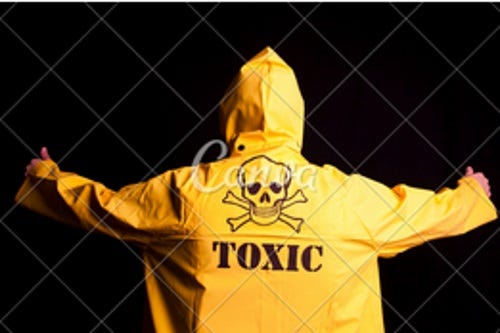
TOXIC METER — 5 Simple Ways to Detect Toxicity
You can use this “meter” to gauge anyone’s toxic levels, even your own.
When you call your friend(s) together do you:
1- Tell them where you are all going for the evening
2- Ask them what they wan to do for the evening
3- Suggest somewhere to go and make a mutual decision
If you’re out with your friend(s) and everyone seems to be having a good time but you do you:
1- Get your friend(s) and say you’re ready to go
2- Stay and complain the whole time
3- Try to amuse yourself and be glad someone’s having fun
When your friend wants to spend time with someone other than you do you?
1- Talk down about the third party and try to change the friend’s mind
2- Find something else to do and tell the friend to have a good time
3- Get mad and stop speaking to the friend for awhile
When your friend wants to bring someone else along to hang out do you:
1- Talk down about the third party and try to change the friend’s mind
2- Let the third person come along but make them feel unwelcome
3- Get mad and don’t bother to go with them
When your friend has a romantic interest in someone do you:
1- Make constant jokes about the person and make them seem unattractive
2- Try to get your friend to neglect, disrespect or cheat on the romantic interest
3- Provide encouraging feedback, and support the friend’s choice
Obviously, this simple little test is not something you can rely on to make a decision about someone you may have known for years; it can, however, help you start thinking a little clearer about the situation.
You’re the one who has to make the decision, because only you know the real truth, you and your friend.
The TAKEAWAY
Toxic friends pollute, although oddly enough, toxic friends always seem to have people flocking around them.
Being attracted to toxic friends instead of true friends can be potentially dangerous.
Toxic friends can poison your thinking because they tend to have an influential effect on people.
Don’t be surprised if you decide to assert yourself in the relationship and your friend starts to pull away. Toxic friends usually all have the same motto, whether they verbalize it or not. “It’s my way or the highway!”
REMEMBER TO ALWAYS CONSIDER:
- Does the my way or highway philosophy sound familiar to you?
- Do you have friends like that?
- Worse yet, are you that kind of friend?
FEEL FREE TO FOLLOW & Retweet this MEDIUM story on TWITTER:

Dear Readers — if you enjoyed this story, please be sure to FOLLOW and show your satisfaction by responding with feedback.
- Comments are AWESOME! Applause is GREAT too.
- But don’t forget to FOLLOW ME and SUBSCRIBE
Visit to promote your Medium Stories here.


