
Extreme Social and Political Ideals Reinforced at the ‘Great Homeschool Convention’
From young-earth creationism to Tucker Carlson, the gathering of homeschool families offered a view of the world — and homeschooling — that is filled with anxiety over the left
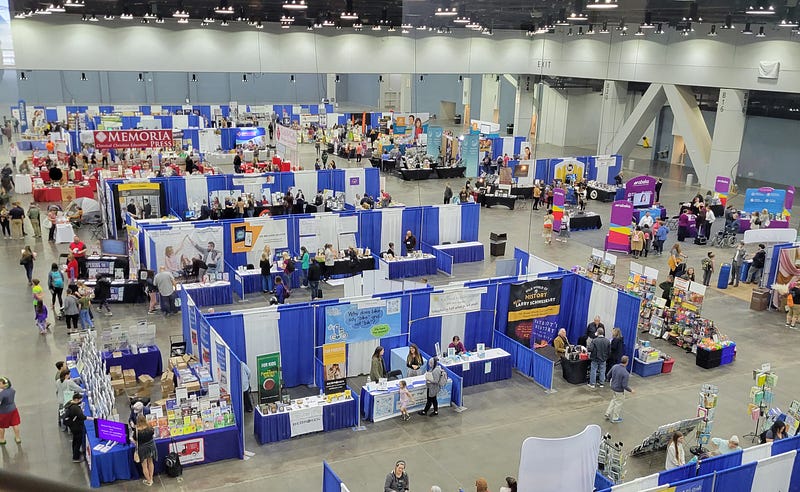
I first learned about the Great Homeschool Convention’s turn through my area in Ohio from a homeschooling family member. She was livid that rather than any of the millions of parents with homeschooling experience or actual expertise in pedagogy, the three-day event’s keynote speaker was going to be Fox News commentator Tucker Carlson.
She sent me a post shared widely in progressive and moderate homeschool circles, written by Susan Wise Bauer, who helped popularize classical Christian education. After Bauer noticed that the event’s keynote speaker would be Tucker Carlson, Bauer, a frequent speaker at these sorts of conferences years ago, lamented, “This is not a home school convention, not any more. If you go, you’re supporting a political agenda.”
For years I’ve interviewed those raised in evangelical Christian homeschooling families. They taught me how theology and evangelical culture spread between homeschool conferences and trickled down to kids through homeschooling curricula from publishers such as Abeka or Bob Jones University Press. They told me how they were taught the upside of American slavery was how many former African people became Christians or how slavery was described as “black immigration.” While some have told me how homeschooling allowed their families to help foster their intellectual interests and creativity, others described how their homeschool social groups also organized young Christians politically and mobilized them to support or volunteer for particular campaigns.
There is a long history of political activism attached to the homeschool movement, ostensibly to protect parents’ rights to teach their own kids, but with stacks of alarmist books and rhetoric warning against secular humanism and Marxism in public schools and threats that government agencies are eager to rip kids from their good, Christian homes.
Since the pandemic though, rates of homeschooling have seen a dramatic uptick. A survey from the U.S. Census Bureau showed a doubling of families with school-aged children reporting homeschooling in the 2020–21 school year. Among the 18 states that shared data this academic year, rates increased by 63 percent in 2020–21, and only declined by 17 percent this school year.
Black families, some citing a desire to protect their children from racism at school and hopes to ensure their children learn Black history, have begun homeschooling at a five-fold rate compared to pre-pandemic times. Hispanic students now make up about a quarter of homeschoolers. Native American and Muslim leaders cite upticks in homeschooling among their communities.
The Great Homeschool Convention, hosting five events around the country, claims to be “the Homeschooling Event of the Year.” So I signed up, wondering who I’d meet, if the event would have adapted to welcome a broader audience. I wanted to float through as an observer; I’m not a homeschooling parent. This isn’t my fight, I figured.
I sat through sessions on raising Christian girls (with free e-resources on gender and identity). I heard scoffing comments about Disney and joy over getting to ride on planes without masks. Another session attempted to encourage Christians not to just give up and stock bunkers full of canned food — what seemed like a half-joke — in the Biden years, but instead learn from the Founding Fathers and keep striving even when times seem dark.
The first time a speaker gave an off-the-cuff slam at gender identity, my head snapped up from my notes. Looking around the room, no one voiced objection or showed uneasiness. This, of course, doesn’t mean no one did feel uncomfortable, but over the course of the convention, in nearly every room, I’d hear at least one gibe at transgender people or concerning gender identity. Not only was it clearly a way to treat transgender people as something other, but it became a sort of shibboleth, terms to help the group know they were on the same side together.
I attended a session led by a “Bible believing creationist” who has done extensive research on UFO sightings and alleged alien abductions. He seemed to really feel for these people and had concluded that in fact they’d had run-ins with demons. A speaker placed in the far corner of the convention center and sharing a temporary wall with the kids’ zone spoke over wild, playful screams to describe how some of Darwin’s scientific ideas were not that bad. Scientists can have good and bad ideas. (Among the bad, he noted, Darwin was racist.) I thought it interesting before the talk began, how the speaker and an audience member discussed the overreach of mask mandates.
One session describing how to parent with patience was mostly full. A session on dyslexia was packed with parents sitting on the floor along the walls. Another on setting boundaries — on time, with children, with friends who assume homeschooling parents have loads of availability to volunteer — was also almost full.
In the exhibition hall, retailers sold grammar guides, math books and Bible lessons. One booth’s banner read “Magnify God.” Ohio U.S. Senate candidate Mark Pukita had a booth. Another group’s booth caught my eye, with handouts describing how it was organizing “America’s minority communities — with a particular focus on African-Americans.” I listened as the man running the booth explained to one family the group’s opposition to Critical Race Theory.
My first day at the conference, I’d worn a long skirt, thinking this would be the best way to fit in. I learned quickly that my picture of homeschooling moms was far outdated. (And really, I ought to have known better, given the number of homeschooling parents I know.) Most moms appeared in T-shirts and yoga pants (though there were a few in stereotypical, ankle-length skirts slogging along with a half-dozen kids).
I also noticed how many mothers seemed to be coming just for the exhibition hall’s homeschool curriculum and resources, having lunch with friends, and heading out without any of the workshop sessions. I wondered what else they might have actually found useful.
I met one mom from Chicago who is teaching her son in homeschool kindergarten. She’d come in for the convention but didn’t necessarily feel like she fit in. As we chatted over lunch, she spoke proudly of her son’s project on the Montgomery bus boycott. She’d taught her son what she hoped was a far fuller portrait of Christopher Columbus than she’d gained in public school. She wants her son to find enchantment in learning.
She asked why I was there, and I explained I’m a writer, doing some research but also there out of curiosity. I explained some of the problematic topics I’ve covered related to certain homeschool curricula, how some former homeschool students describe abuse at home that never got reported, in part, because they didn’t have a trusted adult to turn to outside the home. Given her clear interest in nuanced teaching of history, I suggested she look over the history portions of the curriculum downstairs carefully before buying anything.
In a session on how to inoculate children from radicalization, a man warned in a series of unsubstantiated attacks about a modern “demonic swirl of ideas,” “woke madness,” and a “lust to overthrow human nature.” He was very worried about neo-Marxism and secular humanism. This was all explained with a PowerPoint glowing over his shoulder with clipart of the Preamble to the U.S. Constitution partially occluded with a Soviet hammer and sickle graphic.
The session was really a sales pitch for a curriculum centered on Western philosophy and critical thinking. Multiple times, without context or provocation, the second speaker there scathed about gender identity.
I was surprised at the end, when a man toward the front raised his hand and asked if the curriculum warns just as much against extremism on the right. He was worried about nationalism.
The speaker’s sales pitch shifted, saying the curriculum itself is neutral.
I spoke to the man in the audience after, and he told me his is a Christian anarchist, a passivist libertarian. He was less concerned about Christian nationalism specifically than abusive, state power in general — but he also wanted to push back and play devil’s advocate. I noted how the session touting critical thought and substantive argument had been filled with ad hominem attacks. He noticed too.
Later, we both happened to attend the same session that warned about the evils of Marxism and secular humanism on college campuses. That speaker likened sending your kid to college to D-Day. Sure, some people lived, but plenty were lost (assumably in the college analogy, to secular culture). The homeschooling dad and I caught up later, and he seemed entirely convinced by the dangers of higher education listed in the session. I pushed back gently that I hadn’t had that experience myself and gave examples of family who teach at the college level. He didn’t buy it.
We see the world very differently, and I don’t know how much either of us shifted the other’s lens (probably not at all). But there was a unique moment of conversation and debate between us that I kept thinking could have made for a far more interesting gathering, especially among parents who care enough about education to dedicate such a sizable portion of their family life to teaching and learning.
Mid-day on the last day, former Secretary of Education Betsy DeVos spoke in brief remarks in which she detailed how she’d homeschooled her own kids for a few years and as Secretary of Education had hoped to work herself out of a job. She expressed concern about schools she claimed teach your sons and daughters they are not sons and daughters and schools that teach people are racist because of who they are. She too touted the influx of new homeschool families in the U.S., saying millions have fled “union-controlled schools.” She also highlighted the increased racial diversity of homeschooling families to the predominantly white, homogenous audience.
DeVos, an advocate for charter schools and “school choice” suggested education tax dollars should be returned to homeschool families to invest in their own children’s education. DeVos was there promoting a book she has coming out about “educational freedom.”
Hours before the end of the conference, I spotted people in line for the ballroom where Tucker Carlson would be hosting the finale keynote address. I passed two women on the escalator who wore “Tucker Carlson ‘24” T-shirts. (He’d later insist he deeply disdains politicians and will never run for office.)
I’d just seen days prior that Carlson is releasing a new special, the End of Men, which jumps from MMA, to cow milking, and to “testicle tanning.” It appears to be a distillation of all evangelicalism’s anxieties over declining male prowess in one featurette.
When his time came, Carlson greeted the audience with an aw-shucks attitude, voicing how meaningful it might have been had his family chosen to homeschool rather than sending their kids to boarding school. He congratulated homeschoolers on having taken what was once seen as fringe to the point where now, they’d won and were witnessing a great influx of new families to the homeschool movement.
He didn’t have much else to say about homeschooling but generally entertained the audience with jokes about CNN+’s fast demise and more than once raised the specter of a hypothetical “blue haired kindergarten teacher” in public school making children question their gender identity. His laugh was bubbling and manic — something I’d never heard before — and so alarming as to be infectious for the crowd every time he chortled.
After all the hub-bub, Carlson’s assertions lined up with or were tamer than the rhetoric I’d heard throughout the rest of the conference.
His Q&A was populated by pre-approved questions that did not get more hard-hitting than what books he recommends. The most substantive question started with a joke dismissing the claims that Carlson works for or strives to protect Russian President Vladimir Putin. Carlson described first hearing there was chatter on the internet concerning the claim, which he waved off as silly. But only days after hearing about it, his own neighbor started yelling at him about backing Putin. Carlson voiced dismay.
Carlson, who has had a slander case against him dismissed on the grounds that he is too known for exaggerating and giving “non-literal commentary” to be believed, was disgusted by the state of things. It’s dangerous, he said, how one political party can shift public opinion with lies that quickly.