
The Peculiar Nature Of Light, the Universe, and Everything
Since Visible Light Is Just Part Of The Electromagnetic Spectrum, This Surely Holds For The Rest Of It Too

Have you heard this one?
A photon sidled up to a bar and waited to be served, but the bartender kept walking right by him, as if he didn’t see him! Do you know why?
He didn’t see him, because, you see, light is not visible from its side.
On Earth, when the Sun is visible to me, the sky is bright with light; but when the Sun is not visible, the sky is dark. In Space, the Sun is always visible, yet Space is always dark.
One night when the moon was full, and I watched it as it slowly rose up into the sky, I noticed something…
On a full moon night, when the Sun and Moon are placed in opposition, with a clear path between them that is not blocked by the Earth, the Moon is very bright, but the Space between the two is dark, as I look up at it.
If I turn towards the Moon, its surface is visible because light rays from the Sun which have been reflected by the Moon’s surface travel to my eyes. Those same rays of light are invisible to my eyes as they travel overhead past my position on Earth, on their way to the Moon — in other words light is invisible from its side.
When I shine a bright flashlight out into the space in front of me on a dark night, I do not see the light being projected away from my flashlight. I only see the light coming back to me, once it reflects off something solid.
Of course, if there are obstacles in the air, such as dust, smoke, or fog, the light is partially reflected by that as it passes through it, so some of it reflects back towards me. But in either case there is no light to be seen as it travels away from my flashlight. This is because light only has one surface — facing in the direction of its travel.
Everything we see is a reflection of light, and not just those reflections we see on the surface of still water, a mirror, or even a window from outside when in bright sunlight. Whatever there may be, we only see light, not the actual thing that reflected the light.
So all that I see is like a rainbow, in that the light reflected is only visible to me, because I am directly facing the light in the direction that light is traveling. So, in order to see exactly what I am seeing, you have to be standing exactly where I am — and exactly as I am standing.
Since light can not be seen from the side, and since light only has one surface, it has to be — and can only be — a 2-dimensional outside without an inside — perhaps like a one-sided flat soap film.
Light cannot be a wave, since it has no depth. If it had depth, it would be visible from the side, and would necessarily have two surfaces.
And since it is 2-dimensional, it can’t be a particle either as it only has a surface and nothing beneath it.
But also, if light were a particle, then all stars would have to be putting out an impossible amount of light to fill an enclosing sphere with a radius that is the distance of an observer to the center of that star, so that light is visible at every point on that sphere. And if the universe is infinite, then every star must emit an infinite amount of light in order to be visible at every point on the edge of the entire universe, though the radius of any sphere from which the entire universe is visible must be delimited by the length of time the light has been traveling. But no finite star can emit such an amount of energy, so how is it that we can see other stars, and perhaps even our own? Does light only enter one of my eyes, or does it enter both of them — a particle can only enter one.
It is not valid then to call light a thing, even though we may ‘bathe’ in it, since things are three-dimensional.
But if it is not a thing, then light is not real. And yet, we can be blinded by it. What, then, can light be since we see it?
Here’s another piece of the puzzle: The light that ‘illuminates’ something is only that part of the light that is reflected off the surface of the thing. Even the thing’s color is only that part of the light that is reflected, and not absorbed, by that surface. Truly, the color of something I see is only a reflective signature of its absorption of light — its ‘color’ being the mixture of frequencies of light it cannot absorb — but limited to only those colors that my eyes can see!
But here is something else about what we all see: we have a hole in the vision of each eye, yet what we see never has the appearance of a donut (unless it happens to be a donut)! You can see that this is true by trying this experiment: Take a piece of white paper, and using a black marker (so it will be very obvious), place a small solid circle about 1/2 cm in size on the left side, and an X about the same size on the right, like this:
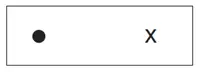
Now hold this paper centered a few centimeters in front of your face, and close your right eye, while focusing your left eye on the X. Notice that you can see the solid circle out of the side of your vision. Now move the paper slowly away from your face until the solid circle disappears. You might need to adjust the paper, a little to the left or right, or slightly up and down, as you move it away from your face. You can also flip the paper around and try it the other way too, and the same effect will happen with your left eye closed and your right eye focused on the X which is now on the left side of the paper. Why does this happen?
At the back of your eye is the retina. Your retina is made up of light-sensitive cells which send nerve impulses to your brain because of the light impacting on those light-sensitive cells. Everyone has a spot in their retina where the optic nerve connects into it, so that it can transmit the nerve impulses to the brain. In this area there are no light-sensitive cells, so this part of your retina can’t see. This is called the blind spot. When the reflected light coming off the solid circle on the paper is lined up with the blind spot of your retina, the circle disappears.
Even more interesting, if you use a ruler and place a straight line through the circle and across to, and through, the X, when again moving the paper away from your face, with the X-side eye closed and the circle-side eye focused on the X, you will suddenly notice that the circle disappears, but the line goes straight through where the circle was. This is because our perceptions are constructed for us by our mind, and since it cannot see the circle, but notes that the line appears on both sides of the blind spot, our minds join the two parts of line with a constructed continuation of it through the blind spot in our vision.
So since what I am seeing is not like a donut with a black hole in the middle, and what I am seeing is only that 2-dimensional light that is reflected by whatever it may be that I am looking at, and since what I see is constructed from, and not simply by, the nerve impulses that the brain receives — because there is more in the construction than is found in the impulses — then what I am seeing is necessarily in my mind, not only in my brain, and has more to do with my eyes, what they are and have been looking at, the nature of reflected light, and the creative responsiveness of my mind, than any actual thing that I believe I am seeing.
And since visible light is just part of the electromagnetic spectrum, this surely holds for the rest of it too.
Now, someone might argue: “Hey! The Double-Slit experiment proves that light is both a wave and a particle! To which I reply: The obvious oxymoronic nature of asserting that something has two natures aside, if you pay attention to the design of the D-S experiment, you may note that it never takes into account that light cannot be seen from the side and only has one surface, so it has to be two-dimensional. And there is a well-known admonition in scientific research that the answers you get depend upon the questions you ask. The Double-Slit experiment, which was an absolute Nobel-Prize winning idea, only asked if light was a wave or a particle — it never considered that light may only be a two-dimensional film that ruptures when striking an obstruction. When that happens, similar to how a soap film ruptures, we may see ‘particles’ and ‘wave-like’ accumulations of flying debris going through the slit(s), leaving the impression that a particle passed through, or a wave split into two and interfered with itself.
We might see that when two slits are open, the interference pattern that is recorded directly in front of the arriving light is not a wave pattern, but the pattern created by a two-dimensional surface — without any depth — going through the two slits, rupturing the single surface. And when only one slit is open, it appears to be a particle because the two-dimensional surface has collapsed, the way a soap film ruptures creating the illusion of a ‘particle’ (watch a slow-motion video here: https://youtu.be/mziis4pbBOw).
So, the two takeaways of my joke, and my full moon reverie are this: Space is filled with three-dimensional objects made up, ultimately, of two-dimensional non-objects, which is why ‘material’ objects are pretty much nothing but empty three-dimensional space. And, even more importantly, what we experience through our visual perceptions are a construction of mind — that amazing, creative, and spontaneously responsive Naturing of all that appears.
And I am quite sure, that if I was a two-dimensional being, I would most likely find that my two-dimensional reality was filled with two-dimensional ‘objects’ that were themselves made up of one-dimensional non-‘objects’, that also were not directly perceived, but only served as the inspiration for what actually would manifest from my two-dimensional mind.
There is a way of seeing the world different.