
19 Uplifting Lessons I Learned From COVID-19
They will help you find peace in chaotic times.
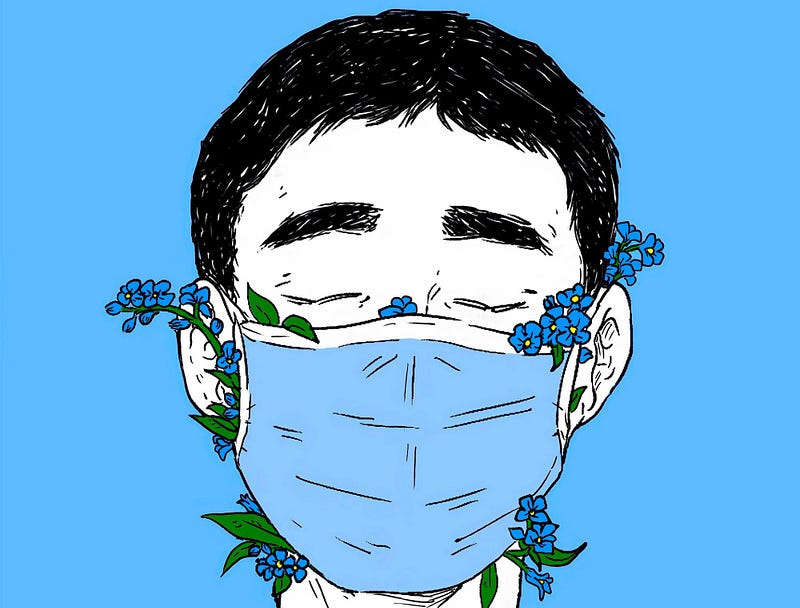
“There is nothing either good or bad but thinking makes it so.”
This iconic line is written by Shakespeare and uttered by Hamlet, and it perfectly describes my attitude towards the COVID-19 pandemic currently ravaging across the world.
Now, I am not a callous man. I know that people are suffering, that the economy is floundering like never before and that hundreds of thousands of innocent lives have been lost. The coronavirus is an undeniable tragedy.
However, it is in these dark moments that we must remind ourselves of the ever-present majesty of existence. Sure, there is great sadness in life, but there is also great beauty. Like Oscar Wilde said,
“We are all in the gutter, but some of us are looking at the stars.”
This article is me counting my blessings. This article is me taking Whitman’s advice and keeping my head to the sun, that the shadows may fall behind me. Most of all, this article is me reminding myself to keep a secret spark of hope alive in my heart of hearts, for no matter how dark the night is, the sun is never far from the horizon.
Read on then, dear reader, if you would like a positive read, one that will bring you a modicum of hope in these turbulent times.
1. You’re going to die.
Sounds gnarly, but hear me out.
Death is the only constant in life. That’s why the ancient Stoics coined the term “Momento Mori”, which translates to “Remember Death.” They understood that paradoxically, remembering that you are mortal will help you live your life to the fullest.
Whether it be from an unprecedented pandemic or something more mundane, as the saying goes,
“You can be a king or a street sweeper, but in the end, everyone dances with the grim reaper.”
You have only one life. Live it.
2. So never take life for granted.
Life is precious.
And all of us have a maximum of 80–100 years to live — and that’s if we’re lucky! So what’s the point of playing it safe? You’re never going to outrun the clock.
So chase lofty dreams! Kiss that beautiful girl. Practice walking on your hands. Sing loudly, badly and lustily. Above all, live a life full of love and zest and wonder.
Who knows when you’re going to get another shot — the odds of being born as a human are seven trillion to one.
So you might as well make this one count.
3. Hug your loved ones tight, every single day.
Seriously, do it.
If you don’t have any loved ones, make some, and hug them.
If they’re pissed at you, or you at them, make your peace — then proceed to hug them tight. Tell them how much you love them, and how much they mean to you.
That’s how you best treasure your loved ones.
Nobody knows when is the last time you will meet, so you want to make every moment count. You want to live a life full of memories of love and forgiveness, not anger or spurned pride.
Waste not one second. Life is too short for infantile ego-measuring contests.
4. The human spirit overcomes all.
Homo Sapiens has become the master of the universe through two predominant traits:
- Intelligence
- Adaptability
And among the two, the former is more important. There were many dark times in history that doomsayers predicted the end of human the human race. They were always wrong.
In the long run, humans have always prevailed. We learned, adapted and bounced back, through countless wars and genocides and plagues. We always came back better and brighter than ever before.
This is no exception. The human spirit is undefeated and all-conquering.
5. Your true friends are the ones who are there during dark times.
Most of our friends aren’t really friends.
They’re acquaintances, bystanders you picked up going about your life, kind of like gum you step in on your way to work. They’re sometimes useful, so you keep them around, but most of the time they just sort of…exist.
Fake friends are the worst of all. As J.R.R Tolkien wrote,
“Faithless is he who says farewell when the road darkens.”
However, by reverse-engineering Tolkien’s statement, we can deduce that true friends are the ones who stay with us, fierce and faithful against all troubles.
These are the buddies who check in on you during tough times. These are the pals who bother to call you on zoom, just to see your face, to say hi. These are the people who actually care about your health and the health of your family.
These are your real friends.
Treat them right, and keep them close.
6. Art is a balm to the human soul.
Art has been historically considered by many cultures to be of second-importance.
A frippery, a distraction, a whimsical plaything at best.
Which is ironic, because when a global pandemic brought the world to its knees, the world turned to art for solace. Countless millions turned to the escapism provided by music, a great film, or a well-made video games — so much so that Spotify and Netflix stock soared.
Stephen King wrote in his memoir that:
“Life is a support system for art, not the other way round.”
The next time you feel down and out, remember the solace that can be found in creative expressions of the human condition. Because art is not a support system for life.
It’s the other way round.
6. Strive to consume great art.
The one good thing about living in the midst of a pandemic?
Most of us have more time on our hands than we know what to do with. And how we spend this newfound resource is important.
For example, spending your extra hours trawling through the sea of negativity known as mainstream news and social media is probably not a good idea. It’s a sure-fire way to drive yourself mad with worry.
Instead, read a great book or three. Watch a masterful film on Netflix, or an award-winning documentary. Visit the museum and study the old masters. Explore.
There is nothing like being awe-inspiring art to put the stars back in our eyes and the wonder back in our hearts.
7. Strive to create great art as well.
The next step is to transcend mere consumption and become a creator in your own right.
Write, pen, paint. Play the piano, strum the guitar, film that home-movie and go wild with grandma’s secret lasagna recipe.
We are not put on earth merely to be a passive admirer of another’s work. Instead, we are supposed to be inspired and spurred on to action. Thus, art perpetuates art, and the endless cycle of wonder begins anew.
I feel closest to God when I create. How about you?
8. Technology is a boon.
Technology, like money, is a neutral force.
Technology allowed us to build automatic rifles and atomic weapons. But it also allows us to see the faces of our families with the tap of the screen, and to work from home via Zoom meetings so we can continue putting food on the table during a worldwide crisis.
At the end of the day, technology is nothing but leverage. It can automate mundane work, and free up precious time which can be spent on more noble pursuits. Technology is, in the right hands, an enabler of human excellence.
It’s a powerful tool, and like all powerful tools, it cuts both ways.
Use it with care.
9. Isolation is a gift.
Charles Bukowski wrote,
“Isolation is the gift. All the others are a test of your endurance.”
Isolation is a blessing in disguise for those who know how to use it. Van Gogh painted Starry Night pent up in an asylum. Oscar Wilde wrote The Ballad of Reading Gaol, well, in jail. And of course, Nelson Mandela would go on to become the President of South Africa and stamp out the Apartheid after serving 27 years in prison.
Being isolated gives us time to reflect, create and become a better version of yourself.
Remember, isolation is a gift. Use it well.
10. You don’t need to travel to find yourself.
Like many Millenials, I love travelling.
However, this pandemic has taught me that travelling is a good-to-have, not a must-have.
After all, if ancient sages such as the Buddha can do things such as achieve enlightenment and start a major world religion without ever leaving their country, I think I can stay put for a few months.
Thailand can wait.
11. Become acquainted with your own mind.
Zeno of Citium said,
“Man conquers the world by conquering himself.”
What was true two millennia ago remains true now. We keep ourselves busy in the hustle and bustle of the outside world, but scarcely take time off to still our minds and look within.
We assume that we have already conquered our minds when in fact we know more about the vastness of space and the deep blue seas combined than the internal workings of the human psyche.
This pandemic, still your heart and ask yourself, what is it you truly want? Be specific. Ask yourself questions such as:
- What do you truly want in life? Not what your family/society want for you — what do you want for yourself?
- What does your ideal future self look like?
- What does an ideal day in your life look like?
This pandemic, reconnect with your own mind. Take the time to explore, and develop an understanding of who you really are.
To know yourself is the beginning of wisdom.
12. Be fearless in the pursuit of your dreams.
By showing up out of the blue and blindsiding everyone, this pandemic shows us that life is a roller coaster ride, and nothing is guaranteed.
Like Buddha said,
“The problem is you think that you have time.”
Therefore, if you have been procrastinating on something, stop and focus. You were not put on this earth just to work in a cubicle, pay your bills and die. You were put on this earth to make a difference, to chase bold dreams.
So go. Set out in seek of what sets your soul on fire.

13. Explore new ways of doing things.
This pandemic has changed the way we live forever, and most people haven’t realized it yet.
Working from home will become more and more acceptable. Zoom calls will replace all except the most important business meetings. More people than ever before will operate side hustles to supplement their income. All in all, these are good developments.
We’ve had the technology to do this for years, but dogma and laziness have held us back. This pandemic, therefore, a harsh but much-needed kick in the butt.
Escape the bonds of societal thought-control. Think for yourself. Colour outside the box. And above all, question everything. That’s how you engineer a more effective life. That’s how you become a visionary.
Because when it’s all said and done, visionaries are the ones who push the human collective ever forward.
14. Treat every problem as an opportunity.
It’s a cliche to say that every within problem exists an opportunity, but it’s true.
There are many who think that a life free from worry is the key to happiness. They are mistaken. No life, no matter how blissful, is without its own unique set of problems. Tim Ferris said it best,
“The quality of our life depends on the quality of our problems.”
Therefore, reframing a problem into a challenge is one of the best things you can do for your mental well-being.
A problem is a hassle. A negative. Something to be avoided at all costs. A challenge, on the other hand, is a positive thing. It’s stimulating. A challenge is a reason to be alive, something to conquer, to achieve. More than anything, a challenge is an opportunity to grow.
So remember, there are no problems to be feared, only challenges to be overcome.
15. Let go of things outside of your control.
We cannot control what the bizarre whims of fate decide to throw at us. All we mortals can do is smile, shrug and do our best. There is a saying we have in Jiu-Jitsu, and that is to “flow with the go.”
Trying to control the uncontrollable is like trying to buy the love of a feral cat – an exercise in futility. A better move would be to relax, focus on yourself, and let the cat come to you at its own time.
That is the meaning of grace.
16. There is nothing that unites us as much as a common foe.
Like how the White Walkers served to unite the bickering Seven Kingdoms, the COVID-19 pandemic is a stark reminder that humanity is on the same team.
There is nothing like a faceless, inhuman enemy to forge our disparate tribes into a single blade. There is nothing like a common foe to remind us that we at the end of the day, we are just a bunch of hairless apes clinging on to the same rock as it soars through the vastness of space, orbiting a gigantic, dying star. And when the pandemic dies off, I know that our united suffering will eventually bring us closer.
For we are all one.
17. Nature can do without us, but we cannot do without nature.
There is an old Cree saying that goes,
“Only when the last tree has been cut down, the last fish been caught, and the last stream poisoned, will we realize we cannot eat money.”
The novel coronavirus, like many deadly pandemics, was caused by animals being held in unsanitary conditions and in close proximity to humans. We’ve been pushing our luck when it comes to things like animal rights, environmental conservation and climate change for far too long.
This pandemic is a good reminder that humans belong to the earth, not the other way round.
We would do well to take care of the only home we have.
18. You don’t need much to be happy.
Epicurus was an ancient Greek philosopher who dedicated his life to studying pleasure. It is telling then that he wrote,
“If thou wilt make a man happy, add not unto his riches but take away from his desires.”
Epicurus believed that a simple life surrounded by friends and doing what one loves is the key to happiness, and he walked the talk. The philosopher spent much of his life bunked up with his friends, eating plain fare and pursuing interests such as poetry and gardening.
Many of us, myself included, thought being locked down would be a torture. It actually wasn’t that bad. Getting to see my loved ones every day was a novel experience in my normally busy life. This, combined with a roof over my head, a full larder and an internet connection were more than enough to bring a smile to my face every morning.
There is pleasure in simplicity. Don’t overthink life.
Live it.
19. No matter how dark it looks, the sun will rise again.
In the 14th century, The Black Death killed an estimated quarter of the world’s total population. The mortality rate of the disease was unparalleled and would go down in the annals of history as the greatest catastrophe in human history.
Yet just a handful of hundred years later, we have not only recovered from its effects — we have excelled. Since those apocalyptic days, the human race has advanced in every way imaginable. We have successfully engineered a scientific and artistic Renaissance which led to us living longer and healthier lives. We built tall and wonderful cities for our growing population, and we now possess a staggering level of technological prowess that rivals the gods of old.
Things may look bleak now but have faith.
A quick look at history tells us that the human spirit always prevails.
Final Thoughts
Keep a secret fire burning in your heart of hearts. Protect it, no matter how harsh the winter winds how. Make sure it’s burning even when you’re cold, naked and afraid and all that remains between you and the abyss is a guttering ember.
For a better day will come. A day where you will look up and see the sun dawning like an old friend over the horizon. A day where the warm breeze tickles your face and the shadows melt away like ice-cream on a hot stove…like they never existed at all. On such a day, even the tiniest spark can leap, crackle and grow – until it becomes a roaring blaze.
Remember, all of humanity is huddled with you against our shared storm. Things are hard now, but we’ll make it.
We always have.


