
1888: When Dirty Politics And The Electoral College Defeated Grover Cleveland
Grover Cleveland fell victim to some rather unfortunate political circumstances.
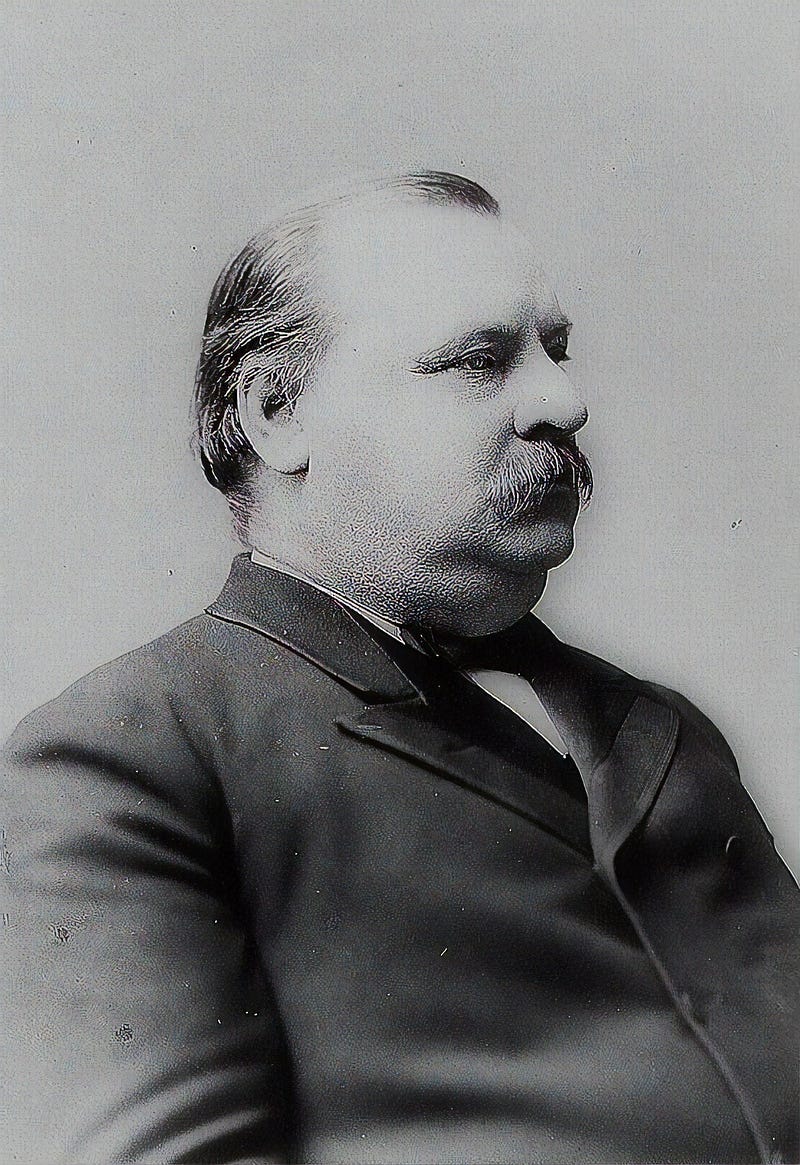
Grover Cleveland was the first Democratic president since the Civil War and the first Democrat to be renominated since Martin Van Buren in 1840. The man was a presidential trendsetter (as you’ll see in further detail below), but he also fell victim to some unfortunate political circumstances that threatened to derail his political career in 1888, when he ran for re-election.
Back in the day, political parties would print ballots for their voters. The ballots were large, and this was before the adoption of secret ballots. Thus, when a voter cast his vote (his because women could not vote back then), his decision could be seen by everyone at the polling station, including representatives of each political party.
Con men could pinpoint voters called floaters who were to known to cast the vote to the highest bidders. Floaters would typically sell their votes for $2.
In the 1888 presidential election, Cleveland ran against former Republican Senator Benjamin Harrison of Indiana. Harrison had a good record on war-related issues and came from a swing state (Indiana), but despite his solid credentials, he opted to play dirty to beat President Cleveland, one of the most honest and scrupulous presidents in American history who spent his career fighting corruption and other dirty political tactics.
Blocks Of Five:
On October 24, 1888, just two weeks before the election, Indianapolis lawyer and Republican campaigner William Wade Dudley sent a circular letter to Indiana’s county chairmen instructing them to “divide the floaters into Blocks of Five, and put a trusted man with the necessary funds in charge of these five, and make them responsible that none get away and that all vote our ticket.” Dudley was telling them to bribe people for votes.
A suspicious railroad postal agent intercepted the letter, which was soon publicized. Democrats were rightfully outraged and campaigned against these “blocks of five.” But the dirty practice went on; Indiana Republicans bought votes despite an avalanche of criticism. It worked — Harrison won the election in large part because he fraudulently won his home state.
President Cleveland received more votes than Benjamin Harrison, but he was not reelected. The Electoral College is to blame, as you can see in the results.
The Electoral College Hands Harrison The Victory:
You probably know that in America, one person does not equal one vote in a presidential election. Instead, the Electoral College indirectly decides how many votes each candidate will receive. 538 electoral votes are up for grabs each presidential election cycle, corresponding to the number of representatives in the U.S. Senate and House of Representatives, plus three electors for Washington D.C. (which is not a state). Thus, a modern-day candidate needs 270 of these votes to win.
In 1888, there were 401 electoral votes up for grabs, so President Cleveland needed 201 votes to win a second term.
He won the most popular votes but didn’t get those crucial electoral votes. Why? The Electoral College.
Benjamin Harrison won a few large states by razor-thin margins. He carried Indiana (15 electoral votes) by 0.44%, New York (36 electoral votes) by 1.09%, Ohio (23 electoral votes) by 2.33%, and Illinois (22 electoral votes) by 2.96%. Of the 233 electoral votes Harrison won, 96 came from states he won by less than 3%. Indiana and New York were the keys to his victory.
In contrast, Cleveland only won one state with more than 13 electoral votes: Missouri, which had 16. Democrats ruled the South because of the Compromise of 1877, whereby federal troops ordered by Republicans to occupy the South to enforce Reconstruction were removed in exchange for Rutherford Hayes winning the 1876 presidential election.
Eager to perpetuate segregation and other oppressive measures, Southerners reliably voted blue for almost a century. Cleveland benefitted from that trend (and from the disenfranchisement of black voters who would reliably vote Republican) but since Southern states were relatively small, he was not rewarded for the large margins of victory he earned in states like South Carolina (which he won by 65.11%), Mississippi (which he won by 47.81%), and Louisiana (which he won by 46.91%).
Unlike Harrison, the states he won slimly (by less than 3%) were small — Virginia (12 electoral votes), New Jersey (9 electoral votes), West Virginia (6 electoral votes), and Connecticut (6 electoral votes). The Electoral College rewards candidates based not only on how many votes they get but also where they get their votes.
Thus, Cleveland got robbed by the Electoral College and by fraudulent practices. He received 48.6% of the popular vote but only 41.9% of the electoral vote. Cleveland became the third of only five presidential candidates (and the only incumbent president) to receive a plurality of popular votes but lose the election. The other four were also Democrats: Andrew Jackson in 1824 (technically not a Democrat until the next election), Samuel Tilden in 1876, Al Gore in 2000, and Hillary Clinton in 2016.
On her way out of the White House in January 1889, First Lady Frances Cleveland reportedly told White House staff to take care of the building since the Clevelands would be back in four years. She was on to something.
Cleveland Wins The Rematch:
Four years later, her husband wanted a rematch. Privately, President Harrison did not want to be renominated, but what he wanted less was for James Blaine (Harrison’s Secretary of State who had lost to Cleveland in the 1884 election) to win the Republican nomination. Three days before the Republican National Convention was set to begin, Blaine resigned. Thus, Harrison reluctantly entered the fray against his old rival, who was eager to validate’s his wife premonition.
The 1892 presidential campaign was not nearly as eventful as the 1888 campaign. It was marked by the tragic death of First Lady Caroline Harrison at age 60 due to tuberculosis just two weeks before the election, which prompted the suspension of campaigning by all candidates.
Cleveland received fewer votes than he had in either the 1884 presidential election or the 1888 presidential election. But this time, he won important swing states. In particular, he won Indiana and New York — two critical swing states Harrison had won four years prior — by thin margins (1.29% and 3.41% respectively). This time, Cleveland got the right votes in the right places.
Overall, Cleveland beat Harrison by 3% in the popular vote and received 132 more electoral votes. He’s the only president to serve two non-consecutive terms and one of four to be a serious competitor in three or more presidential elections (the others being Andrew Jackson, Franklin Roosevelt, and Richard Nixon).
Cleveland Goes Out…Not On Top:
In his second term, Cleveland quickly faced a severe crisis from the Panic of 1893, which induced an economic depression. Combined with strikes that highlighted tensions in nascent industries, critics attacked Cleveland’s inability to manage the economy. Cleveland was comparable to a modern-day libertarian: fiscally conservative, opposed to high tariffs and subsidies, supportive of limited government, and in favor of the gold standard among other high-level similarities. His fairly laissez-faire attitude toward economic issues cost him and his party dearly.
In the 1896 election, as Cleveland completed his second term, the Democrats nominated populist William Jennings Bryan, a fierce critic of Cleveland who was more popular among the agrarian and pro-silver factions of the Democratic Party. Bryan was the youngest major party nominee in American history, but he could not overcome the deep resentment stemming from the troubled economy.
The Democrats would not win another presidential election until 1912. From 1897 to 1933, a time period corresponding with the so-called Fourth Party System, Woodrow Wilson was the only Democratic President, serving eight years.
Meanwhile, Cleveland eased into retirement. He wasn’t fond of Bryan’s policies but he opted not to seek the Presidency again. Eventually, his health deteriorated and he died on June 24, 1908, at age 71 of a heart attack. His last words: “I have tried so hard to do right.”