
Music
17,572 Voices Sing Gently as One
Eric Whitacre’s Virtual Choir 6 sheds light in the darkness of a global pandemic — a soothing lullaby for a troubled world

In spring 2020, an extraordinary event took place in the world of music, a phenomenon that would not only break world records but have a profound impact on thousands of lives, including mine.
Internationally renowned conductor and composer Eric Whitacre, sent an invitation to singers across the globe to join together and fill a void left by the COVID-19 pandemic. The result was the formation of Virtual Choir 6 (VC 6), where 17,572 people from 129 countries united to produce a stunning musical gift to the world.
This article explains the process of participating in a virtual choir, discusses how a virtual choir works and why people might consider joining one. It includes my account as a VC 6 choir member and a video of the final production, released on July 19, 2020.
In March 2020 choirs stopped singing
When the COVID-19 pandemic hit, choirs across the world shut down. It was no longer safe to sing together, so we retreated to our homes to wait it out. Like many other choir members, I felt sad, isolated and uncertain about the future. How long before we could sing together again? Months? Years?
Our choir director had heard about VC 6 and encouraged us to participate. After all the sadness and uncertainty, I was happy to have something positive to focus on and keen to contribute to this global project. I had no idea how much joy it would bring to my life at such a dark, unsettling time, and I’ll forever be grateful for this unique experience.
How Eric’s virtual choir started and the inspiration behind VC 6
Eric Whitacre is a profoundly gifted, Grammy Award-winner whose exquisite music is enjoyed by millions. In his 2013 TED Talk, he explains how the idea of a virtual choir came to him after a young woman sent him a video of her singing one of his choral pieces. His previous virtual choirs include Lux Arumque, Sleep, Water Night, Fly to Paradise, Deep Field, and more have delighted music lovers and singers across the world.

In a May 5, 2020 interview, Eric talked about his thoughts and feelings while watching events unfold around the world as COVID-19 hit. Out of the shock and darkness of a sudden halt to his musical activities and later inspired by heartwarming stories of selfless acts of service in communities, he asked himself a question,
“What can I do for the world? How can I contribute through music?”
His answer was to write an original composition along with lyrics and share it with the world through a virtual choir. He named the piece, Sing Gently.
What is a virtual choir, and how does it work?
A virtual choir consists of individuals singing alone — together; it is a cross-generational, cross-cultural community endeavour — a process that allows singers to share their love of music across the miles.
Individuals rehearse a song and record a video of themselves singing their parts (soprano, alto, tenor, bass). They upload their videos to a website, and sound engineers, film production and editing teams synchronize and splice the video recordings. The final product is a single, full-bodied virtual choir performance.
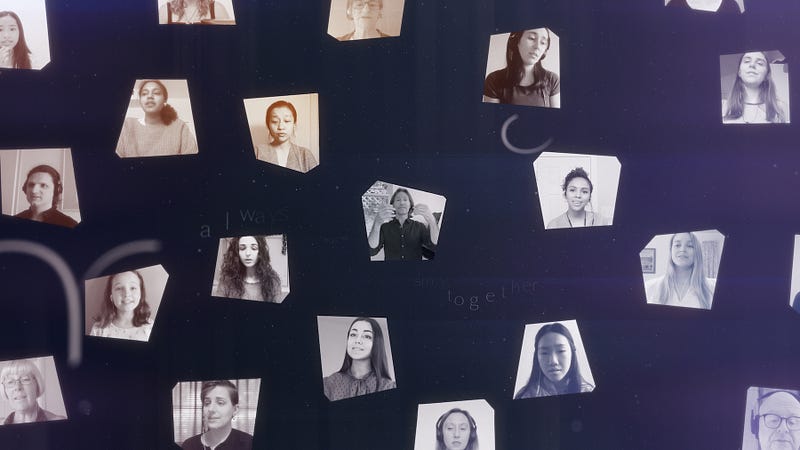
Imagine hundreds, in our case, thousands of voices combining, forming oceans of notes, flowing, mingling, merging, together perfectly. Basses provide deep, powerful undercurrents holding and supporting the rhythm; tenors and altos bring warm, rich, shimmering tones, adding depth and intrigue. Sopranos are like sparkling whitecaps cresting waves, with tendrils of energy soaring into the sky. Rivers of voices blending in melodic harmony.
The challenges of recording yourself singing
Finding a quiet time to record yourself singing is tricky. After putting a “Family, Please Do Not Disturb” sign on my office door, I set up my mini recording studio; this consisted of my daughter’s laptop balanced on a tower of plastic boxes, my smartphone propped at eye level and earbuds.
My first few attempts were disastrous. I made the mistake of recording my video in vertical mode and was so nervous I forgot to look at the camera. I messed up my breathing (taking a breath in the middle of a word is a choir no-no) and missed singing a few of the words.
One choir member said,
“It’s strange singing alone in a room with four walls listening. You feel safe but at the same time vulnerable hearing your voice, raw and in my case, untrained with no supporting music or anything to soften the rough edges. Thoughts cross your mind like ‘Who am I to think I’m good enough to take part in this?”
During my third or fourth take, I discovered my daughter’s laptop shouts out a cheeky phrase on the hour! We couldn’t figure out how to disable this, so I had to avoid recording at the top of the hour.
My next-door neighbour was renovating at the time, and it sounded like he was demolishing his entire house. Hassan, I like you, my friend, but this was not great timing!
Fellow choir members reported they had to deal with noisy bikers, pets wanting to sing along, toddlers screaming and pounding on the door, partners snoring, sheep, goats, frogs, a neighbour with a chainsaw, ring motion detectors, leaf blowers, birds, wind chimes, squeaky floors, neighbourhood garage bands outside and even cuckoo clocks!
One person suggested,
“I say the next Virtual Choir should be all dogs, cats, and lawnmowers. Clearly they all want to participate!”
You don’t have to be a great singer to join a virtual choir
If being a good singer had been a requirement, I wouldn’t have participated. Recording a video of myself singing was way out of my comfort zone. While I enjoy singing and can hold a tune, I don’t have a strong voice. It took several attempts to record the song, and after about 15 takes, I realized my voice was getting raspy. Finally, it was time to pick the best video and pluck up the courage to upload it.
Though I knew thousands of other voices would erase the imperfections in mine, I felt nervous about submitting the video. My family and choir friends encouraged me, and I thought of Henry Van Dyke’s words,
“Use what talents you possess; the woods would be very silent if no birds sang there except those that sang best.”
Why did thousands participate in VC 6, and why did we care so much about it?
Pioneering research conducted by University College London in partnership with Eric Whitacre and Music Productions reveals singing in a virtual choir is good for you. It boosts self-esteem, reduces feelings of social isolation, and promotes better mental health.
It may seem incredible we put so much effort into our videos, knowing others wouldn’t hear individual voices or see more than a fleeting glimpse of our faces in the film.
We all had reasons for participating. Amid the doom and gloom of the COVID world, VC 6 was a creative, positive challenge — a way to connect with other singers across the globe via the invisible bond of music. There’s something soul-stirring about sharing an experience with a large group of people. Singers were swept up in the beautiful, soothing music and extraordinary creativity of the VC 6 project.
Before the pandemic hit, we took so much for granted, never realizing that standing shoulder to shoulder with others singing was a privilege. When choirs gather again in rehearsal rooms across the world, there will be hugging and tears of joy. Meanwhile, I offer thanks to Eric Whitacre and his team for inviting the world to sing and gifting us with this unique and heartwarming experience.
In a virtual choir, each singer plays a tiny part, but without them, there is nothing. You may think you’re insignificant and unimportant, but others rely on your efforts, energy and presence. Never underestimate your part in this world. Sometimes making a small contribution to a bigger picture, is the most vital role you have to play.
It is my great pleasure to present to you Eric Whitacre’s Virtual Choir 6 performing Sing Gently:
Thanks for reading! If you’d like to get an email when I publish a story, please subscribe here
Join Medium for $5.00 per month to get more stories like these and earn money with your writing. If you use this link, you’ll support me directly with a portion of your $5.00 fee at no extra cost to you. If you choose to do this, thank you — I appreciate it! 🙂