
16 Screenplay Story Structures — with Download Printables
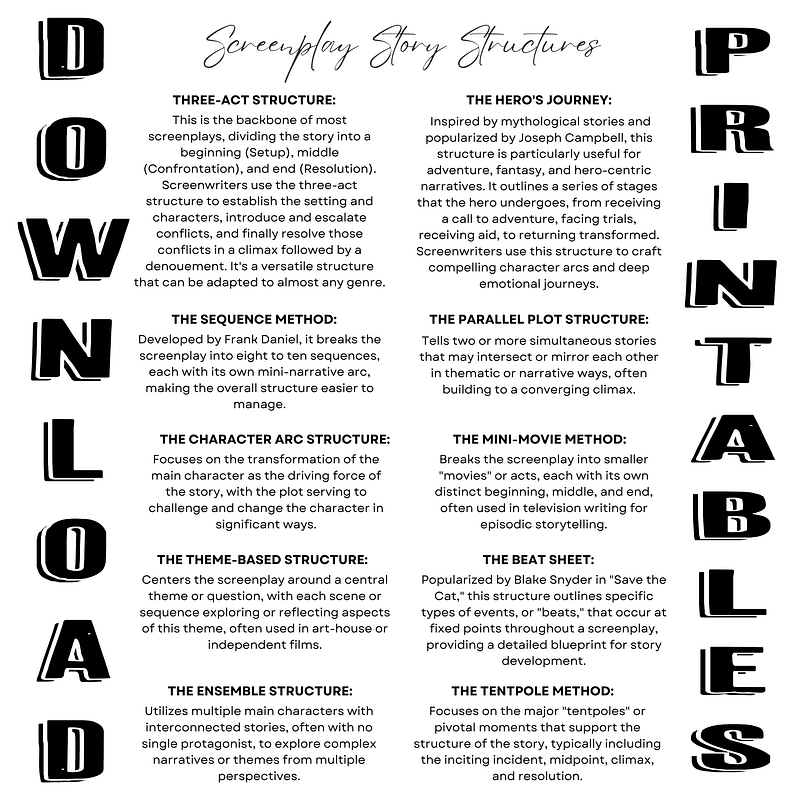
Screenplay story structures are essential frameworks that guide screenwriters in crafting compelling and cohesive narratives for films and television shows. These structures serve as blueprints, helping writers to organize their stories in a way that maximizes emotional impact, maintains pacing, and ensures a satisfying narrative arc. Understanding and effectively using these structures can significantly enhance the storytelling process, making the difference between a disjointed screenplay and a captivating cinematic experience.
Importance of Structure
The structure of a screenplay is crucial because it shapes how the story unfolds on screen. A well-structured screenplay ensures that the story progresses logically, builds tension, develops characters, and leads to a resolution that resonates with the audience. It helps maintain the viewer’s interest by pacing the narrative, spacing out key events, and balancing action with character development.
Download Printables in US Letter and A4 Sizes
Option 1: You can download them securely with Dropbox.
Option 2 Below: Right-click over the page and select ‘open image in a new tab’ and save it or print it.
The original file is PNG but it might convert to a Webp File when you save it. If you have trouble with the .webp, try option 1.
However, webp is a modern image format that preserves the image quality in a more compact file size than png.
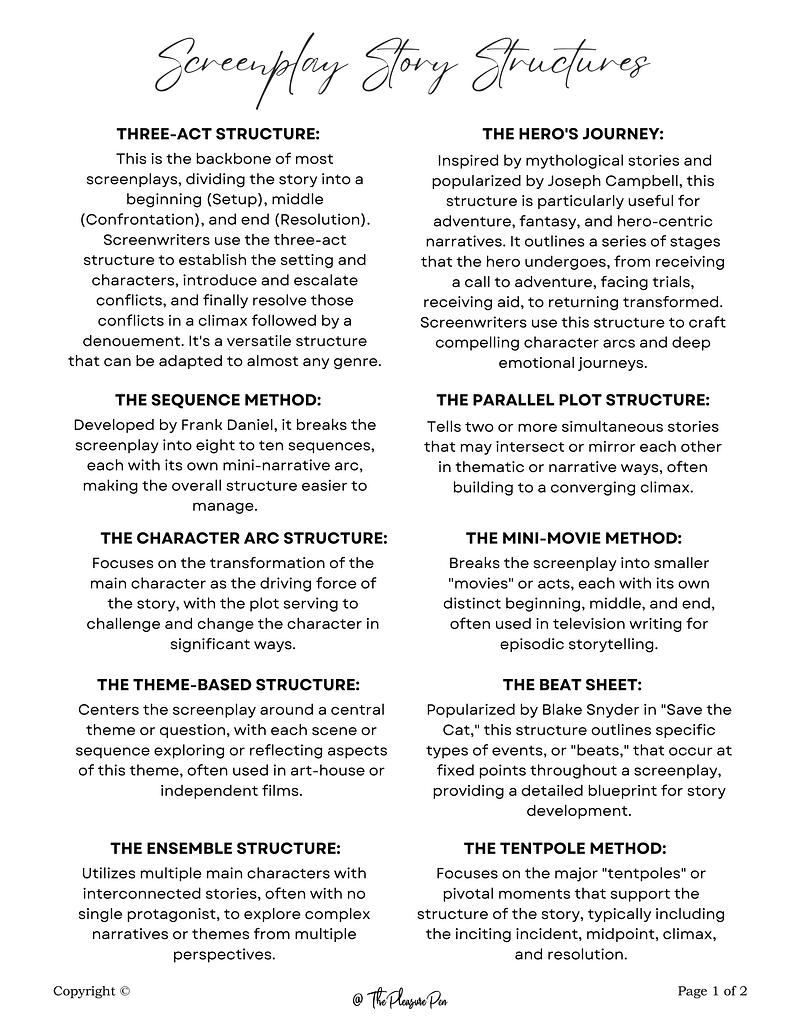
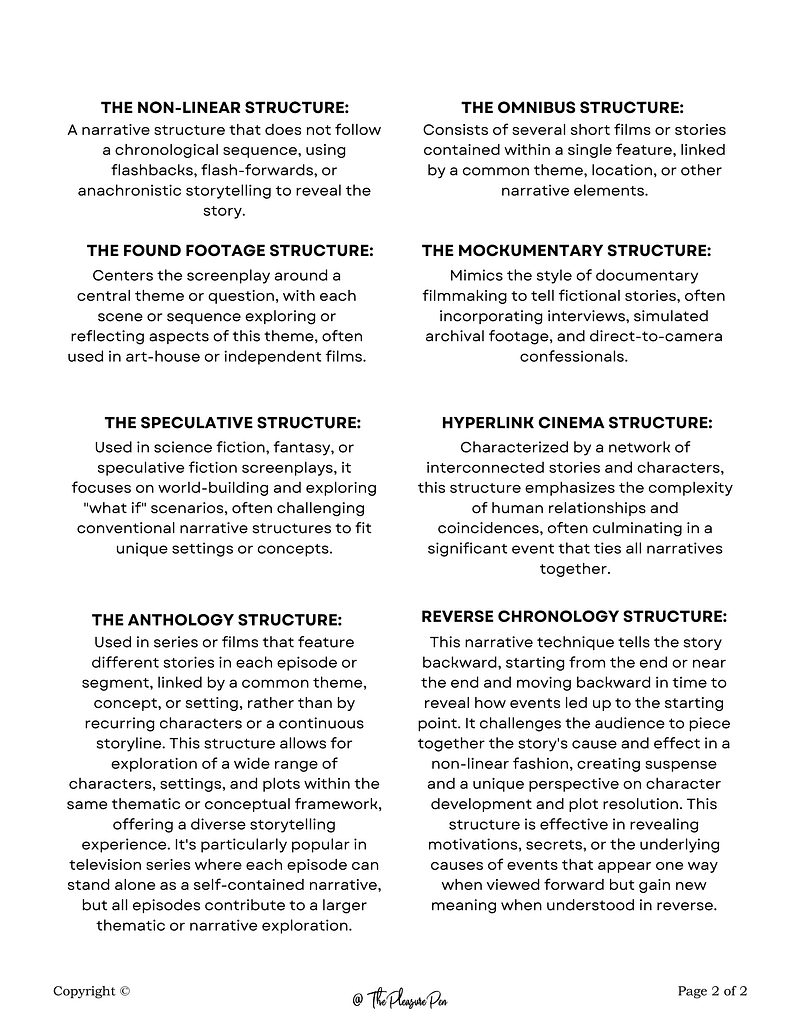
US LETTER SIZE — 2-SIDED — 8.5" x 11" PRINTABLE
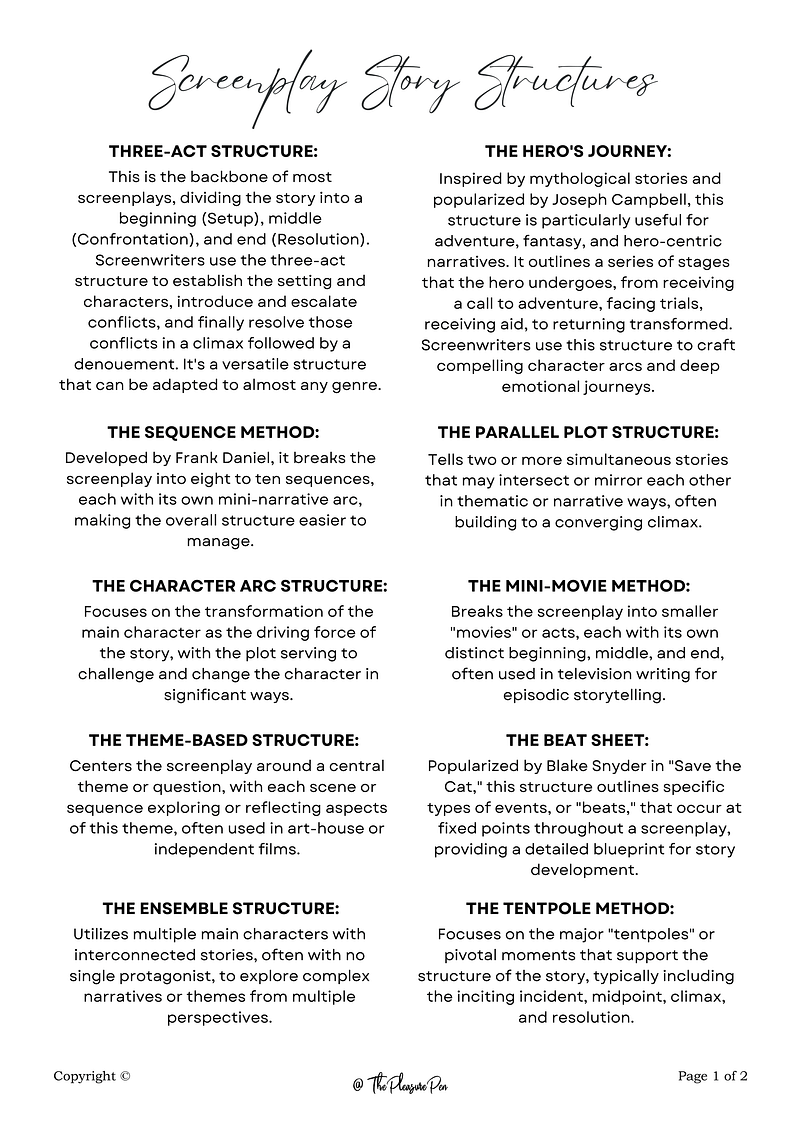
A4 SIZE — 2-SIDED — 21 X 29.7 PRINTABLE
Screenplay Story Structures
Three-Act Structure:
This is the backbone of most screenplays, dividing the story into a beginning (Setup), middle (Confrontation), and end (Resolution). Screenwriters use the three-act structure to establish the setting and characters, introduce and escalate conflicts, and finally resolve those conflicts in a climax followed by a denouement. It’s a versatile structure that can be adapted to almost any genre.
The Hero’s Journey:
Inspired by mythological stories and popularized by Joseph Campbell, this structure is particularly useful for adventure, fantasy, and hero-centric narratives. It outlines a series of stages that the hero undergoes, from receiving a call to adventure, facing trials, receiving aid, to returning transformed. Screenwriters use this structure to craft compelling character arcs and deep emotional journeys.
The Sequence Method:
Developed by Frank Daniel, it breaks the screenplay into eight to ten sequences, each with its own mini-narrative arc, making the overall structure easier to manage.
The Parallel Plot Structure:
Tells two or more simultaneous stories that may intersect or mirror each other in thematic or narrative ways, often building to a converging climax.
The Character Arc Structure:
Focuses on the transformation of the main character as the driving force of the story, with the plot serving to challenge and change the character in significant ways.
The Mini-Movie Method:
Breaks the screenplay into smaller “movies” or acts, each with its own distinct beginning, middle, and end, often used in television writing for episodic storytelling.
The Theme-Based Structure:
Centers the screenplay around a central theme or question, with each scene or sequence exploring or reflecting aspects of this theme, often used in art-house or independent films.
The Beat Sheet:
Popularized by Blake Snyder in “Save the Cat,” this structure outlines specific types of events, or “beats,” that occur at fixed points throughout a screenplay, providing a detailed blueprint for story development.
The Ensemble Structure:
Utilizes multiple main characters with interconnected stories, often with no single protagonist, to explore complex narratives or themes from multiple perspectives.
The Tentpole Method:
Focuses on the major “tentpoles” or pivotal moments that support the structure of the story, typically including the inciting incident, midpoint, climax, and resolution.
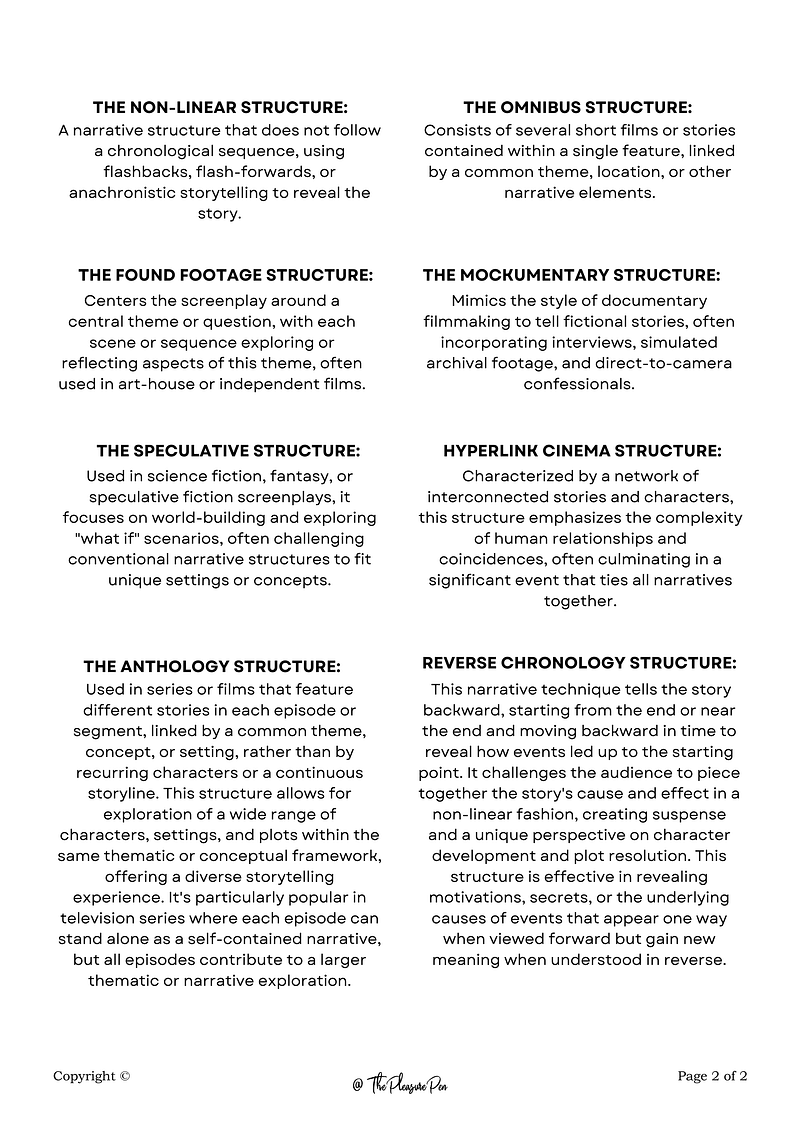
The Non-Linear Structure:
A narrative structure that does not follow a chronological sequence, using flashbacks, flash-forwards, or anachronistic storytelling to reveal the story.
The Omnibus Structure:
Consists of several short films or stories contained within a single feature, linked by a common theme, location, or other narrative elements.
The Speculative Structure:
Used in science fiction, fantasy, or speculative fiction screenplays, it focuses on world-building and exploring “what if” scenarios, often challenging conventional narrative structures to fit unique settings or concepts.
The Mockumentary Structure:
Mimics the style of documentary filmmaking to tell fictional stories, often incorporating interviews, simulated archival footage, and direct-to-camera confessionals.
The Found Footage Structure:
Presents the story through purportedly discovered film or video recordings, often used in horror or thriller genres to create a sense of realism and immediacy.
The Hyperlink Cinema Structure:
Characterized by a network of interconnected stories and characters, this structure emphasizes the complexity of human relationships and coincidences, often culminating in a significant event that ties all narratives together.
The Anthology Structure:
Used in series or films that feature different stories in each episode or segment, linked by a common theme, concept, or setting, rather than by recurring characters or a continuous storyline. This structure allows for exploration of a wide range of characters, settings, and plots within the same thematic or conceptual framework, offering a diverse storytelling experience. It’s particularly popular in television series where each episode can stand alone as a self-contained narrative, but all episodes contribute to a larger thematic or narrative exploration.
The Reverse Chronology Structure:
This narrative technique tells the story backward, starting from the end or near the end and moving backward in time to reveal how events led up to the starting point. It challenges the audience to piece together the story’s cause and effect in a non-linear fashion, creating suspense and a unique perspective on character development and plot resolution. This structure is effective in revealing motivations, secrets, or the underlying causes of events that appear one way when viewed forward but gain new meaning when understood in reverse.
Applying Structure in Screenwriting
When applying a structure to a screenplay, the writer starts by outlining the major plot points and character arcs according to the chosen framework. This outline serves as a roadmap for drafting the screenplay, ensuring that each scene contributes to the overall narrative and character development.
Screenwriters often adapt and blend these structures to suit their unique stories. For example, a screenplay might follow the three-act structure overall but incorporate elements of the Hero’s Journey for character development, or it might blend linear and non-linear storytelling to create suspense or reveal character backstories.
Flexibility and Creativity
While structures provide a foundation for storytelling, they are not strict formulas that must be followed to the letter. The best screenplays often innovate within or even subvert these structures to surprise the audience and deliver fresh storytelling experiences. The key is understanding the principles behind these structures — such as character growth, thematic development, and narrative pacing — and using them creatively to tell your story in the most effective way possible.
In summary, screenplay story structures are tools that, when used skillfully, can help screenwriters craft compelling, coherent, and emotionally resonant stories. Whether sticking to traditional frameworks or experimenting with more avant-garde forms, the effective use of structure is essential to the art of screenwriting.


